Bose 401-SERIES-I: Pioneering the Direct/Reflecting Sound Experience
In the early 1970s, the audio world was dominated by traditional speaker designs—boxy enclosures with forward-firing drivers aimed directly at the listener. Into this landscape stepped Dr. Amar G. Bose, an MIT professor and audio visionary, who challenged conventional wisdom with a radical new concept: sound should not just come at you, but around you. The result was the Bose 401-SERIES-I, one of the earliest commercial expressions of Bose’s revolutionary Direct/Reflecting® speaker technology. Though overshadowed by later models like the iconic 901, the 401-SERIES-I holds a special place in audio history as a bold first step toward redefining how we experience music in the home.
Introduction and Historical Context
Introduced in 1971, the Bose 401-SERIES-I emerged from Dr. Bose’s dissatisfaction with the sound of conventional loudspeakers, even high-end ones. After purchasing a premium speaker system and being underwhelmed by its performance in a real room, he began researching how humans perceive sound in natural environments. His findings led to a groundbreaking insight: in concert halls and other live settings, much of what we hear is reflected sound arriving slightly after the direct sound. This blend creates a sense of spaciousness and realism.
The 401-SERIES-I was designed to replicate this phenomenon. Unlike traditional speakers that focus on direct radiation, the 401-SERIES-I emphasized a balance between direct and reflected sound, aiming to create a more immersive and natural listening experience. It was part of Bose’s first wave of consumer products following the company’s founding in 1964 and represented a philosophical departure from the hi-fi norms of the time.
While not as widely produced or recognized as the Bose 901 (introduced a year later in 1972), the 401-SERIES-I laid the technical and conceptual groundwork for Bose’s future success. It was marketed as a high-fidelity speaker for discerning listeners who valued a spacious, enveloping soundstage over the pinpoint imaging favored by audiophiles of the era.
Technical Specifications
| Feature | Specification |
| Model | 401-SERIES-I |
| Year Introduced | 1971 |
| Type | 2-way, direct/reflecting loudspeaker |
| Driver Configuration | 1 x 8" woofer, 1 x 1" dome tweeter |
| Frequency Response | 45 Hz – 18 kHz (±3 dB) |
| Sensitivity | 86 dB (2.83V @ 1m) |
| Nominal Impedance | 8 ohms |
| Recommended Amp Power | 10–100 watts per channel |
| Crossover Frequency | ~3 kHz |
| Enclosure Type | Bass-reflex with rear-firing port |
| Dimensions (H×W×D) | 22" × 8" × 8" (55.9 × 20.3 × 20.3 cm) |
| Weight | 28 lbs (12.7 kg) per speaker |
| Finish Options | Walnut veneer, black ash (rare) |
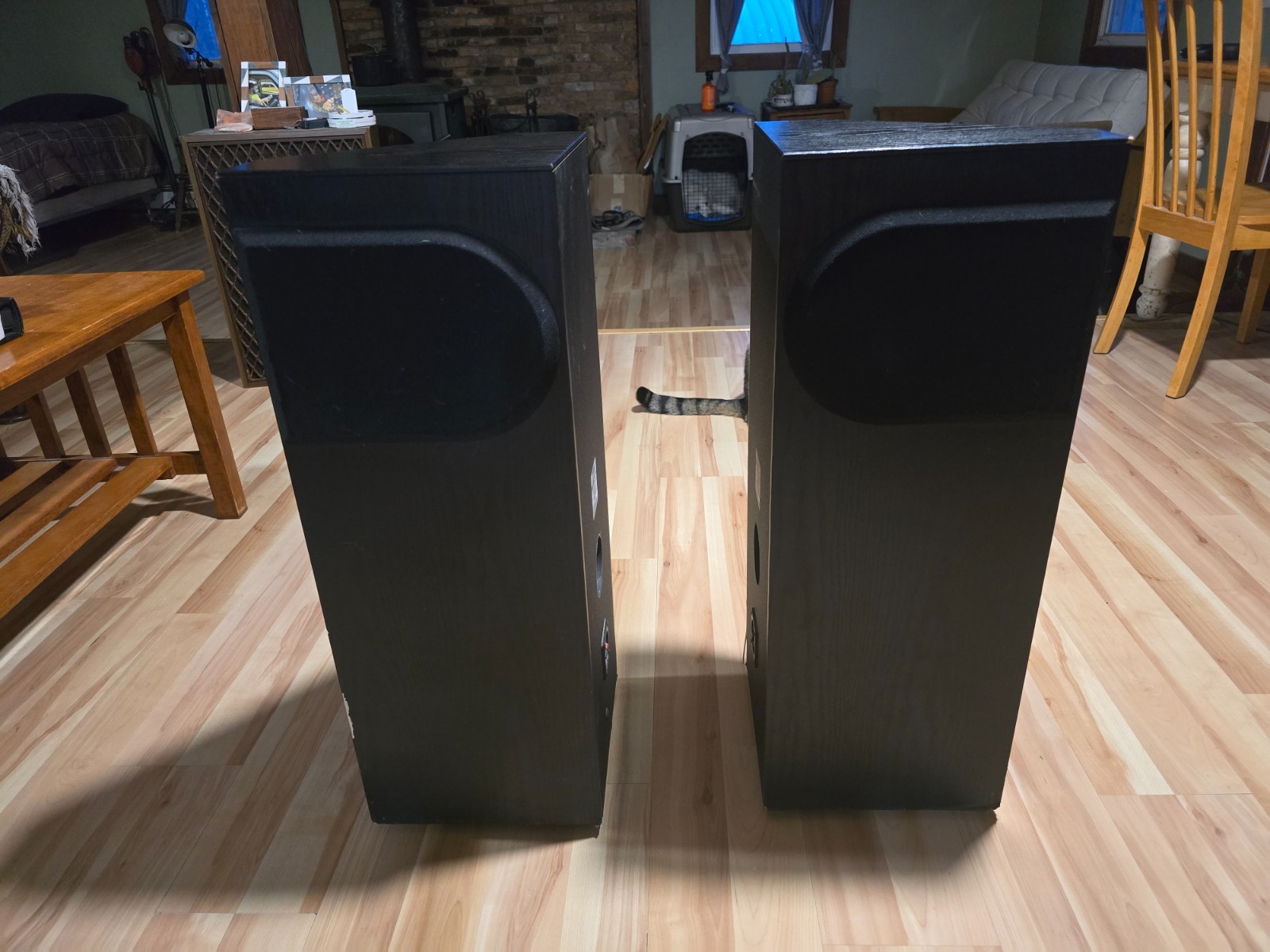
The 401-SERIES-I featured a tall, narrow cabinet with the tweeter mounted on the rear panel, angled to reflect high frequencies off the wall behind the speaker. This design was central to Bose’s philosophy—by blending direct and reflected sound, the speaker could create a diffuse, concert-hall-like ambiance. The front-firing 8" woofer handled bass and midrange, while the rear tweeter ensured smooth high-frequency dispersion.
Sound Characteristics and Performance
The sonic signature of the 401-SERIES-I is best described as spacious, warm, and forgiving. Rather than delivering the tight, focused imaging of traditional bookshelf or floor-standing speakers, the 401-SERIES-I creates a wide, enveloping soundstage that fills the room. This makes it particularly effective in medium to large listening environments where reflections enhance the listening experience.
Bass response is modest for a speaker of its size, extending down to 45 Hz—adequate for most music but lacking the deep punch of larger systems. The midrange is smooth and natural, with vocals and acoustic instruments rendered with a pleasing warmth. High frequencies are less prominent, contributing to the speaker’s non-fatiguing character. This makes the 401-SERIES-I ideal for long listening sessions, especially with jazz, classical, and vocal recordings.
Critics at the time were divided. Traditional audiophiles dismissed the 401-SERIES-I for its lack of imaging precision and bass extension. However, many casual listeners and music lovers praised its ability to make recordings sound “alive” and “present.” It was never about technical measurements—it was about emotional impact.
Notable Features and Innovations
The 401-SERIES-I introduced several concepts that would become hallmarks of Bose’s design language:
- Direct/Reflecting® Technology: The core innovation, using rear-mounted tweeters to blend direct and reflected sound for a more natural listening experience.
- Room-Adaptive Design: Unlike most speakers of the era, the 401-SERIES-I was designed to work with room acoustics rather than fight them.
- Simplified Aesthetics: The clean, minimalist cabinet design reflected Bose’s belief that speakers should complement home decor, not dominate it.
- Matching Acoustic Research Crossover: Bose employed advanced crossover networks (for the time) to ensure seamless integration between drivers.
While the 401-SERIES-I did not include an active equalizer like the later 901 Series V, it was often paired with Bose’s proprietary electronics to optimize performance, foreshadowing the company’s integrated system approach.
Common Issues and Maintenance
As a vintage speaker now over 50 years old, the Bose 401-SERIES-I requires careful attention to maintain optimal performance:
- Aging Foam Surrounds: The most common issue is deterioration of the foam surrounds on the woofers. Re-foaming or full reconing is often necessary to restore bass response.
- Tweeter Failures: The rear-mounted dome tweeters can suffer from oxidation or diaphragm fatigue. Replacement or refurbishment by a specialist is recommended.
- Crossover Components: Electrolytic capacitors in the passive crossover may have dried out, leading to tonal imbalances. Replacing these with modern equivalents can significantly improve clarity.
- Cabinet Integrity: Check for loose joints or veneer lifting, especially on walnut-finished models. Humidity and age can affect wood stability.
Owners are advised to consult vintage audio specialists for restoration. Due to the speaker’s historical significance, preserving originality—while upgrading critical components—is often the best approach.
Current Market Value and Collectibility
The Bose 401-SERIES-I is a rare and increasingly collectible piece of audio history. Complete pairs in good condition typically sell for $400–$800, with fully restored units commanding higher prices. Black ash finishes are particularly sought after due to their scarcity.
While not as iconic as the 901, the 401-SERIES-I appeals to collectors interested in the evolution of speaker design and the early years of Bose. Its significance as a prototype for Bose’s philosophy makes it a valuable addition to any vintage audio collection.
Conclusion and Legacy
The Bose 401-SERIES-I may not have achieved the commercial success of its successors, but its influence is undeniable. It was the first tangible expression of Bose’s revolutionary approach to sound reproduction—one that prioritized psychoacoustics over traditional engineering metrics. By challenging the notion that speakers must fire directly at the listener, the 401-SERIES-I opened the door to a new way of thinking about home audio.
Today, it stands as a fascinating artifact of audio innovation—a speaker that was ahead of its time in concept, if not in universal acclaim. For vintage audio enthusiasts, the 401-SERIES-I offers not just sound, but a story: the story of a professor who dared to ask, “Why does reproduced music never sound like a live performance?”—and then set out to answer it.
eBay Listings



As an eBay Partner, we earn from qualifying purchases. This helps support our independent vintage technology research.
Related Models
- Bose 4.2-SERIES-I (1984)
- Bose 101-MUSIC-MONITOR (1970)
- Bose 10.2-SERIES-I (1988)
- Bose 10.2-SERIES-II (1988)
- Bose 1800-SERIES-II (1979)
- Akai AM-2850 (1975)
- Akai AP-206 (1975)
- Nakamichi BX-1 (1985)
- Acoustic Research research-ar-17 (1978)
- Acoustic Research AR-19 (1994)