Blaupunkt Frankfurt: The Quintessential 1970s European Car Radio
Introduction
The Blaupunkt Frankfurt, introduced in 1970 and produced through 1979, stands as a hallmark of automotive audio engineering from one of Germany’s most respected electronics manufacturers. During a transformative decade for car audio, when stereo FM broadcasting was becoming widespread across Europe and drivers began to expect more from in-vehicle entertainment, the Frankfurt emerged as a reliable, stylish, and sonically competent solution. Positioned as a mid-to-high-tier model in Blaupunkt’s extensive lineup, the Frankfurt was commonly factory-fitted in premium European automobiles of the era, including models from Mercedes-Benz, BMW, and Volkswagen. Its enduring appeal lies not only in its functionality but in its iconic design and reputation for durability—qualities that have made it a sought-after component among vintage car restorers and analog audio enthusiasts today.
Technical Specifications
| Specification | Value |
| Model | Blaupunkt Frankfurt |
| Category | Car Audio |
| Years Produced | 1970–1979 |
| Power Output | 10W total (5W x 2) |
| Impedance | 4 ohms |
| Frequency Response | 40Hz - 15kHz |
| Total Harmonic Distortion | < 1.5% |
| Signal-to-Noise Ratio | 55dB |
| Dimensions | 180 x 50 x 130 mm |
| Weight | 1.2 kg |
Design & Engineering
The Blaupunkt Frankfurt exemplifies the minimalist yet functional design language that defined German industrial aesthetics in the 1970s. Housed in a compact, single-DIN chassis, it was engineered for seamless integration into European dashboards, with precise tolerances and a robust metal casing that provided both structural integrity and electromagnetic shielding. The front panel features a brushed aluminum finish, lending a premium feel that contrasted with the plastic-heavy designs emerging elsewhere. Three large rotary knobs dominate the layout: one for power and volume, one for tuning, and one for band selection (FM/AM), each offering smooth, tactile feedback—a hallmark of Blaupunkt’s attention to user experience.
Internally, the Frankfurt employs analog circuitry with discrete components and a traditional ferrite rod antenna for AM reception, paired with a dedicated FM tuner section capable of receiving the 87.5–108 MHz band in stereo. The radio uses a phase-locked loop (PLL) tuning system in later production models, improving frequency stability. Its dual-speaker output is impedance-matched to 4-ohm drivers, common in European cars of the period, and includes basic tone controls (bass and treble) accessible via small recessed potentiometers—adjustable with a screwdriver for fine-tuning.
One of the Frankfurt’s engineering strengths is its resilience to electrical fluctuations, a critical feature in older vehicles with less stable power systems. The unit includes built-in transient protection and thermal cutoffs to prevent damage from voltage spikes or overheating. Additionally, its RF shielding and grounding design minimize interference from ignition systems—a common issue in vintage cars—making it remarkably quiet for its era.
Sound Characteristics
While modest by modern standards, the Blaupunkt Frankfurt delivers a warm, natural sound that many vintage audio aficionados find pleasing. With 5 watts per channel, it provides ample volume for small car interiors without significant distortion. The frequency response of 40Hz to 15kHz captures most of the audible spectrum, though bass response is limited by the small speakers typically paired with it. The FM stereo separation is decent for the time, offering a sense of spatial imaging that was advanced in the early 1970s.
The analog tuner imparts a certain character to the listening experience—seeking stations requires patience and precision, but the result is a satisfying connection between user and machine. The Frankfurt excels with midrange clarity, making it ideal for vocal-centric music, jazz, and spoken-word broadcasts. While it lacks the deep bass and crisp highs of modern digital systems, its sonic signature is often described as “musical” and “organic,” particularly when paired with period-correct speakers.
Market & Collectibility
Today, the Blaupunkt Frankfurt is a prized component in the vintage car audio market. Units in working condition with original faceplates and knobs can fetch between $150 and $300, depending on cosmetic condition and provenance. Fully restored models with recalibrated tuners, replaced capacitors, and cleaned controls command higher prices, especially when accompanied by original documentation or packaging.
Collectors look for several key indicators of authenticity and quality: the crispness of the lettering on the faceplate, the smoothness of the tuning dial, and the presence of factory service tags or model-specific serial numbers. Common issues include dried-out electrolytic capacitors, worn potentiometers, and degraded rubber insulation on wiring—typical of electronics from this era. Many enthusiasts undertake restoration projects, replacing internal capacitors and cleaning contacts to return the unit to full functionality while preserving its original appearance.
The Frankfurt’s compatibility with classic European cars makes it especially valuable for restorations where originality is paramount. It is also popular in custom vintage audio builds, where its analog charm is paired with modern amplification or Bluetooth adapters—though purists prefer to keep it entirely stock.
The Blaupunkt Frankfurt remains a symbol of an era when car audio was becoming a serious pursuit—not just a convenience, but a reflection of engineering excellence and design integrity.
eBay Listings


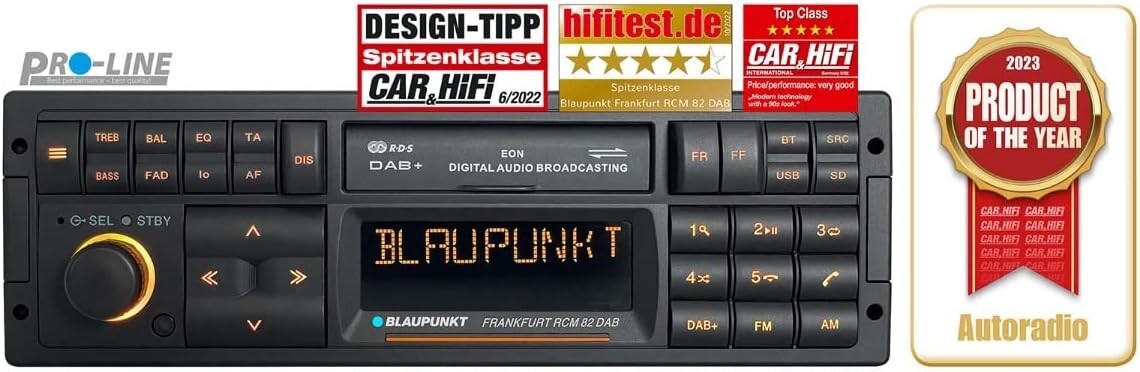
As an eBay Partner, we earn from qualifying purchases. This helps support our independent vintage technology research.
Service Manuals & Schematics
- Service Manual — archive.org
- Service Manual — archive.org
- Service Manual — archive.org
- Manual — archive.org
Related Models
- Blaupunkt KV 900 (1970-1975)
- Blaupunkt Blaupunkt SQR 46 Bremen (1986-1990)