BBC LS3/5A
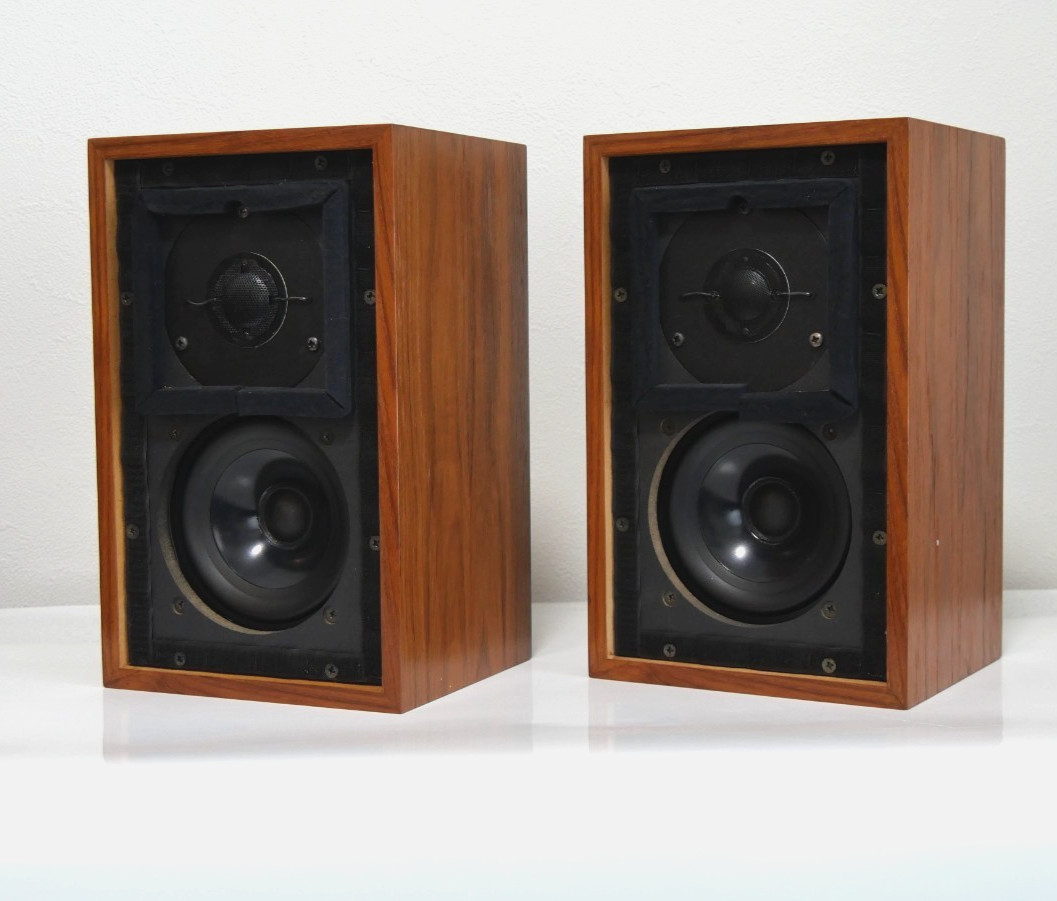
At just over 30cm tall, it looks unassuming — but this little monitor was built to dissect sound, not flatter it.
Overview
The BBC LS3/5A isn’t a speaker for those chasing warmth or boom. It was engineered with clinical intent: to expose flaws in recordings, not hide them. Designed as a compact, mobile monitoring solution for broadcast use, its small sealed enclosure and tightly specified components made it a tool, not a toy. Production reportedly ceased nearly two decades ago, though the design lives on through licensed manufacturers like Rogers, Goodmans, and later revivals from Graham Audio and Falcon Acoustics. Despite its modest footprint, the LS3/5A earned a reputation that far outstrips its size — described by some as “perhaps the most widely celebrated loudspeaker” and an icon whose name carries weight independent of any single brand.
What set the LS3/5A apart was its obsessive attention to consistency. The BBC didn’t manufacture the speakers themselves but licensed the design to multiple companies, requiring them to use specifically selected or modified KEF drivers and crossover components. This wasn’t off-the-shelf gear — every element, from the cabinet construction to the gasket thickness, was dictated to ensure uniform performance across units. The result was a monitor that could be trusted in outside broadcast vans and control rooms, where accuracy mattered more than appeal.
Specifications
| Manufacturer | BBC (design/license); Licensed manufacturers including Rogers, Goodmans, and others |
| Product type | Two-way, sealed-box, stand-mounted loudspeaker / monitor |
| Dimensions | 305mm H x 190mm W x 165mm D |
| Weight | approximately 5.31 kg each |
| Impedance | 15Ω and 11Ω versions exist |
| Power handling | 45W program |
| Crossover types | FL6/23 (15 ohm) and FL6/38 (11 ohm) |
| Low-frequency driver | KEF B110 driver (specifically the SP1003 "White Belly" or later variants) |
| High-frequency driver | KEF T27 |
| Cabinet seal | Designed to be airtight |
Key Features
Sealed Enclosure with Thin-Wall Construction
The LS3/5A’s compact cabinet uses a sealed-box design, avoiding ports or vents to maintain tight, controlled bass response within its limited range. The enclosure was built with thin-wall construction, a deliberate choice to minimize coloration — though this also meant the structure could flex slightly during playback. Small rubber feet were included, possibly to allow for controlled movement rather than rigid coupling. Despite the airtight design goal, real-world build quality varied: some 11Ω versions suffered from misaligned front panel battens, leaving gaps at the corners that compromised the seal. The front baffle gasket is also noted to be extremely thin, raising questions about long-term sealing integrity.
KEF B110 "White Belly" Bass Driver with PVA Mass Loading
The heart of the early LS3/5A’s sound lies in the KEF B110 unit, specifically the SP1003 variant known as the “White Belly.” To meet the BBC’s low-frequency response requirements in such a small cabinet, KEF applied a layer of PVA glue to the paper cone, increasing its mass and lowering its resonance. This hand-modified driver became a signature of the original specification. Later versions used a purpose-built SP1003 without the visible PVA coating, while an even later 6Ω B110 (SP1228) eliminated mass loading entirely. Owners report that the “White Belly” units can develop a pronounced 80Hz buzz if the cone resonance isn’t damped properly, and age-related suspension sag remains a common failure point.
FL6/23 and FL6/38 Crossover Networks
The LS3/5A’s crossover is often described as “oddball” — a reflection of its non-standard component values and tight tolerances. The 15Ω version uses the FL6/23 network, which includes a C6 capacitor (680nF) and resistor R4, both critical to the circuit’s behavior. There are reports of R4 overheating or burning out in some 15Ω units, suggesting thermal stress under prolonged use. The 11Ω version uses the FL6/38 crossover, and licensed manufacturers had to match these networks precisely to maintain compliance with the BBC’s specification. Because driver parameters shift with age, replacing units without recalibrating the crossover can throw the entire balance off — a key reason why matched pairs and measured replacements are emphasized by specialists.
Tygan Grilles on 15Ω Versions
The 15Ω variants typically came with Tygan plastic grilles — a durable, slightly textured material that became a visual identifier for that impedance version. Later reissues and replica builds sometimes substitute different grille materials, which can subtly alter the high-frequency response. The original Tygan version remains a point of authenticity for purists.
Historical Context
The LS3/5A was originally developed for mobile monitoring and production use, allowing engineers to evaluate recordings in different environments with a consistent reference. Its compact size and sealed design made it ideal for outside broadcast vans and temporary setups. Rogers received a license to produce the speaker in 1975, becoming one of the most well-known manufacturers of the type. Over time, multiple companies produced licensed versions, each adhering — with varying degrees of fidelity — to the BBC’s exacting standards.
Collectibility & Value
Finding original spares for vintage BBC LS3/5As is notoriously difficult, and many units in circulation today have had drivers replaced or crossovers modified. When refurbishing, it’s essential to measure new drivers and adjust the crossover accordingly — a matched pair from Falcon Acoustics, which offers replica SP1003 B110 and T27 units, crossovers, and grilles, can restore a 30-year-old speaker to spec. Stirling Broadcast also provides baffle kits and replacement cabinets for restoration projects. The Graham Audio reissue carries a current price of $3,499.00, reflecting the enduring demand for the authentic LS3/5A experience. Common faults include voice coil rubbing from aged suspension, buzzing from loose dust caps, and degraded terminals — Goodmans’ original terminal design was particularly poor, prompting some owners to fill the recess with resin to maintain an airtight seal during replacement.
eBay Listings


As an eBay Partner, we earn from qualifying purchases. This helps support our independent vintage technology research.