Bang & Olufsen Beovox 901 (1963)
The Bang & Olufsen Beovox 901, introduced in 1963, stands as a landmark achievement in both audio engineering and industrial design. Part of Bang & Olufsen’s prestigious Beovox speaker line, the 901 was developed during a period when the Danish company was establishing its reputation for merging high-fidelity sound with avant-garde aesthetics. The speaker’s unique construction, innovative acoustic principles, and timeless visual design have cemented its status as a collector’s item and a milestone in mid-century audio technology.
Design and Aesthetic Philosophy
The Beovox 901 is instantly recognizable for its striking, space-age appearance. Designed by Erik Bang and influenced by the modernist principles of functionalism, the speaker features a tall, slender cabinet with a distinctive horn-like front baffle that curves upward. This isn’t merely decorative—the shape plays a crucial role in the speaker’s acoustic performance. The cabinet is typically crafted from high-quality teak veneer, with a brushed aluminum front panel that houses the drivers and branding. The minimalist use of materials and clean lines reflect the Scandinavian design ethos that Bang & Olufsen became famous for.
Measuring approximately 90 cm in height, the 901 was designed to be a floor-standing speaker, often mounted on optional wall brackets or placed on dedicated stands. Its vertical orientation and narrow footprint made it suitable for integration into modern living spaces without dominating the room acoustically or visually. The speaker’s design was so forward-thinking that it won multiple design awards and has been featured in museum collections, including the Museum of Modern Art (MoMA) in New York.
Acoustic Innovation: The Acoustic Lens
At the heart of the Beovox 901’s performance is its patented Acoustic Lens technology—a revolutionary approach to sound dispersion. Unlike conventional speakers that project sound in a narrow beam, the 901 was engineered to deliver a wide, even soundstage that fills the room uniformly. This was achieved through a specially shaped horn structure that acts as a waveguide for the high-frequency driver.
The Acoustic Lens ensures that high frequencies are dispersed over a broad horizontal angle while maintaining controlled vertical dispersion. This reduces floor and ceiling reflections, minimizing coloration and creating a more natural listening experience. The result is a speaker that performs exceptionally well in a variety of room environments, offering consistent tonal balance regardless of listener position—a rare feat for its time.
Driver Configuration and Sound Characteristics
The Beovox 901 employs a two-way driver configuration. It features a 19 cm (7.5 inch) paper-cone bass-midrange driver positioned below a 2.5 cm (1 inch) dome tweeter mounted at the throat of the acoustic horn. The crossover network, located externally in a separate enclosure (a common practice at the time), ensures a smooth transition between drivers. The recommended crossover frequency is around 2,500 Hz.
The bass-midrange unit delivers warm, articulate midrange performance with surprisingly deep bass for a speaker of its era, though it benefits from being paired with a subwoofer or used in rooms with supportive acoustics. The tweeter, integrated into the lens system, produces clear, detailed highs without harshness or sibilance. Overall, the 901 is known for its balanced, natural sound signature—neither overly bright nor excessively warm—making it well-suited for a wide range of music genres, from classical to jazz and vocal recordings.
Technical Specifications and Compatibility
The Beovox 901 has a nominal impedance of 8 ohms, making it compatible with a wide range of tube and solid-state amplifiers from the 1960s and beyond. Bang & Olufsen recommended an amplifier with an output of 15 to 25 watts per channel for optimal performance. While not highly sensitive by modern standards (approximately 86 dB/W/m), the 901 responds well to high-quality amplification and benefits from being driven by well-matched electronics.
Frequency response is typically cited as 50 Hz to 18,000 Hz, though this can vary depending on room placement and associated equipment. The speaker’s efficiency and dispersion characteristics make it particularly effective in medium-sized rooms where even sound coverage is desired.
System Integration and Accessories
The Beovox 901 was often sold as part of a complete Bang & Olufsen system, paired with amplifiers such as the Beolab 5000 or Beomaster 900. It was also compatible with the Beovox C8000 series of stands and wall mounts, which allowed for flexible installation options. Some users mounted the speakers on walls to optimize sound projection and save floor space—a testament to their dual role as both audio devices and design objects.
A notable accessory was the external crossover unit, which not only managed driver signal distribution but also allowed for fine-tuning of tonal balance. This modular approach reflected Bang & Olufsen’s philosophy of system coherence and long-term usability.
Legacy and Collectibility
Today, the Beovox 901 is highly sought after by vintage audio enthusiasts and design collectors alike. Its combination of engineering excellence and aesthetic innovation makes it a standout piece from the golden age of hi-fi. Well-preserved units in original condition can command high prices at auctions and specialty dealers, especially those with matching serial numbers and original grilles.
Restoration of the 901 is possible, though care must be taken with the original drivers and crossover components. Modern replacements that respect the original acoustic design are available from specialty firms, allowing these speakers to continue performing for another generation.
Conclusion
The Bang & Olufsen Beovox 901 is more than just a speaker—it is a symbol of Danish design ingenuity and a testament to the belief that form and function can coexist in perfect harmony. Released in 1963, it pushed the boundaries of what loudspeakers could achieve in terms of sound dispersion and visual elegance. Over six decades later, the 901 remains a benchmark for integrated audio design, admired not only for how it sounds but for how it represents a moment when technology, art, and craftsmanship converged. For collectors and audiophiles, owning a pair of Beovox 901s is not just about vintage audio—it’s about owning a piece of design history.
eBay Listings

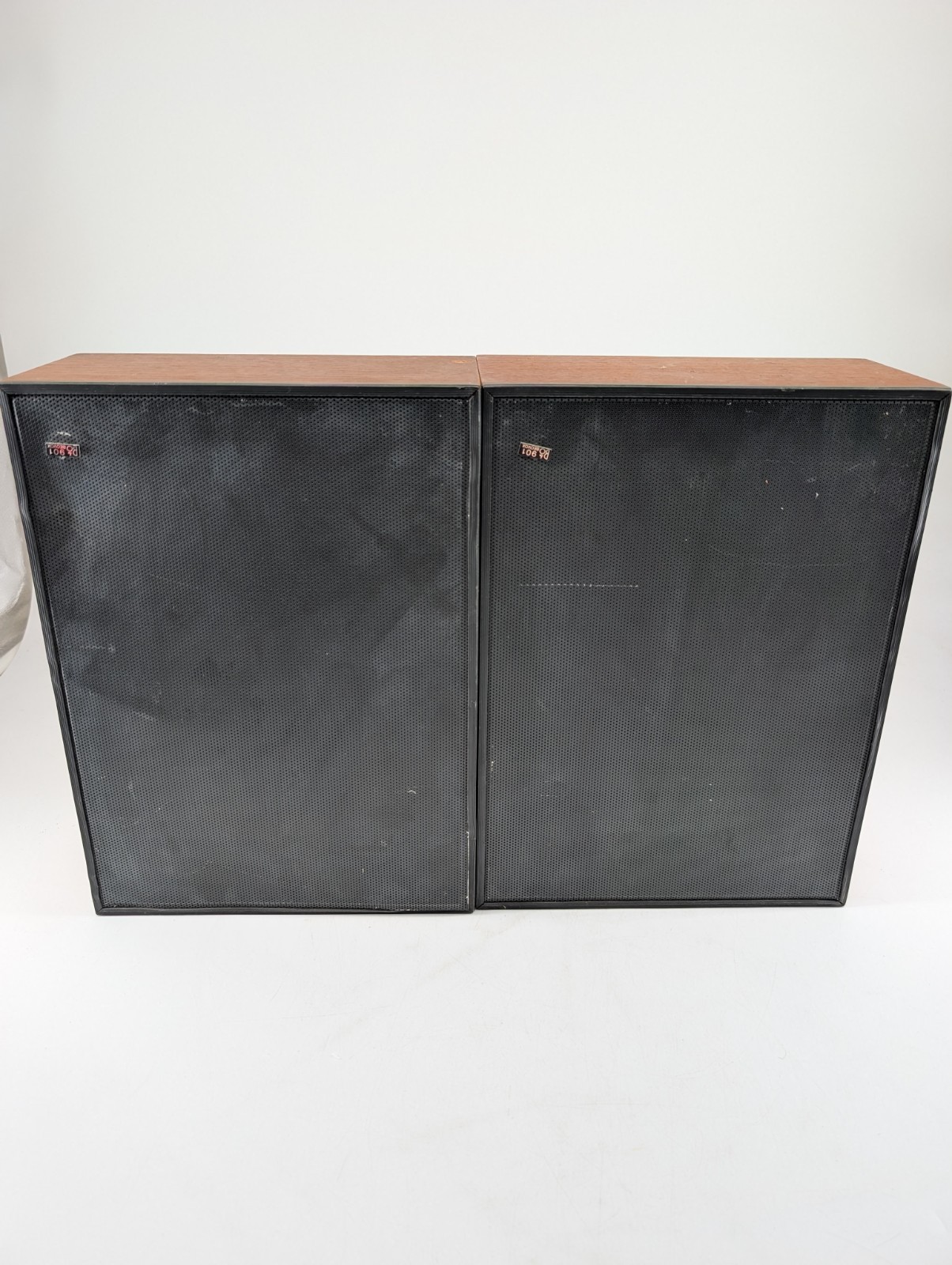

As an eBay Partner, we earn from qualifying purchases. This helps support our independent vintage technology research.
Related Models
- Bang & Olufsen Beocord C75 (1968)
- Bang & Olufsen BeoSound S120 (1995)
- Bang & Olufsen BeoSound 5500 (1997)
- Bang & Olufsen 1702 (1976)
- Bang & Olufsen 505 (1970)
- Akai AM-2850 (1975)
- Akai AP-206 (1975)
- Nakamichi BX-1 (1985)
- Acoustic Research research-ar-17 (1978)
- Acoustic Research AR-19 (1994)