Bang & Olufsen Beolab 7700 (1998)
The Bang & Olufsen Beolab 7700 is a landmark in high-fidelity audio design, representing the pinnacle of Danish engineering and minimalist aesthetics during the late 1990s. Introduced in 1998, the Beolab 7700 was part of Bang & Olufsen’s prestigious Beolab series, which focused on active speaker systems with built-in amplification and advanced acoustic tuning. Unlike conventional passive speakers, the Beolab 7700 featured fully active architecture, meaning each driver had its own dedicated amplifier channel, allowing for precise control over frequency response, phase alignment, and dynamic range.
Design and Aesthetic Philosophy
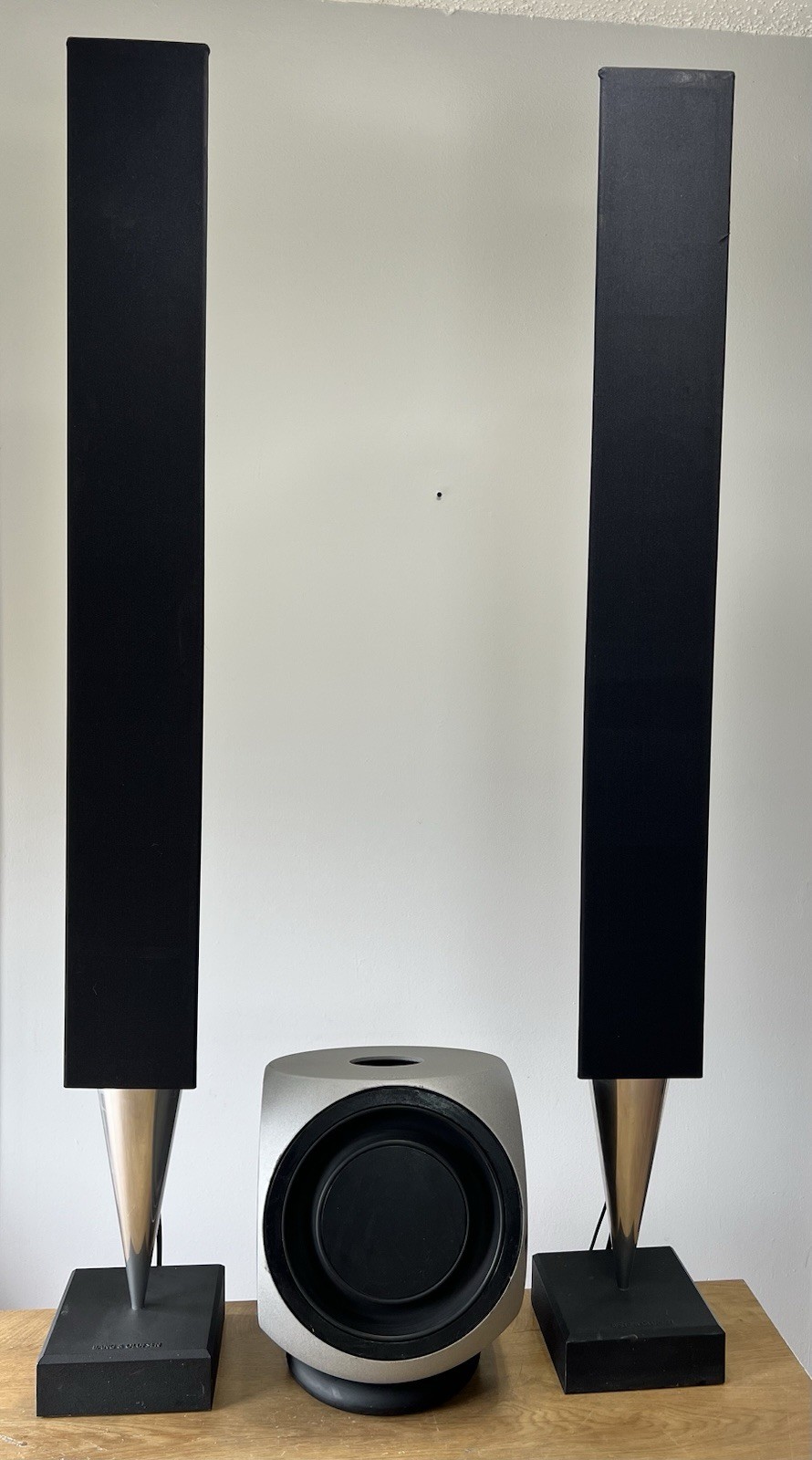
The Beolab 7700 is instantly recognizable for its sleek, futuristic design. Standing at approximately 115 cm (45 inches) tall, the speaker features a slender, cylindrical aluminum body with a brushed finish, available in silver or black anodized variants. The minimalist form follows Bang & Olufsen’s design language of the era—clean lines, absence of visible grilles, and a focus on materials and craftsmanship. The drivers are arranged in a vertical array, concealed behind a perforated metal grille that extends the full height of the unit, giving it a monolithic and sculptural appearance.
The base includes a weighted foot for stability and a cable management system that routes the single power and signal cable through the stand, maintaining the clean visual aesthetic. The speaker was designed not just as an audio component but as a piece of modern furniture, intended to blend seamlessly into high-end living spaces.
Technical Specifications and Audio Performance
The Beolab 7700 is a three-way active loudspeaker system with four dedicated amplifier channels totaling 500 watts of power—250 watts per speaker. Each speaker contains three drivers:
- Tweeter: 19 mm (0.75 inch) soft-dome tweeter for high-frequency reproduction (14–20,000 Hz)
- Midrange: 76 mm (3 inch) aluminum cone midrange driver (300 Hz – 14 kHz)
- Woofer: Two 133 mm (5.25 inch) aluminum cone bass drivers (30–300 Hz), configured in a push-pull arrangement for reduced cabinet resonance and enhanced bass control
Each driver is powered by its own Class D amplifier module, allowing for precise bi-amping (the woofer has its own dedicated amp, while midrange and tweeter share separate amps). This configuration minimizes intermodulation distortion and ensures clean signal delivery across the frequency spectrum.
The system operates on Bang & Olufsen’s proprietary digital signal processing (DSP) platform, which includes active crossover networks, time alignment, and equalization tailored to the speaker’s physical design. The DSP ensures a flat frequency response from 30 Hz to 20 kHz with minimal phase deviation, delivering a transparent and neutral sound signature.
A key innovation of the Beolab 7700 is its use of a digital input system. Unlike most speakers of the time, it accepted digital audio signals directly via B&O’s proprietary Link system—a shielded twin-cable interface that carried both digital audio and control data. This allowed the speakers to be connected directly to compatible B&O sources such as the Beosound 9000 or Beovision Avant television, eliminating analog conversion losses and enabling system-wide synchronization.
Setup and Integration
The Beolab 7700 was designed for use in stereo pairs and required a B&O control center or compatible source unit to function. It did not have analog inputs, which made it incompatible with standard AV receivers or amplifiers. Instead, it relied on the B&O Link protocol, which also enabled remote control via the system’s central remote (such as the Beoremote).
The speakers featured automatic room compensation technology—when paired with a Beovision TV, the system could emit test tones and adjust the speaker output based on room acoustics. This feature was advanced for its time and demonstrated B&O’s commitment to delivering optimized sound regardless of placement.
Due to the active design, each speaker required its own power connection. The internal power supply was regulated and shielded to prevent electrical noise from affecting audio performance. The system also included thermal and over-current protection to safeguard the amplifiers during extended playback.
Market Position and Legacy
Priced at a premium—over $10,000 per pair at launch—the Beolab 7700 was targeted at affluent audiophiles and design-conscious consumers. It was not intended to compete on raw specifications alone but as a holistic audio experience combining sound quality, aesthetics, and system integration.
While not as widely adopted as more conventional speaker systems, the Beolab 7700 gained a cult following among Bang & Olufsen enthusiasts and interior designers. Its influence can be seen in later B&O models such as the Beolab 5 and Beolab 90, which continued the philosophy of active design, digital signal processing, and architectural integration.
Today, the Beolab 7700 is considered a vintage audio treasure. Well-maintained units are sought after in the second-hand market, particularly by collectors of high-end Scandinavian design. However, due to the age of the electronics and the obsolescence of the Link interface, servicing can be challenging. Replacement parts and technical support are limited, though specialized audio restoration shops occasionally refurbish these units.
Conclusion
The Bang & Olufsen Beolab 7700 stands as a bold statement in the evolution of high-end audio. It represents a time when a consumer electronics company dared to redefine what a loudspeaker could be—not just a box with drivers, but an intelligent, self-contained audio system integrated into a lifestyle ecosystem. Its combination of advanced engineering, elegant design, and forward-thinking connectivity makes it a milestone in both audio and industrial design history.
Though no longer in production, the Beolab 7700 continues to inspire modern active speakers and high-end audio systems that prioritize both sonic excellence and aesthetic harmony. For those who appreciate the fusion of art and technology, the Beolab 7700 remains a timeless icon of late-20th-century innovation.
eBay Listings


As an eBay Partner, we earn from qualifying purchases. This helps support our independent vintage technology research.
Related Models
- Bang & Olufsen Beocord C75 (1968)
- Bang & Olufsen BeoSound S120 (1995)
- Bang & Olufsen BeoSound 5500 (1997)
- Bang & Olufsen 1702 (1976)
- Bang & Olufsen 505 (1970)
- Akai AM-2850 (1975)
- Akai AP-206 (1975)
- Nakamichi BX-1 (1985)
- Acoustic Research research-ar-17 (1978)
- Acoustic Research AR-19 (1994)