Bang & Olufsen Beolab 5702 (1986)
The Bang & Olufsen Beolab 5702 is a landmark in high-end audio engineering and industrial design, representing the Danish company’s unwavering commitment to combining sonic excellence with minimalist elegance. Introduced in 1986, the Beolab 5702 was part of B&O’s Beolab series — a line dedicated to active loudspeaker systems that integrated amplification, filtering, and speaker drivers into a single, precisely tuned unit. This integration allowed for superior control over sound reproduction, a hallmark of B&O’s philosophy during the 1980s.
Design and Aesthetic Philosophy
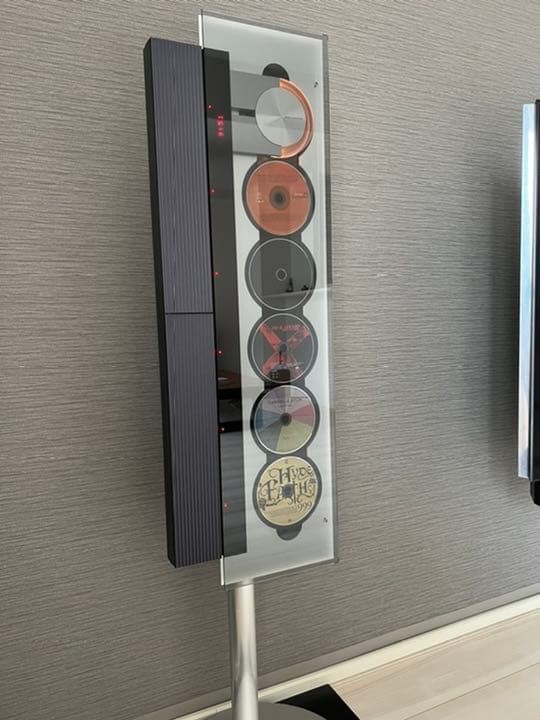
The Beolab 5702 exemplifies Bang & Olufsen’s signature Scandinavian design language: clean lines, geometric precision, and the use of premium materials. Standing at approximately 110 cm (43 inches) tall, the speaker features a sleek, vertical profile with a distinctive aluminum and acrylic glass enclosure. The front baffle is typically finished in polished anodized aluminum, while the sides are made from thick, transparent acrylic, allowing a glimpse of the internal components and contributing to the speaker’s futuristic aesthetic.
The transparent housing was not merely decorative — it served to reduce cabinet resonance and internal standing waves, enhancing acoustic clarity. The base is constructed from heavy die-cast aluminum, providing stability and minimizing vibration. This attention to both form and function is a defining characteristic of B&O’s design ethos, and the 5702 remains a sought-after piece among audiophiles and design collectors alike.
Technical Specifications and Acoustic Engineering
As an active speaker system, the Beolab 5702 incorporates built-in amplification tailored specifically to its driver configuration. Each speaker contains two internal amplifiers: one dedicated to the low-frequency driver and another to the midrange and tweeter. This bi-amped design ensures optimal power delivery and minimizes intermodulation distortion.
The speaker features a three-way driver configuration:
- Tweeter: 22 mm soft-dome tweeter with neodymium magnet, positioned at the top for optimal high-frequency dispersion.
- Midrange: 75 mm aluminum cone driver, designed for clarity and minimal coloration in vocal and instrumental reproduction.
- Woofer: 220 mm (8.7 inch) aluminum cone bass driver, capable of deep, controlled low-end response.
The crossover network is an active electronic type, located before the amplifiers, allowing for precise frequency separation and phase alignment. This contrasts with passive crossovers found in conventional speakers, which can degrade signal quality. The crossover frequencies are set at approximately 350 Hz (between woofer and midrange) and 3.5 kHz (between midrange and tweeter).
Power handling is rated at 150W dynamic power per speaker, with amplifiers delivering clean, low-distortion output. The frequency response spans from 35 Hz to 22 kHz, with a sensitivity of around 89 dB, making the 5702 suitable for medium to large listening rooms when paired with appropriate source equipment.
Impedance is a nominal 8 ohms, ensuring compatibility with most preamplifiers and control units of the era. However, since the Beolab 5702 is an active system, it does not require a traditional power amplifier. Instead, it connects directly to a line-level source via B&O’s proprietary 5-pin DIN connectors or standard RCA inputs, depending on the configuration.
Integration with Bang & Olufsen Systems
The Beolab 5702 was designed to function as part of a complete B&O ecosystem. It was commonly paired with control units such as the Beovision 6000 television, Beocenter 9500, or Beolab 5000 preamplifier. These systems communicated with the speakers via B&O’s unique speaker cable system, which carried both audio signals and power in a single shielded cable, reducing clutter and signal degradation.
One of the standout features of the 5702 is its adjustable acoustic settings. Located on the rear panel are controls for bass and treble adjustment, allowing users to tailor the sound to room acoustics or personal preference. Additionally, a “Room Compensation” switch helps optimize bass response in corner or wall placements.
Legacy and Collectibility
The Beolab 5702 was produced during a golden era for Bang & Olufsen, when the company pushed the boundaries of what consumer audio could be — not just in sound, but in experience. While production numbers were limited due to the high cost and specialized nature of the system, surviving units are highly prized today.
In the vintage audio market, the Beolab 5702 commands strong interest. Fully functional pairs in good condition can fetch between $1,500 and $3,000, depending on finish, provenance, and included accessories. Collectors value not only the sound quality but also the speaker’s status as a design artifact. The 5702 has been featured in design museums and retrospectives on 20th-century industrial design.
Maintenance and Restoration
Due to their age, many Beolab 5702 units require servicing. Common issues include degraded internal cabling, failing capacitors in the amplifier modules, and wear on the acrylic enclosures. Fortunately, a dedicated community of B&O enthusiasts and specialized technicians exists to support restoration. Original parts are scarce, but some components can be refurbished or replaced with modern equivalents without compromising performance.
Owners are advised to store the speakers away from direct sunlight to prevent yellowing of the acrylic and to maintain the polished aluminum finishes with non-abrasive cleaners.
Conclusion
The Bang & Olufsen Beolab 5702 stands as a testament to the fusion of audio engineering and design artistry. More than just speakers, they are functional sculptures that deliver a rich, balanced soundstage with precision and authority. Their active design, advanced materials, and integration within the B&O ecosystem made them revolutionary in the 1980s — and they remain impressive today.
For audiophiles who appreciate both sonic fidelity and aesthetic mastery, the Beolab 5702 offers a rare combination of timeless design and enduring performance. Whether as a centerpiece in a vintage audio setup or as a design statement in a modern living space, the 5702 continues to captivate with its elegance and engineering excellence.
eBay Listings


As an eBay Partner, we earn from qualifying purchases. This helps support our independent vintage technology research.
Related Models
- Bang & Olufsen Beocord C75 (1968)
- Bang & Olufsen BeoSound S120 (1995)
- Bang & Olufsen BeoSound 5500 (1997)
- Bang & Olufsen 1702 (1976)
- Bang & Olufsen 505 (1970)
- Akai AM-2850 (1975)
- Akai AP-206 (1975)
- Nakamichi BX-1 (1985)
- Acoustic Research research-ar-17 (1978)
- Acoustic Research AR-19 (1994)