Bang & Olufsen BeoCom 505 (1997)
The Bang & Olufsen BeoCom 505, introduced in 1997, stands as a landmark in the evolution of home telephony, merging high-end industrial design with exceptional audio performance. At a time when most cordless phones were utilitarian plastic devices focused solely on function, the BeoCom 505 redefined expectations by treating the telephone not just as a communication tool, but as a sculptural object worthy of a place in the modern living space.
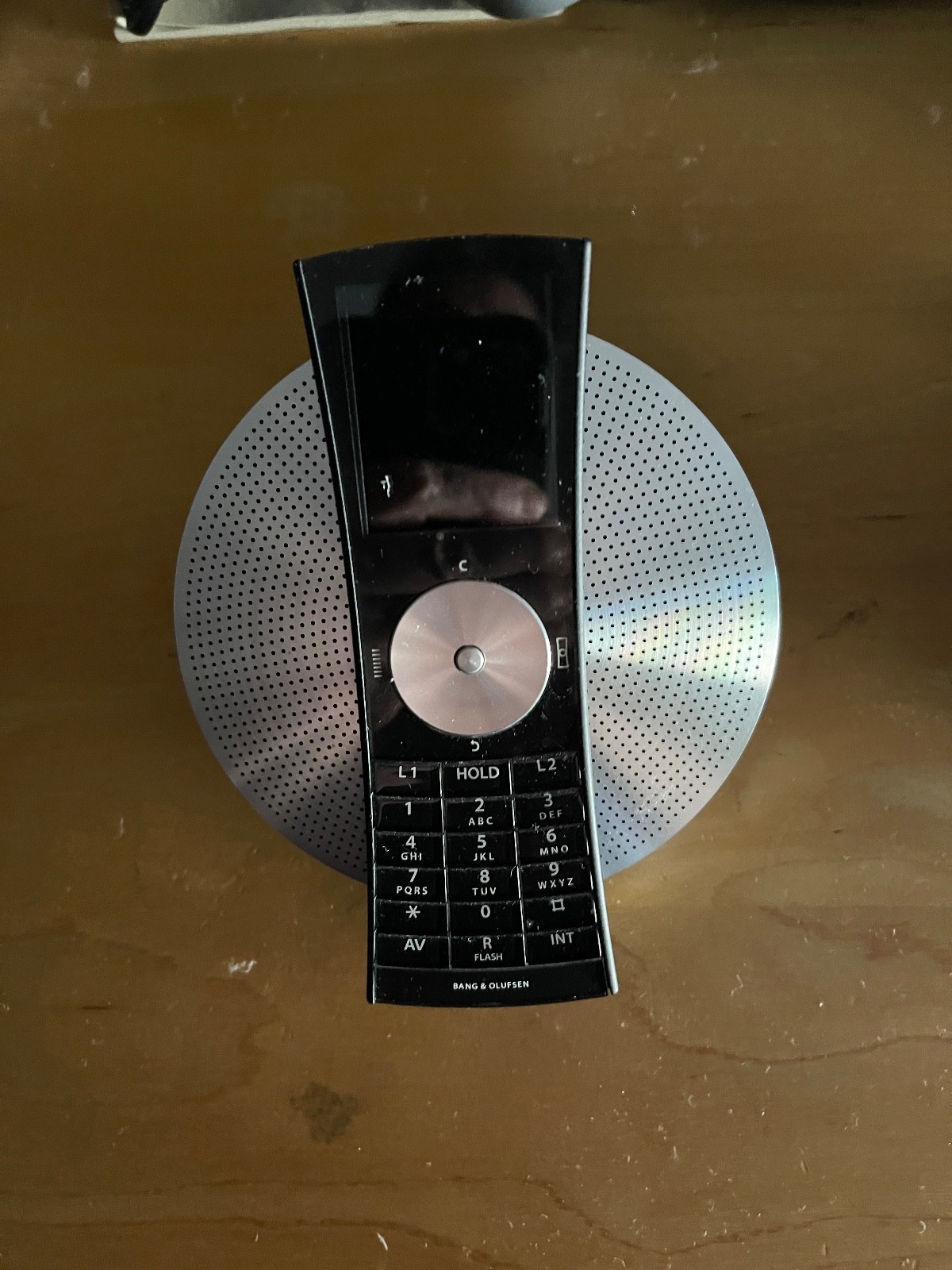
Designed by David Lewis, one of Bang & Olufsen’s most celebrated designers, the BeoCom 505 embodies the Danish company’s long-standing commitment to minimalism, precision engineering, and user-centric innovation. Its sleek, compact form—crafted from high-quality plastics with a soft-touch finish—echoes the design language seen in other B&O products of the era, such as the BeoVision and BeoSound systems. The handset features a gently curved body that fits comfortably in the hand, with a recessed keypad and a small analog display window that glows with soft illumination. The base station is equally refined, with a low-profile design that allows it to blend seamlessly into high-end interiors.
One of the most distinctive features of the BeoCom 505 is its use of DECT (Digital Enhanced Cordless Telecommunications) technology, which was still relatively new in consumer telephones at the time of its release. DECT provided clearer voice transmission, greater range (up to 100 meters indoors and 300 meters outdoors), and improved security compared to earlier analog cordless systems. This made the BeoCom 505 not only a luxury item but also a technically advanced device that offered real performance benefits.
Audio quality was a central focus in the development of the BeoCom 505. Bang & Olufsen applied its expertise in acoustics to ensure that the handset delivered rich, natural-sounding voice reproduction. The speaker and microphone were engineered to minimize background noise and optimize speech clarity, resulting in conversations that felt more lifelike and less fatiguing over long calls. This attention to sonic detail set the 505 apart from mass-market competitors and reinforced B&O’s reputation for audio excellence across all product categories.
The user interface of the BeoCom 505 is both intuitive and elegant. The keypad uses recessed rubber buttons with a soft tactile response, designed to minimize accidental presses while maintaining ease of use. The analog display—unusual for a digital device—shows time, caller ID (when supported by the telephone service), and call status using a series of illuminated segments. This analog aesthetic was a deliberate design choice, aligning with B&O’s philosophy of creating timeless objects that avoid the rapid obsolescence associated with digital screens.
The BeoCom 505 was available in a range of color finishes, including classic black, white, and metallic silver, allowing users to match the phone to their interior decor. Each unit came with a dedicated charging cradle that doubled as a hands-free speakerphone base. When the handset was docked, incoming calls could be answered with a single button press, enabling speakerphone functionality without lifting the handset. This feature was particularly innovative for its time and reflected B&O’s forward-thinking approach to usability.
Despite its premium positioning, the BeoCom 505 was engineered for practicality. It offered standard telephony features such as redial, mute, volume control, and a built-in answering machine (on certain variants). Later models in the 500 series added support for multiple handsets and expanded memory for contacts, but the 505 remained the flagship of the line due to its design purity and build quality.
From a collector’s perspective, the BeoCom 505 has gained cult status among vintage audio and design enthusiasts. Its scarcity, combined with its iconic status in design history, makes it a sought-after item. Original units in good condition—especially those with the base station and original packaging—can command high prices in the secondary market. The phone is often displayed as a design object rather than used for daily communication, a testament to its enduring aesthetic appeal.
Bang & Olufsen’s decision to enter the telephony market in the 1990s was part of a broader strategy to extend its brand beyond audio and video equipment into the wider realm of home electronics. The BeoCom 505 was one of the first products to demonstrate that a telephone could be both a high-fidelity communication device and a piece of industrial art. It paved the way for later models such as the BeoCom 6000 and BeoCom 2, which continued to push the boundaries of design and functionality.
Technically, the BeoCom 505 operated on the 1.88–1.90 GHz DECT frequency band, ensuring minimal interference with other household electronics like Wi-Fi routers or microwave ovens. Battery life was typical for the era, with a NiMH (Nickel-Metal Hydride) rechargeable battery providing up to 10 hours of talk time and 100 hours of standby. Charging took approximately 12 hours, and the base station required a standard 220–240V AC power supply, common in European markets where the device was primarily sold.
While the BeoCom 505 was not marketed as a “smart” device—long before the era of smartphones and VoIP—it represented a peak in analog-digital hybrid design. It bridged the gap between traditional telephony and the emerging world of digital communication, offering users a glimpse of what was possible when technology was guided by design principles.
Today, the BeoCom 505 is remembered not just as a phone, but as a symbol of a design philosophy that values longevity, craftsmanship, and sensory experience. In an age of disposable electronics, it stands as a reminder that technology can be both beautiful and functional. For vintage audio and design collectors, the BeoCom 505 remains a quintessential piece of late-20th-century Scandinavian modernism—a quiet masterpiece of form and function.
eBay Listings



As an eBay Partner, we earn from qualifying purchases. This helps support our independent vintage technology research.
Related Models
- Bang & Olufsen Beocord C75 (1968)
- Bang & Olufsen BeoSound S120 (1995)
- Bang & Olufsen BeoSound 5500 (1997)
- Bang & Olufsen 1702 (1976)
- Bang & Olufsen 505 (1970)
- Akai AM-2850 (1975)
- Akai AP-206 (1975)
- Nakamichi BX-1 (1985)
- Acoustic Research research-ar-17 (1978)
- Acoustic Research AR-19 (1994)