Bang & Olufsen Beogram 3800 (1976)
The Bang & Olufsen Beogram 3800, released in 1976, stands as one of the most iconic and technically advanced turntables of its era. Hailing from the Danish design powerhouse Bang & Olufsen, the Beogram 3800 was not merely an audio component but a statement of engineering excellence and aesthetic minimalism. Designed during a golden age of high-fidelity audio, it combined cutting-edge technology with a sleek, futuristic form that continues to captivate audiophiles and design enthusiasts alike.
Design Philosophy and Aesthetic
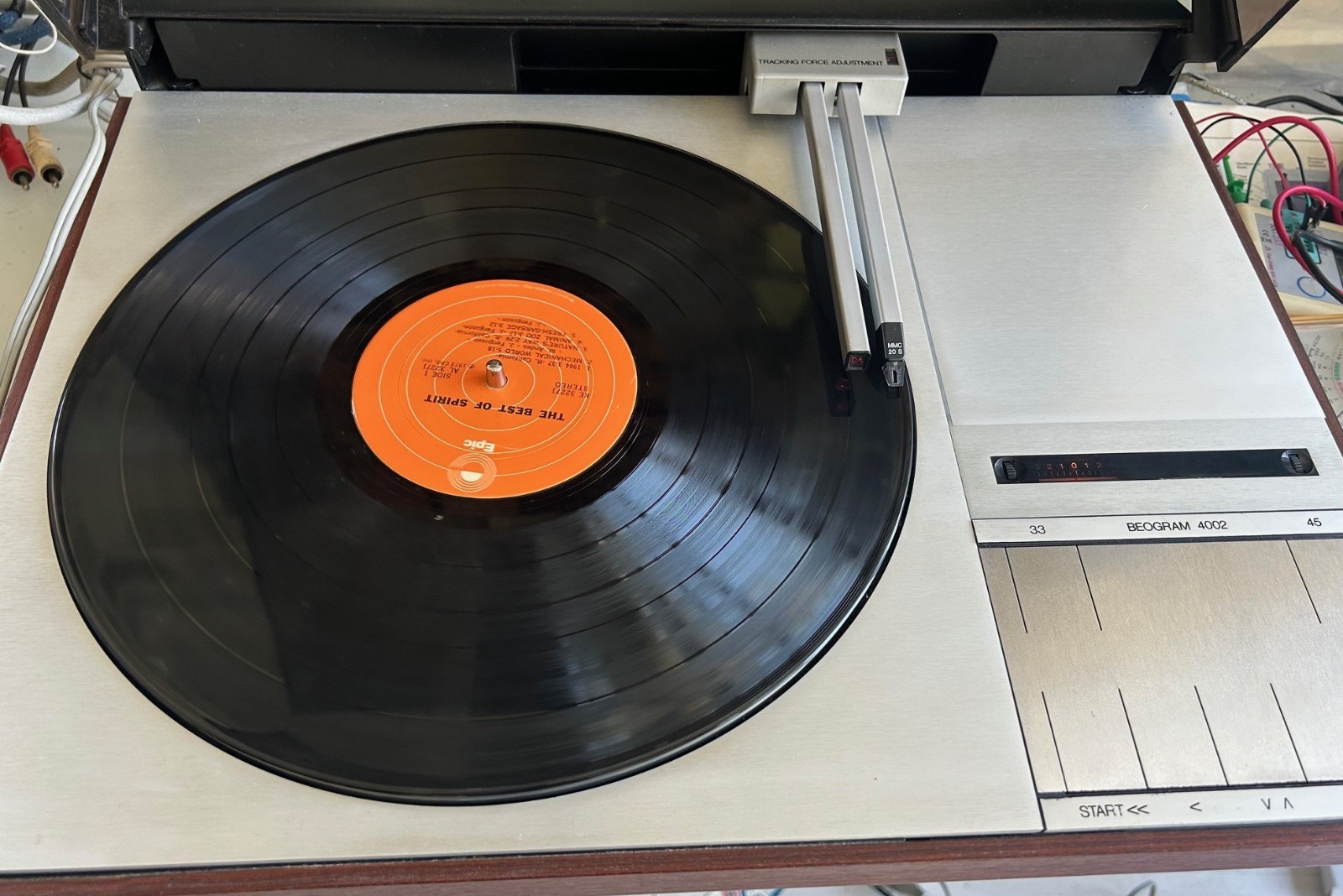
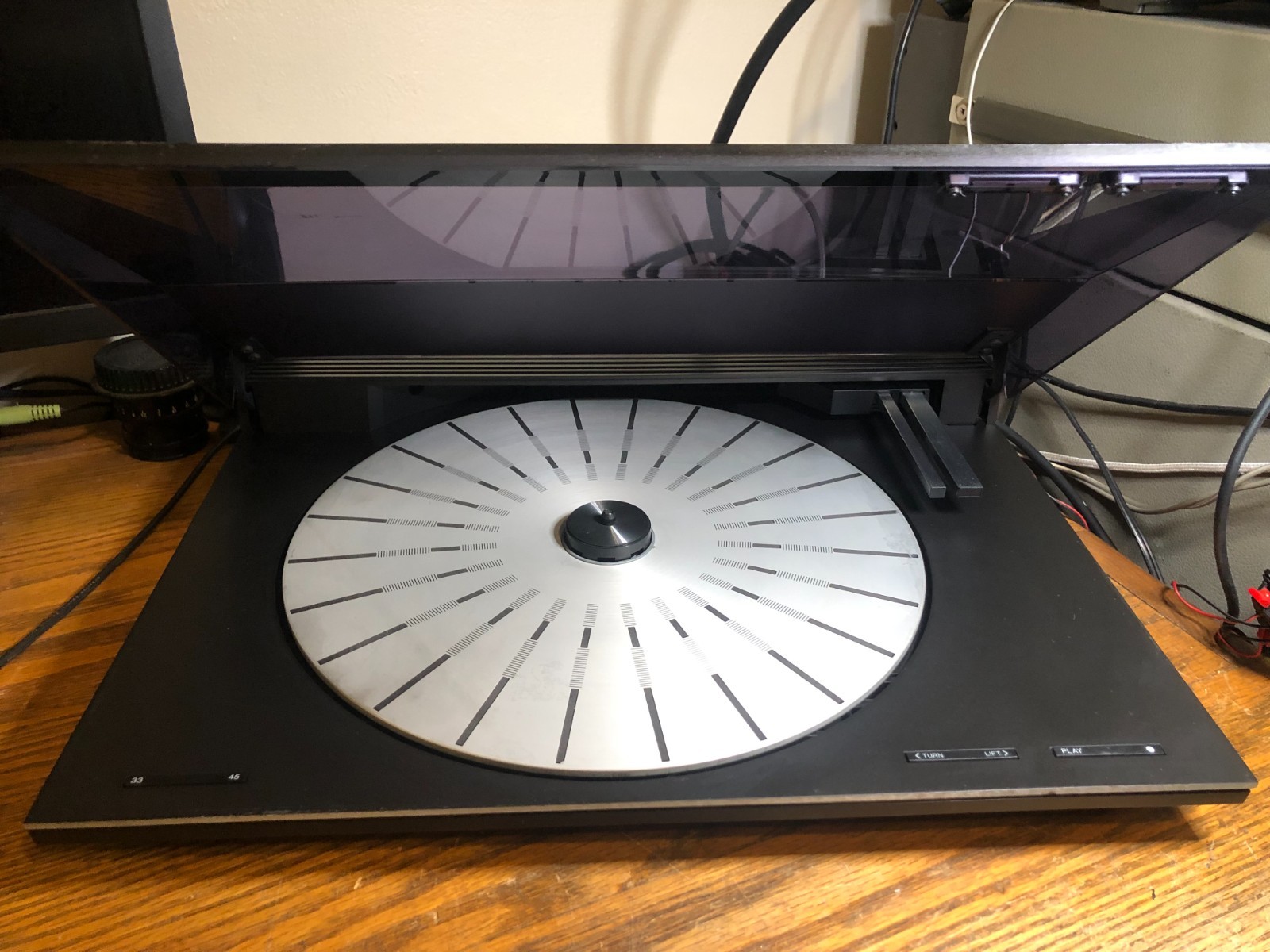
The Beogram 3800 is a quintessential example of Scandinavian design—clean lines, functional elegance, and a focus on material quality. Housed in a solid aluminum base with a brushed finish, the turntable exudes a sense of permanence and precision. Its minimalist plinth is devoid of unnecessary ornamentation, with only essential controls and indicators. The tonearm, a striking horizontal beam that glides across the record, appears almost weightless, suspended on a low-friction linear tracking mechanism.
One of the most visually distinctive features is the transparent dust cover, which opens vertically via a motorized lift—activated by a soft-touch button—giving the unit a futuristic, almost sci-fi appearance. This motorized cover was not just a gimmick; it reflected Bang & Olufsen’s commitment to integrating technology seamlessly into domestic life, where form and function were in perfect harmony.
Linear Tracking Technology
Unlike conventional turntables that use a pivoted tonearm, the Beogram 3800 employs a linear tracking system. This means the tonearm moves in a straight line across the record surface, maintaining a constant tangential angle to the grooves. The result is significantly reduced tracking error and distortion, especially near the inner grooves of a record.
The tonearm is guided by a precision steel rail and driven by a quartz-locked DC motor via a toothed belt. This system ensures extremely accurate tracking, with a tracking force that can be finely adjusted. The linear tracking mechanism was a hallmark of high-end Bang & Olufsen turntables of the 1970s and positioned the Beogram 3800 among the elite in analog playback technology.
Cartridge and Sound Quality
The Beogram 3800 was typically supplied with a high-quality moving magnet (MM) cartridge, often a B&O-branded unit or a collaboration with well-regarded manufacturers of the time. The cartridge delivered an output of approximately 5mV, suitable for standard phono preamplifiers. While not user-replaceable in the same way as on many other turntables, the system was designed for optimal synergy between the tonearm and cartridge.
Sonically, the Beogram 3800 is praised for its clarity, low background noise, and precise stereo imaging. The linear tracking arm virtually eliminates inner-groove distortion, allowing for extended play of the entire record surface with consistent fidelity. The heavy aluminum plinth and precision bearing contribute to excellent speed stability and low resonance, further enhancing sound quality.
Speed accuracy is maintained by a quartz-locked servo system, ensuring that both 33⅓ and 45 RPM speeds are maintained within ±0.1%. This level of precision was rare at the time and remains impressive even by modern standards.
Technical Specifications
- Model: Beogram 3800
- Release Year: 1976
- Type: Linear tracking belt-drive turntable
- Speeds: 33⅓ and 45 RPM (quartz-controlled)
- Tonearm: Linear tracking, horizontal beam design
- Tracking Force: Adjustable, typically set to 1.2–1.5 grams
- Cartridge Type: Moving magnet (MM), factory-mounted
- Output Level: 5mV at 1kHz, 5cm/sec
- Signal-to-Noise Ratio: >60dB
- Wow and Flutter: <0.05% (weighted)
- Platter: Die-cast aluminum with rubber mat
- Drive System: Belt-driven via DC motor with quartz speed control
- Dust Cover: Motorized, vertical lift
- Power Supply: External transformer (100–240V compatible via internal switching)
- Dimensions: 540 mm (W) × 170 mm (H) × 380 mm (D)
- Weight: 12.5 kg
User Experience and Operation
Operating the Beogram 3800 is a ritualistic experience. The user places the record on the platter, presses the open button, and watches the dust cover rise silently. The tonearm can be manually positioned or set to automatic start, depending on the configuration. Once playback begins, the arm glides smoothly across the record with a quiet, mechanical grace.
The turntable lacks a traditional cueing lever; instead, the user raises or lowers the arm using a precision knob that controls the tracking force. This requires a delicate touch but ensures fine control over stylus placement. The absence of a cueing lever is consistent with the design ethos—only essential elements are included, and every interaction is deliberate.
Legacy and Collectibility
The Beogram 3800 is now a highly sought-after collector’s item. Its combination of advanced engineering, timeless design, and association with Bang & Olufsen’s golden era makes it a centerpiece in many vintage audio collections. Well-preserved units in working condition can command high prices at auction, particularly those with original packaging and accessories.
While linear tracking turntables never achieved mass-market dominance due to complexity and cost, the Beogram 3800 demonstrated what was possible when audio engineering was fused with industrial design. It influenced later B&O models such as the Beogram 4000 and Beogram 6000, which refined the concept with even more automation and user-friendly features.
Conclusion
The Bang & Olufsen Beogram 3800 is more than a turntable—it is a masterpiece of 1970s audio engineering and Scandinavian design. Its linear tracking arm, quartz speed control, and motorized dust cover were technological marvels at the time, and its aesthetic remains striking decades later. For audiophiles, it offers exceptional sound quality with minimal maintenance. For design lovers, it is a sculptural object that transcends its function.
Even today, the Beogram 3800 serves as a reminder that technology, when guided by vision and craftsmanship, can create objects of lasting beauty and performance. It stands as a testament to Bang & Olufsen’s philosophy: that luxury lies not in excess, but in precision, simplicity, and the pursuit of perfection.
eBay Listings


As an eBay Partner, we earn from qualifying purchases. This helps support our independent vintage technology research.
Related Models
- Bang & Olufsen 2202 (1973)
- Bang & Olufsen 2404 (1972)
- Bang & Olufsen 5005 (1980)
- Bang & Olufsen Beogram 1000 (1972)
- Bang & Olufsen BeoGram 2402 (1974)
- Luxman PD-272 (1983)
- Garrard 2025tc (1968)
- Onkyo CP-1010 (1976)
- Pioneer PL-15R (1975)
- Pioneer PL-250 (1979)