Bang & Olufsen BeoLufsen MS150/2 (1981)
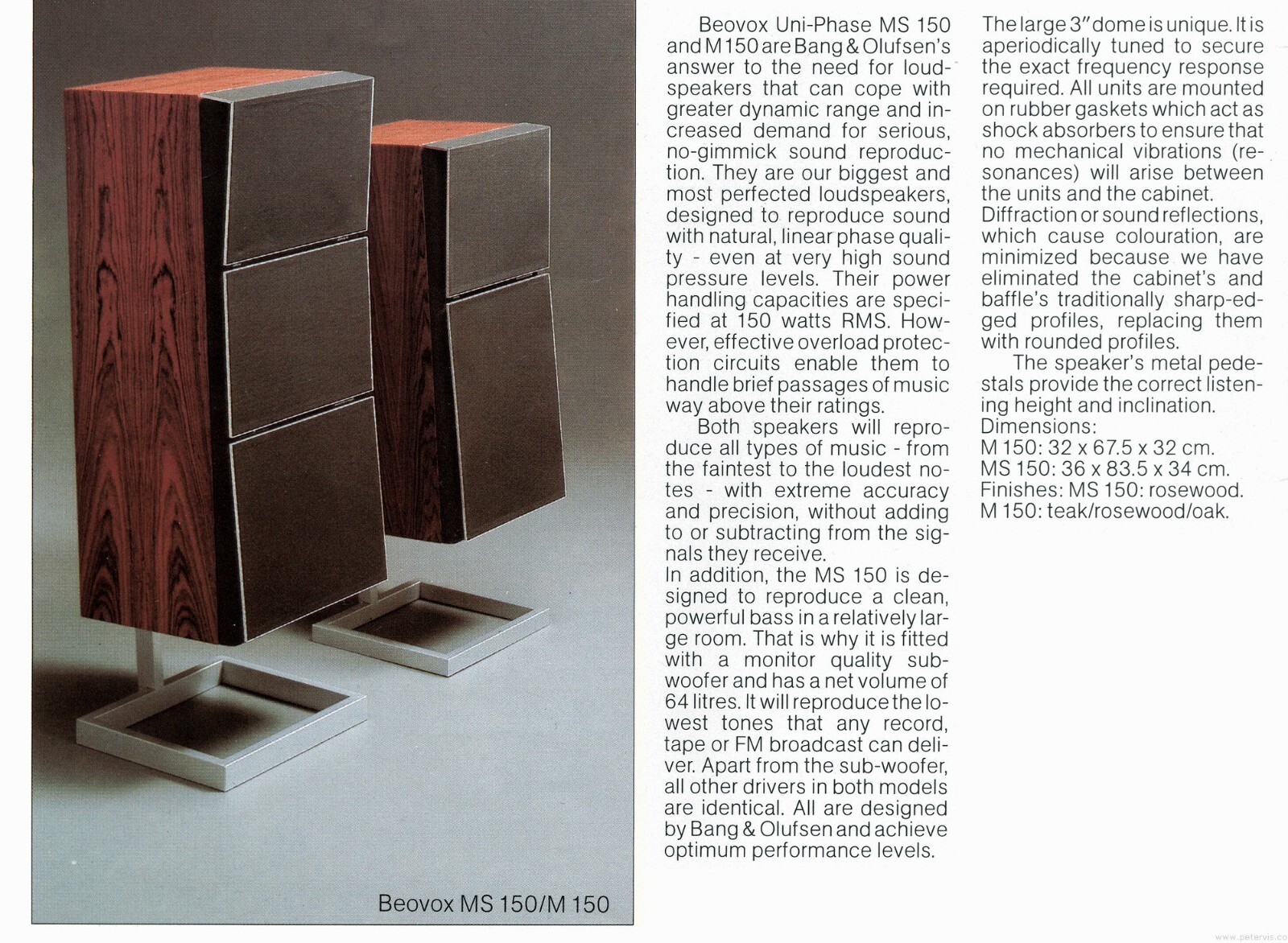
Step into the world of 1980s high-end audio, and you’ll find the Bang & Olufsen BeoLufsen MS150/2 standing tall—literally and figuratively. Introduced in 1981, these bookshelf speakers weren’t just components in a stereo system; they were sculptural statements, precision instruments wrapped in minimalist Scandinavian elegance. Built for B&O’s modular Beosystem ecosystem, the MS150/2 blends engineering rigor with design purity, delivering sound that’s as refined as its silhouette. This is audio gear that belongs in a living room, not hidden in a cabinet.
Specifications
| Feature | Specification |
| Model | MS150/2 |
| Year of Production | 1981–1984 |
| Type | Passive, 2-way bass reflex |
| Woofer | 8-inch (20 cm) |
| Tweeter | 1-inch (25 mm) soft dome |
| Impedance | 4 ohms |
| Sensitivity | 88 dB (1W/1m) |
| Frequency Response | Not officially documented; estimated 50 Hz – 20 kHz |
| Crossover | Internal passive crossover |
| Tweeter Control | Adjustable level (+3 dB, 0, -3 dB) |
| Magnetic Shielding | Yes – suitable for placement near CRT TVs |
| Enclosure Finish | Vinyl-clad MDF with wood-veneer options |
| Dimensions (H×W×D) | 380 × 240 × 290 mm (15 × 9.4 × 11.4 in) |
| Weight | 9.5 kg (20.9 lbs) each |
| Recommended Amp Power | 25–100 watts per channel (compatible with BeoSystem 5500) |
Design and Key Features
Sharp lines, a compact footprint, and that unmistakable B&O restraint—this is early ’80s Danish design at its most confident. The MS150/2’s angular cabinet doesn’t shout; it commands attention through proportion and presence. Its 2-way bass reflex layout gives it surprising low-end authority for a bookshelf model, anchored by an 8-inch woofer and topped with a 1-inch soft dome tweeter that glides into the upper frequencies without strain.
Out back, a small but brilliant touch: an adjustable tweeter level switch. Whether your room swallows treble or reflects it back like a mirror, you can dial in +3 dB, flat, or -3 dB to match the acoustics. It’s a feature that shows B&O wasn’t just building speakers—they were crafting experiences.
And then there’s the magnetic shielding. In an era when families gathered around bulky CRT televisions, this wasn’t a luxury—it was essential. The MS150/2 could sit right beside a BeoVision set without distorting the picture, making it a natural fit for the integrated living room setups that defined B&O’s vision of modern life.
Historical Context
The early 1980s were golden years for Bang & Olufsen. The brand wasn’t just selling audio gear—it was selling a lifestyle. The MS150/2 arrived at the peak of the Beosystem era, where every component, from turntable to amplifier, shared a design DNA and worked in harmony. This was modular audio done right: elegant, expandable, and deeply cohesive.
Most often, the MS150/2 shared the stage with the Beosystem 5500, that sleek horizontal powerhouse housing tuner, tape deck, and amplifier in one seamless unit. Together, they formed a premium audio solution that looked like furniture and performed like serious hi-fi. No clutter. No compromise. Just clean lines and clear sound.
At a time when many brands chased technical specs or flashy styling, B&O doubled down on minimalism, material quality, and system coherence. The MS150/2 wasn’t designed to impress at a glance—it was built to age gracefully, to feel at home for decades.
Sound Signature
The MS150/2 speaks in a calm, collected voice. This isn’t a speaker that punches you in the chest; it invites you in. The midrange is transparent and articulate—ideal for vocals, jazz, and acoustic sets where nuance matters. Bass is slightly warm and well-controlled, thanks to the reflex port, offering depth without muddiness. It won’t rattle your walls, but it will fill your room with purpose.
Top-end clarity is where the soft dome tweeter shines, especially when adjusted to suit the room. Paired with a matching B&O amplifier, the result is a soundstage that feels unified, natural—like the music was always there, floating in the air. These speakers don’t draw attention to themselves. They let the music do the talking.
Maintenance and Restoration Tips
After 40 years, these speakers need love—not just admiration. Here’s what to watch for:
- Foam Surround Degradation: The 8-inch woofer’s foam edges are time bombs. Drying, crumbling, and disintegration are common. Re-foaming or full reconing isn’t optional for daily use—it’s essential.
- Crossover Components: Old capacitors can dull the highs or cause distortion. Swapping in modern equivalents breathes new life into the sound, restoring clarity and dynamics.
- Cosmetic Care: The vinyl veneer wears with time—scratches, peeling, fading. A soft cloth and gentle polish go a long way. For serious damage, consider professional refinishing or replacement panels.
- Grille Fabric: Original grilles often fade or tear. Period-correct replacement fabric is available from specialty suppliers—don’t settle for mismatched mesh.
A little preventive care keeps these speakers sounding—and looking—like the classics they are.
Collectibility and Market Value
The BeoLufsen MS150/2 lands at a solid 6/10 on the collectibility scale. It’s not the rarest B&O speaker, but it’s deeply representative of a golden era in design-driven audio. Enthusiasts of Scandinavian modernism and modular systems consistently seek them out.
Today, a working pair in decent condition trades for $100–$300. But restore them properly—re-foamed, recapped, and cosmetically refreshed—and they can easily hit the top end or beyond. That $1,200 listing? That’s for a full set with matching M150s. Provenance and completeness matter.
Conclusion
The Bang & Olufsen MS150/2 is more than just a speaker—it’s a piece of audio history that embodies the elegance and innovation of early 1980s high-fidelity design. Whether used as part of a restored Beosystem or appreciated as a standalone classic, the MS150/2 continues to offer a compelling blend of style, build quality, and musicality. For collectors and vintage audio lovers, these speakers remain a worthy addition to any curated setup.
eBay Listings

As an eBay Partner, we earn from qualifying purchases. This helps support our independent vintage technology research.
Related Models
- Bang & Olufsen Beocord C75 (1968)
- Bang & Olufsen BeoSound S120 (1995)
- Bang & Olufsen BeoSound 5500 (1997)
- Bang & Olufsen 1702 (1976)
- Bang & Olufsen 505 (1970)
- Akai AM-2850 (1975)
- Akai AP-206 (1975)
- Nakamichi BX-1 (1985)
- Acoustic Research research-ar-17 (1978)
- Acoustic Research AR-19 (1994)