Bang & Olufsen C40 (1985)
The Bang & Olufsen Beocenter C40, released in 1985, stands as a quintessential example of Danish design philosophy applied to high-end audio. As part of Bang & Olufsen’s Beocenter series, the C40 was designed to deliver exceptional sound quality within a compact, aesthetically refined system. It reflects the company’s long-standing commitment to merging form and function, offering users a seamless blend of audio performance, build quality, and minimalist Scandinavian design.
Design and Build
The Beocenter C40 features a sleek, horizontal chassis constructed from high-quality materials typical of Bang & Olufsen’s standards during the 1980s. The front panel is dominated by an aluminum fascia, with a combination of brushed and polished finishes that give it a luxurious feel. The unit’s modular design allows for integration into custom cabinetry or standalone placement, and its compact footprint makes it ideal for smaller living spaces or modern interiors where space efficiency is key.
One of the most distinctive design elements of the C40 is its motorized flip-up front panel. When activated, the top section swings upward to reveal the cassette deck and control interface. This innovative mechanism not only protects the internal components when not in use but also adds a theatrical flair to the user experience—a hallmark of B&O’s design language. The controls are minimal and intuitive, with tactile buttons and a central tuning dial that provides precise control over radio and playback functions.
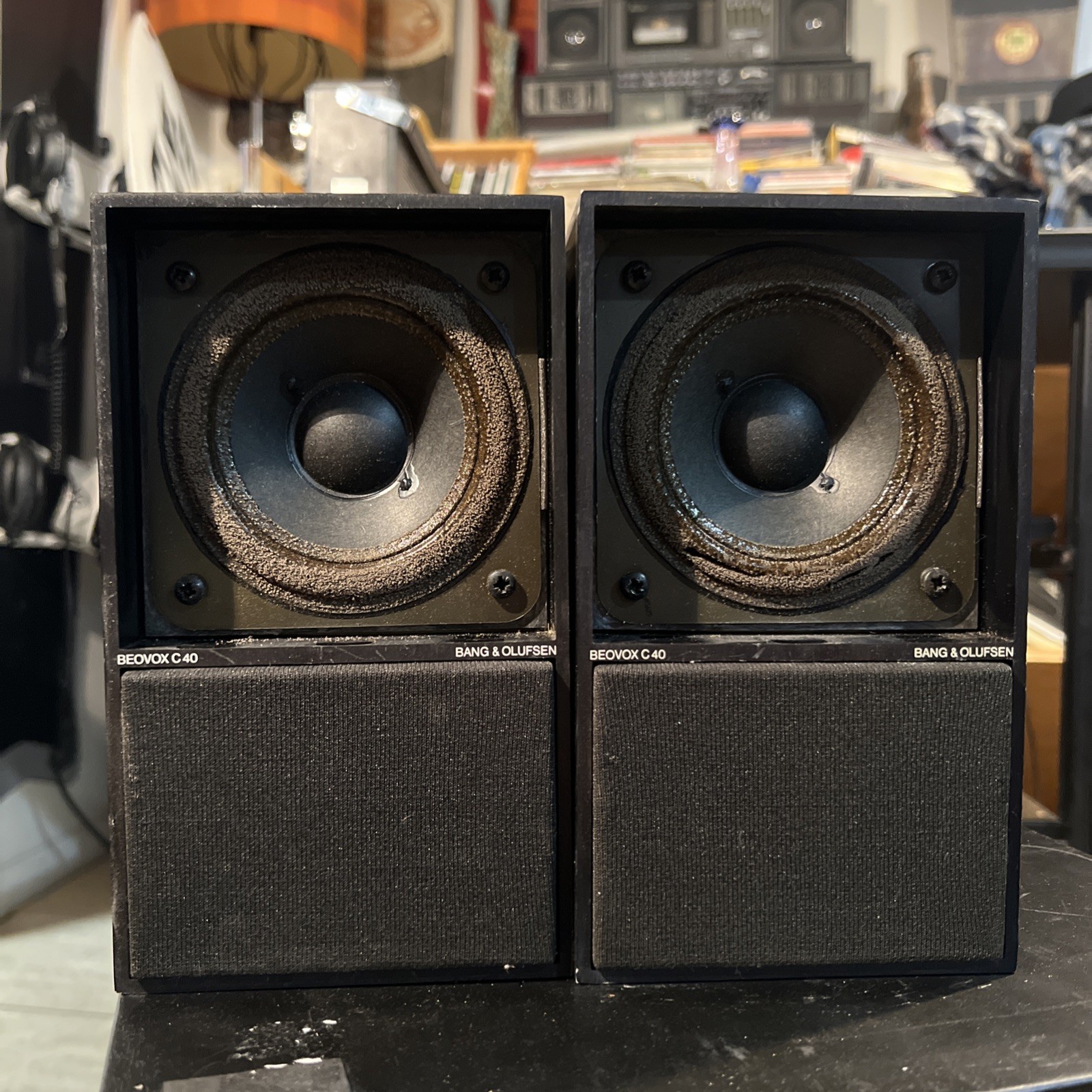
The C40 was available in multiple color finishes, including black, silver, and champagne, allowing it to blend with various interior styles. Its speaker grilles were typically made from fabric-covered foam, stretched over a rigid frame, and matched the tone of the main unit. The overall aesthetic is timeless, avoiding the overly technical look common in many audio systems of the era.
Audio Components and Features
The Beocenter C40 is a fully integrated microsystem that includes an AM/FM radio tuner, a cassette deck, and a built-in power amplifier. It was marketed as a high-fidelity solution for listeners who wanted quality sound without the complexity of separate components.
Radio Tuner:
The C40 features a digitally tuned PLL (Phase-Locked Loop) FM/AM radio with excellent reception sensitivity. The tuner includes memory presets for up to 10 FM and 5 AM stations, allowing users to quickly access their favorite broadcasts. The digital display, located behind a smoked glass panel, shows frequency and station information in a clean, easy-to-read format.
Cassette Deck:
The built-in cassette mechanism supports both standard and chrome tapes, with auto-reverse functionality. It features Dolby B noise reduction for improved tape hiss suppression, ensuring clearer playback. The tape transport includes full logic control, meaning the play, stop, and rewind functions are electronically managed for smooth and reliable operation. Record and playback levels are automatically optimized, reducing the need for manual calibration.
Amplifier and Sound Output:
The internal amplifier delivers 2 x 20 watts RMS into 8 ohms, providing ample power for medium-sized rooms. While not as powerful as separates from the same era, the amplifier is well-matched to B&O’s proprietary loudspeakers, ensuring balanced frequency response and low distortion. The tone controls allow for bass and treble adjustment, and a loudness compensation feature enhances low and high frequencies at lower volume levels.
The C40 was typically paired with Beovox speakers—most commonly the Beovox M50 or Beovox S35—which were designed to complement the system’s sonic characteristics. These speakers feature high-quality drivers and cabinet construction, contributing to a warm, detailed sound signature.
Connectivity and Expandability
Despite its compact size, the C40 offers a reasonable selection of connectivity options. It includes a stereo line input for connecting external sources such as turntables (with optional preamp), CD players (though CDs were still emerging in 1985), or later, MP3 players via adapters. A headphone output is located on the front panel, allowing private listening without disturbing others.
The system also features a proprietary B&O data bus connection, enabling integration with other components in the BeoLink ecosystem. This allowed users to control multiple devices with a single remote (such as the Beoremote) and synchronize power and volume settings across a multi-room setup—a forward-thinking feature for its time.
User Experience and Innovation
Bang & Olufsen placed a strong emphasis on user experience, and the C40 reflects this with thoughtful engineering. The motorized front panel not only looks impressive but also serves a practical purpose by shielding the cassette mechanism from dust. The system’s remote control capability (via BeoLink) was advanced for a microsystem in the mid-1980s, offering convenience that few competitors could match.
The C40’s interface is designed for simplicity. There are no cluttered menus or digital displays beyond what is necessary. Instead, users interact with physical dials and buttons that provide clear tactile feedback. This design philosophy ensures that the system remains intuitive, even for users unfamiliar with high-end audio gear.
Legacy and Collectibility
Today, the Bang & Olufsen Beocenter C40 is regarded as a classic piece of vintage audio equipment. Its enduring appeal lies in its combination of elegant design, solid build quality, and reliable performance. Unlike many mass-market systems from the 1980s, the C40 was built to last, and many units remain in working condition today.
Collectors of vintage audio and design enthusiasts often seek out the C40 for its aesthetic value as much as its sound quality. Its modular design and compatibility with other B&O components make it a desirable addition to curated audio setups. Restored units with original Beovox speakers can command premium prices in the vintage market.
The C40 also represents a transitional period in audio technology—bridging the gap between analog cassette-based systems and the digital future. It captures a moment when high-fidelity audio was becoming more accessible without sacrificing craftsmanship.
Conclusion
The Bang & Olufsen Beocenter C40 is more than just a compact stereo system; it is a statement of design excellence and engineering precision. With its motorized front panel, high-quality tuner, and integrated cassette deck, it offered a premium listening experience in a compact form. Its 2 x 20W amplifier delivers clean, dynamic sound, especially when paired with matching Beovox speakers.
While categorized as a microsystem, the C40 transcends the limitations often associated with such devices. It was built for discerning listeners who valued both aesthetics and audio fidelity. In an era increasingly dominated by disposable electronics, the C40 stands as a testament to Bang & Olufsen’s enduring philosophy: that technology should be beautiful, functional, and built to last.
For vintage audio collectors and design aficionados alike, the Beocenter C40 remains a prized possession—a timeless icon of 1980s Scandinavian design and high-end audio engineering.
eBay Listings



As an eBay Partner, we earn from qualifying purchases. This helps support our independent vintage technology research.
Related Models
- Bang & Olufsen Beocord C75 (1968)
- Bang & Olufsen BeoSound S120 (1995)
- Bang & Olufsen BeoSound 5500 (1997)
- Bang & Olufsen 1702 (1976)
- Bang & Olufsen 505 (1970)
- Akai AM-2850 (1975)
- Akai AP-206 (1975)
- Nakamichi BX-1 (1985)
- Acoustic Research research-ar-17 (1978)
- Acoustic Research AR-19 (1994)