Bang & Olufsen Beomaster 1000 (1968)
Overview
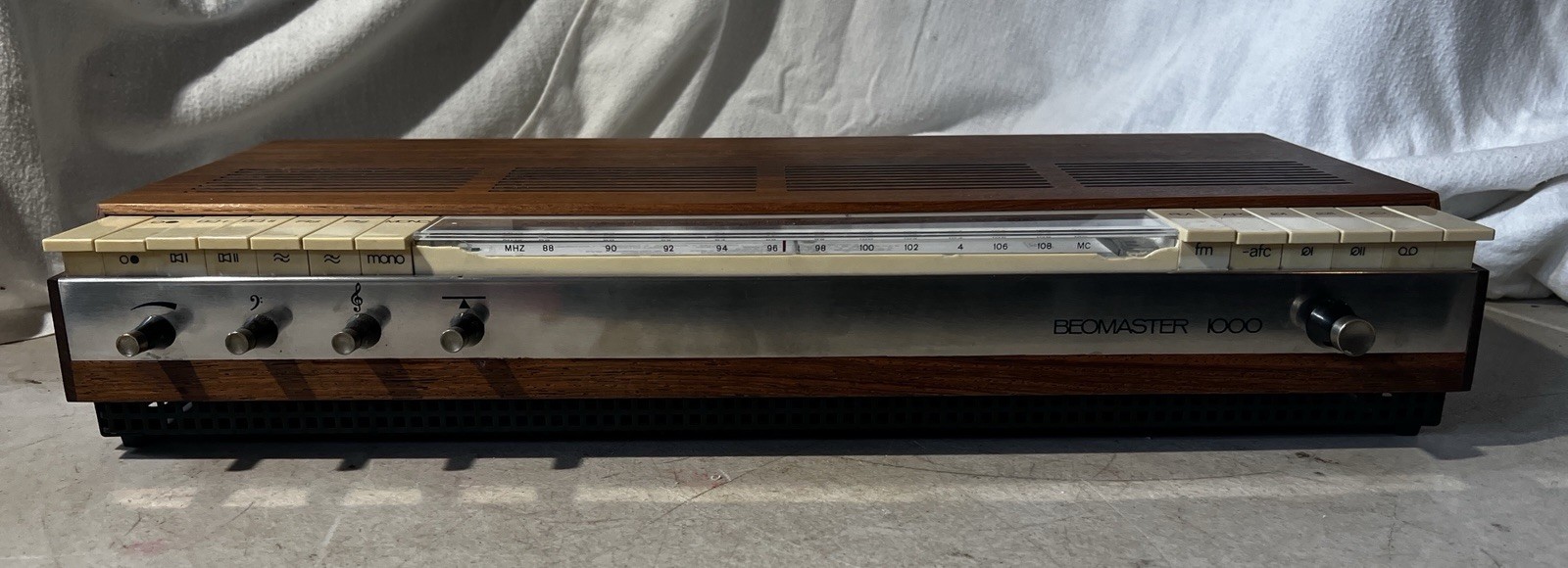
The Bang & Olufsen Beomaster 1000, introduced in 1968, stands as an early example of the brand’s commitment to merging minimalist Scandinavian design with solid-state audio engineering. Unlike the tube-driven behemoths of the era, this was a compact all-transistor hi-fi receiver—sleek, low-profile, and built for integration into modern living spaces. Its understated presence belies the complexity within: a carefully laid-out circuit board populated with discrete components, including the original AD149 output transistors and AC127/AC132 driver pairs, all protected by onboard safety circuits that demand precise alignment during servicing. Maintenance is non-trivial—their proprietary parts and complex mechanics require a specialist. The market is polarized, with working, serviced examples commanding high prices, while non-functional units become beautiful, frustrating paperweights.
Despite its modest power rating of approximately 2 × 15 watts RMS into 4–8 ohms, the Beomaster 1000 was never about brute force. It was about tonal balance, clarity, and integration. After repair, the sound is described as "really impressive," offering "a beautifully colorful, warm sound with a good foundation." This isn’t a receiver that shouts; it converses. Its capacitor-coupled output stage avoids DC offset issues common in direct-coupled designs, though forum discussions note that some units still develop DC offset problems over time—likely due to aging components or bias instability. The design prioritizes reliability and serviceability in theory, but in practice, decades of oxidation, capacitor drift, and fragile crimp connections have made fully functional units increasingly rare.
Specifications
| Manufacturer | Bang & Olufsen |
| Product type | stereo receiver / amplifier |
| Production years | 1968 |
| Technology | all-transistor |
| Power output | 2×15 watts RMS |
| Power output | approx. 2 × 15 watts RMS into 4–8 ohms |
| Power consumption | 120 watts |
| Original price | approx.: 995 DM |
| Original price | £82 |
| Inputs | Phono 1: 25 mV, 500 kOhm. phono 2: 200 mV, 47 kOhm. |
| Technology | capacitor coupled output |
Key Features
Compact All-Transistor Hi-Fi Design
The Beomaster 1000 was part of Bang & Olufsen’s push into solid-state audio during the late 1960s, marking a shift from tube-based systems to more reliable, cooler-running transistorized circuits. Described as a "compact all-transistor hi-fi," its engineering reflects a transitional moment—where high fidelity met modernist restraint. The layout is dense but logical, with an emphasis on thermal stability and long-term operation. The metal case houses serious engineering, from the large gray capacitor in the secondary supply next to the transformer to the precise biasing network that keeps the output stage in check.
AD149 Output Transistors with Crimp Connections
The original output/power stage transistors are AD149 types, mounted with crimp connections rather than solder. While this allowed for easier replacement in theory, in practice, these crimps are prone to loosening and oxidation over time. Collectors note that loose and oxidized crimp connections on the AD149 transistors can lead to higher current consumption and eventual transistor failure—a common failure mode that demands careful inspection during restoration. Though AD149 transistors were still available at the time of one repair report, sourcing NOS or suitable substitutes today requires patience.
NTC Resistor-Based Bias Setting with 100 Ohm Trimming Potentiometers
Bias stability is managed via an NTC (negative temperature coefficient) resistor, a design choice intended to automatically compensate for thermal drift in the output stage. However, these NTC resistors can fail over decades, developing a steeper characteristic curve that disrupts the bias point. The system includes 100 ohm trimming potentiometers for manual adjustment, but repairers caution that if the NTC is defective, the bias will drift regardless. Some technicians recommend replacing the NTC with fixed resistors as a permanent fix, though purists may frown upon the modification.
Protective Circuits Requiring Service Manual Alignment
Unlike simpler receivers of the era, the Beomaster 1000 includes protective circuits designed to safeguard the output stage and speakers. However, these circuits aren’t set-and-forget—they require alignment and testing according to the official service manual. This adds a layer of complexity to servicing, reinforcing the need for specialized knowledge. Owners attempting DIY repairs without the manual risk misalignment, instability, or even damage to connected speakers.
3000uF Output Capacitors and Secondary Supply Components
The output stage uses 3000uF capacitors, critical for coupling the audio signal and blocking DC. These electrolytic capacitors, like others in the unit, are prone to aging—showing oxidation points and increased ESR (equivalent series resistance) over time. The large gray capacitor in the secondary supply, located near the transformer, is another aging point; a measurable change in capacity often indicates it needs replacement. Given the unit’s age, a full capacitor refresh is typically recommended before powering it up after long storage.
Collectibility & Value
The Beomaster 1000 is increasingly sought after for its classic Danish mid-century modern design, but its collectibility hinges entirely on functionality. Common problems include oxidation and verdigris on transformer fuse holders (rated at 800 mA on the secondary side), oxidation of contacts on potentiometers and switches, and dust accumulation inside the chassis. The 2 amp fuse in the power amplifier stage often blows as a symptom of deeper issues—typically failed output transistors or shorted capacitors. Plastic parts, such as the power switch housing, can become brittle or slightly torn with age, and switches often develop a yellowed patina.
Repair paths exist: the AC187/AC188 transistor pair is a known replacement for the original AC127/AC132 drivers, offering better heatsinking capability. Contact cleaning with specialized products is recommended, as is careful dust removal using brushes and low-pressure air. Despite these challenges, a fully serviced unit delivers a listening experience that owners describe as rich and engaging—proof that, when working, the Beomaster 1000 is more than just a design artifact. However, without service history or recent restoration, buyers should assume a non-working unit and price accordingly.
eBay Listings
As an eBay Partner, we earn from qualifying purchases. This helps support our independent vintage technology research.