Bang & Olufsen Beogram 5005 (1986–1987)
That quiet moment when the arm glides forward on its own, finds the groove, and the music begins—no fingerprints, no fumbling, just precision.
Overview
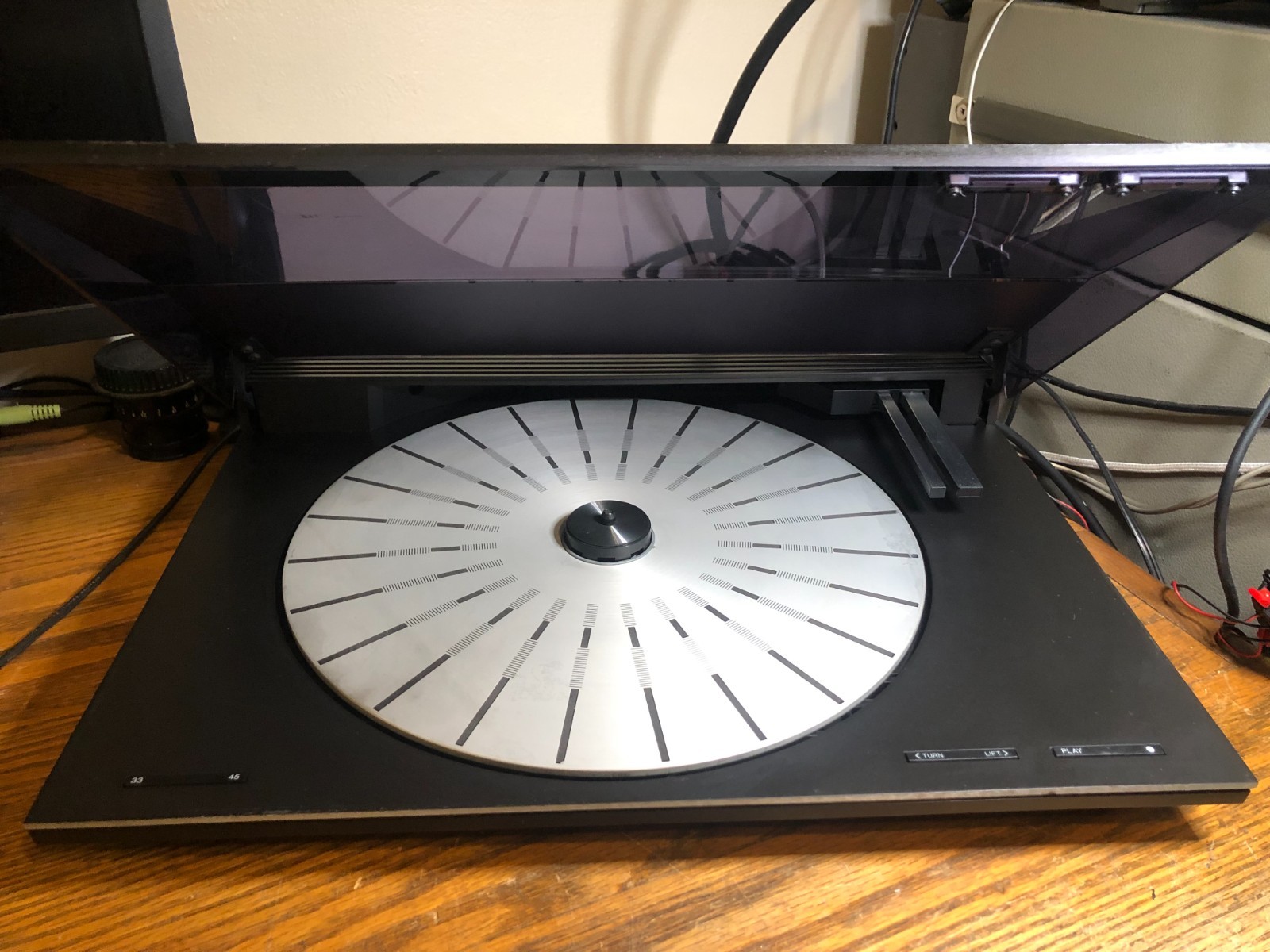
The Bang & Olufsen Beogram 5005 Automatic Turntable is one of those rare machines that makes you forget you're operating it. From the second you press play, it takes over—lifting the tonearm, detecting the record size, positioning itself with silent confidence, and dropping into the groove like it's been doing this for decades. And in a way, it has. Introduced in 1986 and produced through 1987, the 5005 was the first of what would become the core of B&O’s turntable lineup: a new generation of lightweight, linear-tracking decks built for elegance and automation. It wasn’t the flashiest model in the range, nor the most complex, but it marked a pivot—streamlined, integrated, and designed to work seamlessly within the Beosystem 5000 ecosystem. This was B&O’s vision of the future: high fidelity without the fuss.
It replaced the Beogram 5000, stepping into a mid-tier role between the Beogram 1800 derivatives and the flagship Beogram 8002. But don’t let “mid-range” fool you—what started as a modest upgrade would, over time, rise to the top as more expensive models were phased out. The 5005 wasn’t just a stopgap; it was the foundation of a new era. Owners report a machine that feels both familiar and forward-thinking, carrying over the iconic styling cues of earlier tangential-tracking Beograms while quietly simplifying the mechanics underneath. It’s a design that whispers rather than shouts, with clean lines, an aluminum finish, and that unmistakable Jacob Jensen touch. You don’t just play records on it—you interact with it, guided by subtle feedback and intuitive automation.
And yes, it’s automatic. Fully. The tonearm comes over, drops, plays, and returns properly—all without you touching a thing. With a single button, it can even lift and queue up records, making it one of the most hands-off turntables of its time. That’s not just convenience; it’s a philosophy. B&O believed your focus should be on the music, not the mechanism. The 5005 delivers on that promise, offering neutral sound with little to no coloration—clean, accurate, and unobtrusive. It’s not trying to impress you with warmth or punch. It’s just there, doing its job, sounding exactly like the record, nothing more, nothing less.
Specifications
| Manufacturer | Bang & Olufsen (B&O) |
| Product type | Linear tracking (tangential) automatic turntable |
| Production years | 1986 - 1987 |
| Speed | 33 1/3 and 45 rpm |
| Speed detection | Automatically detects 33 RPM versus 45 RPM sized records |
| Wow and Flutter | 0.08% |
| Rumble | -70dB (DIN B) |
| Tonearm type | Linear tracking (tangential) |
| Cartridge | MMC 20CL |
| Stylus included | MMC 4 Stylus |
| Tracking force | 1.2 grams |
| Outputs | 7-pin DIN connector |
| Power connection | Captive power cable |
| Power consumption | 14 watts |
| Dimensions | 430 x 350 x 115 mm (WxDxH) |
| Weight | 7.5 kg |
| Has transport screws | Yes |
Key Features
Linear Tracking with Precision
At the heart of the Beogram 5005 is its tangential tonearm—a design that eliminates tracking error by moving in a straight line across the record. Unlike pivoting arms, which drag through the groove at an angle, this one stays perfectly aligned from edge to center. The arm uses a cord-drive system with plastic pulleys and a nylon-covered steel wire, a setup that’s both quiet and reliable when maintained. Its movement is guided by the Optimum Pivot Point (OPP) suspension, a pendulum-based system that isolates vibration at the back of the tonearm so the stylus tip remains undisturbed. That’s not just engineering jargon—it translates to cleaner tracking, especially on worn or warped records.
Smart Automation
The 5005 doesn’t just play records; it manages them. Drop a stack on the platter, press a button, and it will lift and queue them up—no manual intervention needed. It automatically detects whether you’ve placed a 33 or 45 RPM record based on size, thanks to a weight-sensing system beneath the platter (the radial bars on the surface are purely decorative). The tonearm operates fully automatically: it moves into position, lowers gently, plays the record, lifts, and returns to its cradle. And if you want control, it’s there—manual track selection, search (forward and backward), repeat, and even a pause function let you navigate like a CD player before CDs were everywhere.
Integrated Design
Built for the Beosystem 5000, the 5005 shares the same cabinet style, size, colors, and finishes as the Beomaster 5000 and other components in the line. It’s part of a family, meant to sit together, look together, and work together. The Datalink connection allows it to be controlled remotely via the Beomaster or Master Control Panel 5000, making multi-room operation a real possibility. You can stop or change records mid-play without touching the unit or powering down the system—a small convenience that felt revolutionary at the time. The orange “standby” dot from earlier models was removed because the software no longer required a Datalink standby mode, streamlining the interface.
Subtle Details
Jacob Jensen’s design philosophy shines in the quiet details. The lid uses a simple counterbalance spring—no release catch, just a smooth, silent lift. At the back, a tiny spotlight activates automatically when the arm is under manual control, illuminating the stylus area so you can see what you’re doing. It’s the kind of thoughtful touch that makes you smile the first time it happens. The second arm, positioned to the right of the tonearm, doesn’t play records—it only carries a speed indicator light. Even the drive system is refined: a belt drive with an electronic DC servo motor, ensuring stable speed with minimal noise. The tracking motor itself is a simpler, more cost-effective design borrowed from the Beocord 5000 reel-to-reel, a sign that B&O was streamlining internally while maintaining external excellence.
Historical Context
The Beogram 5005 was the first model in what would become the final new Beogram turntable design. Though it lacked the direct-drive “tangential drive” motor of the Beogram 8000, it represented a shift toward compact, lightweight, and serviceable automation. It was introduced as a replacement for the Beogram 5000 and positioned between the Beogram 1800 series and the top-tier Beogram 8002. Unlike its predecessor, it didn’t include the elegant light inside the lid, but it carried forward the essential styling language of B&O’s tangential turntables.
Inside, some observers noted a slight lowering of standards compared to the 4000 and 8000 series—more molded plastic parts, a simpler tracking motor, and a reliance on gears driven from the turntable shaft for mechanical functions. But this wasn’t decline; it was evolution. The 5005 was designed to be practical, repairable, and integrated. It completed the Beosystem 5000 lineup by making remote-controlled turntable operation a reality. And while it started as a mid-range offering, later models in this lineage would eventually rise to the top of the range as more complex and expensive turntables were discontinued. The 5005 was replaced by the nearly identical Beogram 5500, continuing the line with minimal changes.
Collectibility & Value
Today, the Beogram 5005 occupies a sweet spot for collectors who appreciate B&O’s design but want something more accessible than the 8000-series flagships. Market prices vary widely—recent listings show units selling from €245 to €1,150, depending on condition and region. A refurbished unit with warranty can go for as much as £1,299.00 GBP, reflecting the cost of professional restoration. However, not all units on the market are ready to play: some are sold “for parts or repair” and remain untested, while others exhibit issues like “starts for a bit then stops.”
Common problems include cosmetic discoloration or staining in the aluminum finish, uneven platters that cause record scraping, and aging electronics or mechanical parts. The cord-drive system, while elegant, can degrade over time, and the plastic pulleys may need replacement. Fortunately, replacement parts are available from specialists—platters, upgraded drive cords, and even modern equivalents like the Soundsmith SMMC 4 stylus/cartridge combo that can replace the original MMC 20CL. Transport screws are included, which helps with shipping, but many units arrive with wear from improper handling.
If you’re considering a purchase, condition is everything. A well-maintained 5005 delivers a satisfying, near-silent performance that feels decades ahead of its time. But a neglected one can be a money pit. Look for units with even platters, clean finishes, and verified operation. Refurbished models from reputable dealers offer peace of mind, though at a premium. For those who value design, automation, and B&O’s unique approach to high fidelity, the 5005 remains a compelling piece—not just as a player, but as a statement.
eBay Listings


As an eBay Partner, we earn from qualifying purchases. This helps support our independent vintage technology research.