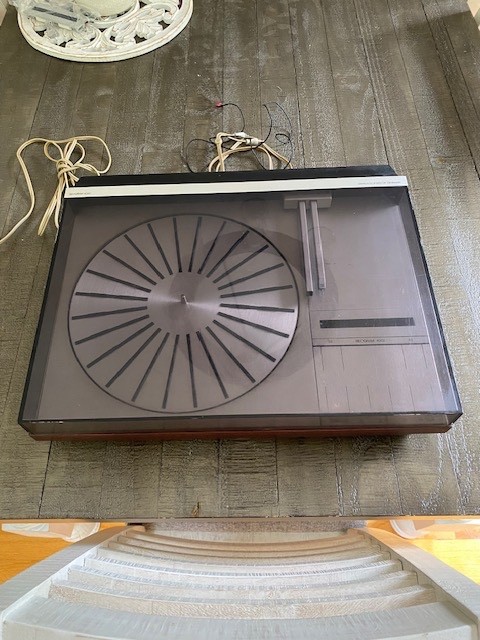
Bang & Olufsen Beogram 4002 (1974–1980)
At 12kg, it rests like a precision instrument—no wobble, no pretense, just Danish calm and a tonearm that glides like it’s defying physics.
Overview
The Bang & Olufsen Beogram 4002 isn't a turntable built for hobbyists who like to tweak; it’s for those who believe high fidelity should be silent, seamless, and almost invisible in its operation. Released in 1974 and produced until 1980, this linear tracking turntable was made in Denmark during the golden stretch of B&O’s analog dominance. It carries the minimalist signature of designer Jacob Jensen—clean lines, brushed aluminum surfaces, and a sense of quiet authority on any shelf. More than just a record player, it’s a statement of intent: audio equipment as furniture, engineering as art.
What sets the Beogram 4002 apart isn’t just its looks. It uses a tangential tonearm that moves in a perfectly straight line across the record, eliminating tracking error entirely—a feat most belt-driven turntables with pivoted arms can’t match. No manual cueing, no guesswork. Drop the record, press play, and the arm finds its path with clinical precision. The system was advanced for its time, and in well-maintained units, it still feels like magic.
Under the hood, it runs on a DC synchronous motor coupled to a belt drive system, spinning a 30 cm platter weighing 2.2 kg—massive enough to ensure speed stability without unnecessary inertia. It supports 33 and 45 rpm playback, and comes factory-fitted with the MMC-4000 cartridge, which delivers 2 x 1mV output and operates within a tracking force range of 0 to 1.5 grams. The signal-to-noise ratio is rated at 65dB, and wow and flutter held to an exceptionally low ±0.025% WRMS, figures that rival many modern turntables. Power supply is universal—accepting 110V, 130V, 220V, or 240V at either 50Hz or 60Hz—making it truly global out of the box. At 490 x 100 x 380 mm and 12kg, it occupies space like a piece of lab equipment, not consumer electronics.
The Beogram 4002 was available with a rare factory CD4 option, suggesting B&O anticipated the short-lived quadraphonic vinyl trend. Whether many were sold this way is unclear, but the existence of the option points to a machine designed for forward compatibility, even if the market didn’t follow through.
Specifications
| Manufacturer | Bang & Olufsen |
| Product type | Turntable |
| Years of manufacture | 1974–1980 |
| Made in | Denmark |
| Output | 2 x 1mV |
| Speed | 33 & 45 rpm |
| Attached cartridge | MMC-4000 |
| Wow & flutter | ± 0.025% WRMS |
| Signal-to-noise ratio | 65dB |
| Tracking force range | 0 – 1.5g |
| Motor | DC synchronous motor |
| Drive system | Belt drive |
| Platter | 30 cm diameter, 2.2 kg mass |
| Power supply | AC 110V/130V/220V/240V, 50Hz/60Hz |
| Power consumption | 40W |
| Dimensions (W x H x D) | 490 x 100 x 380 mm |
| Weight | 12kg |
| Type | Linear Tracking / tangential turntable |
| Factory option | rare CD4 factory option |
Key Features
Electronic Tangential Pick-Up Arm
The Beogram 4002’s most defining trait is its linear tracking arm, which moves in a perfectly straight line from the center to the edge of the record. Unlike traditional pivoted tonearms that introduce tracking error as they swing across the disc, this system maintains a constant 90-degree angle to the groove. The result is theoretically perfect alignment and minimal distortion. It’s a mesmerizing process—mechanical ballet disguised as simplicity.
MMC-4000 Cartridge Integration
Factory-mounted with the MMC-4000 cartridge, the Beogram 4002 arrives calibrated and ready. , capable of resolving fine groove detail without aggressive wear—assuming the arm’s delicate balance is preserved.
Universal Power Supply & Global Design
Engineered for international use, the Beogram 4002 accepts 110V, 130V, 220V, or 240V inputs at both 50Hz and 60Hz. No voltage converters, no internal jumpers—just plug and play, anywhere in the world. This flexibility reflects B&O’s global market ambitions and the product’s premium positioning.
DC Synchronous Motor with Belt Drive
The motor system combines a DC synchronous motor with a belt-driven platter, a configuration chosen for low noise and stable speed regulation. The 2.2 kg platter provides sufficient inertia for consistent rotation, while the belt isolates the platter from motor vibrations. The motor runs quietly, and in a functioning unit, the only audible cue of operation is the soft click of the arm engaging.
Collectibility & Value
The Beogram 4002 originally retailed for ¥250,000 circa 1976, a premium price that placed it firmly in the high-end market. Today, working and restored units command strong prices: listings on Reverb and Facebook Marketplace have appeared at $1,249.50 and $1,300.00 respectively. Non-functioning units, such as one listed on Lenco Heaven for £2.50, underscore the importance of condition—this is not a plug-and-play collectible without risk.
A well-documented and very common issue is the tonearm failing to lower, often due to old, frozen grease in the rail mechanism or degraded internal lubricants. Owners report that disassembly, cleaning, and re-lubrication are frequently required to restore full function. Replacement belts, while not original, are available through specialists—references exist to custom-made belts fitting perfectly, suggesting a niche but active restoration ecosystem. Refurbished units are offered by specialty dealers, indicating ongoing demand.
Despite its age, the Beogram 4002 remains a sought-after piece, not just for sound but for design. It was replaced by the Beogram 8000, which brought further technological refinements, but the 4002 captures the moment when B&O perfected the fusion of minimalism and mechanical innovation.
eBay Listings


As an eBay Partner, we earn from qualifying purchases. This helps support our independent vintage technology research.
Related Models
- Bang & Olufsen BEOGRAM 1202
- Bang & Olufsen BEOGRAM 4000
- Bang & Olufsen BEOGRAM 6000
- Bang & Olufsen Beogram 8002
- Bang & Olufsen 1602 (1975)
- Luxman PD-272 (1983)
- Garrard 2025tc (1968)
- Onkyo CP-1010 (1976)
- Pioneer PL-15R (1975)
- Pioneer PL-250 (1979)