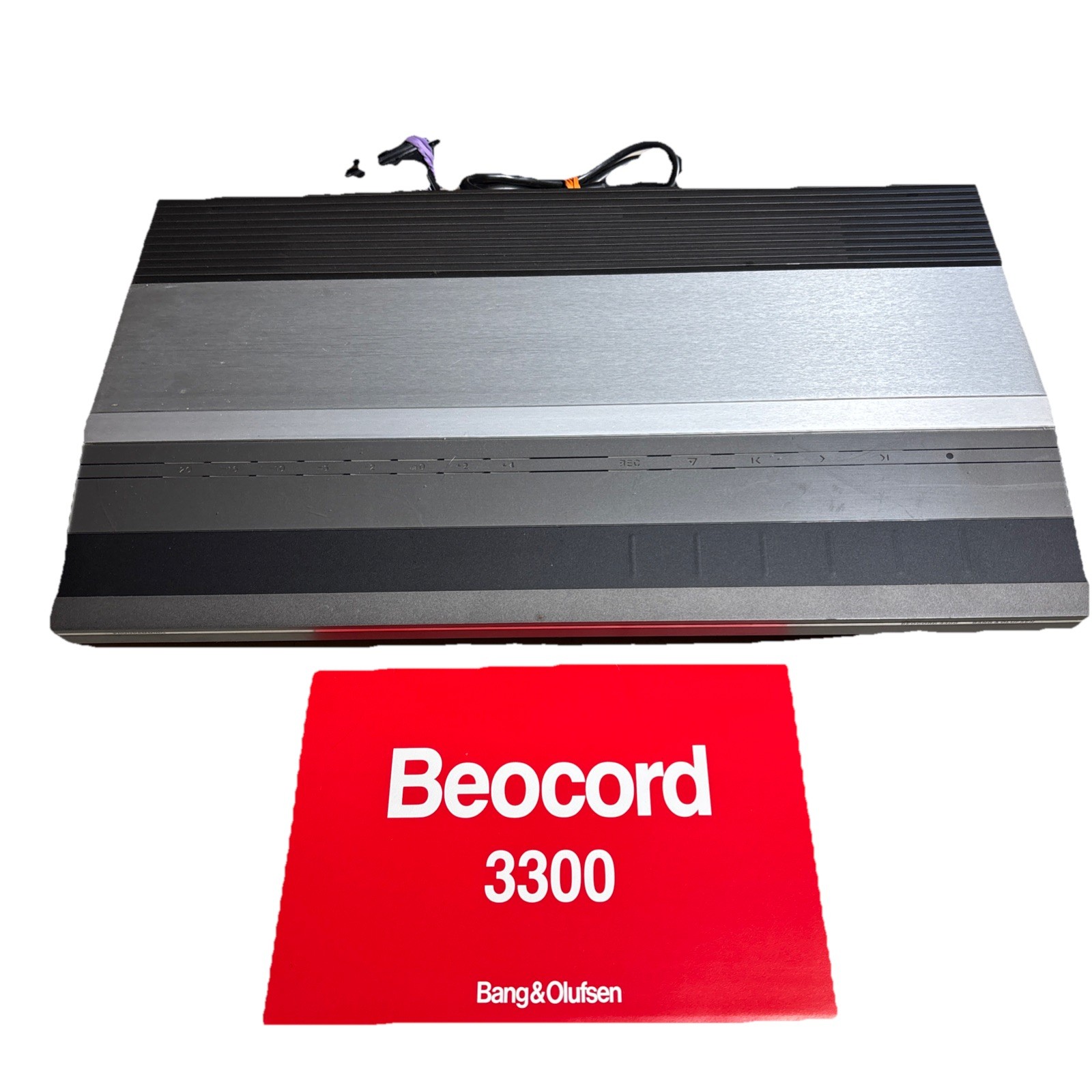
Bang & Olufsen Beocord 3300 Cassette Deck (1978)
The Bang & Olufsen Beocord 3300 is a premium cassette deck introduced in 1978 as part of B&O’s high-fidelity audio lineup. Renowned for its precision engineering, elegant Scandinavian design, and advanced tape transport technology, the Beocord 3300 exemplifies the Danish brand’s philosophy of merging form and function. Designed for audiophiles and design-conscious consumers alike, this cassette deck remains a sought-after classic among vintage audio enthusiasts.
Key Features
- 3-Head Design: Separate record, playback, and erase heads for superior sound quality and precise editing
- Dolby B Noise Reduction: Reduces tape hiss during playback for cleaner audio
- Automatic Tape Type Detection: Identifies Type I, II, and IV tapes and adjusts bias accordingly
- Bias and Level Calibration: Manual calibration controls for optimal recording performance
- Servo-Controlled Transport: Ensures stable tape speed with minimal wow and flutter
- Soft-Touch Controls: Elegant, tactile buttons with smooth operation
- Scandinavian Design: Minimalist aluminum and black finish, modular form factor compatible with B&O’s Beosystem wall installations
Specifications
| Specification | Detail |
| Model | Beocord 3300 |
| Brand | Bang & Olufsen |
| Year Introduced | 1978 |
| Production Period | 1978–1982 |
| Head Configuration | 3-head (record, playback, erase) |
| Tape Speed | 4.76 cm/s (1⅞ ips) |
| Wow and Flutter | < 0.07% (weighted) |
| Frequency Response | 30 Hz – 16 kHz (Type IV tape) |
| Signal-to-Noise Ratio | Up to 68 dB (Dolby B on) |
| Noise Reduction | Dolby B |
| Tape Type Support | Type I (Ferric), Type II (Chrome), Type IV (Metal) |
| Calibration Controls | Front-panel bias and level adjustment |
| Transport Mechanism | Servo-controlled direct drive |
| Design Compatibility | Beosystem 2500/3500 wall mounting |
| Power Supply | Integrated (exact voltage varies by region) |
| Dimensions (W×H×D) | 480 × 126 × 295 mm |
| Weight | 10.5 kg |
Sound Signature
The Beocord 3300 delivers a clean, neutral, and highly accurate sound profile. Its 3-head design ensures excellent channel separation and frequency response, while the servo-controlled transport minimizes speed fluctuations. The result is a detailed, transparent playback experience with low distortion and exceptional dynamic range—hallmarks of Bang & Olufsen’s high-end audio philosophy. With Dolby B engaged, tape hiss is significantly reduced, making it ideal for both music recording and archival playback.
Historical Context
Launched during the golden era of high-fidelity home audio, the Beocord 3300 was part of Bang & Olufsen’s integrated Beosystem approach, where components were designed to work together seamlessly in a living space. It reflected the company’s commitment to combining cutting-edge technology with timeless design. At a time when many manufacturers were producing utilitarian cassette decks, the 3300 stood out with its precision engineering, modular aesthetics, and user-centric features like automatic tape detection and manual calibration—features typically reserved for professional equipment.
As cassette technology matured in the late 1970s, the Beocord 3300 represented the pinnacle of consumer-grade tape decks, appealing to both audiophiles and design aficionados. Its integration into B&O’s wall-mounted systems made it a centerpiece of modern living rooms, reinforcing the brand’s reputation for luxury and innovation.
Maintenance and Restoration Tips
Due to its age, the Beocord 3300 requires careful maintenance to ensure reliable operation:
- Replace Aging Belts: Although the transport is direct-drive, rubber idler wheels and pressure pads may degrade. Replace with high-quality equivalents.
- Clean Tape Heads and Guides: Use 99% isopropyl alcohol and lint-free swabs after every few uses to prevent head clogging and ensure optimal playback.
- Demagnetize Regularly: Use a tape head demagnetizer (500–2000 ohm) every 50–100 hours of use to maintain clarity and frequency response.
- Check Capacitors: Electrolytic capacitors in the power supply and signal path may dry out over time. Replacing them prevents noise and instability.
- Lubricate Transport Mechanism: Use synthetic grease on gears and moving parts; avoid petroleum-based lubricants.
- Verify Calibration: If recording functionality is used, recalibrate bias and level using a reference tape or alignment cassette.
- Inspect Motors and Sensors: Ensure capstan motor runs smoothly and optical sensors are clean for accurate speed control.
Collectibility and Market Value
The Beocord 3300 holds a collectibility rating of 7/10. Its iconic design, build quality, and association with Bang & Olufsen’s legacy make it a desirable piece for vintage audio collectors and mid-century modern design enthusiasts.
- Market Value: $150–$400 USD
- Factors Affecting Value: Cosmetic condition, operational status, completeness (original remote, documentation), and provenance
- Restoration Potential: High—well-restored units command premium prices, especially when calibrated and serviced
Conclusion
The Bang & Olufsen Beocord 3300 is more than just a cassette deck—it’s a statement of design excellence and audio precision. With its 3-head configuration, advanced transport, and timeless aesthetics, it remains a benchmark in vintage cassette technology. Whether used as a functional component in a classic audio setup or displayed as a design artifact, the Beocord 3300 continues to captivate with its blend of engineering and elegance.
eBay Listings



As an eBay Partner, we earn from qualifying purchases. This helps support our independent vintage technology research.
Related Models
- Bang & Olufsen Beolab 8000 (1980)
- Bang & Olufsen 8004 (1983)
- Bang & Olufsen BeoCom 2400 (1982)
- Bang & Olufsen BeoCom 3500 (1982)
- Bang & Olufsen BeoCom 6002 (1992)
- Sony TC-2050SD (1978)
- Aiwa AD-F990 (1993)
- Kenwood KX-3060 (1982)
- Sony TC-2130A (1974)
- Sony TC-2220 (1972)