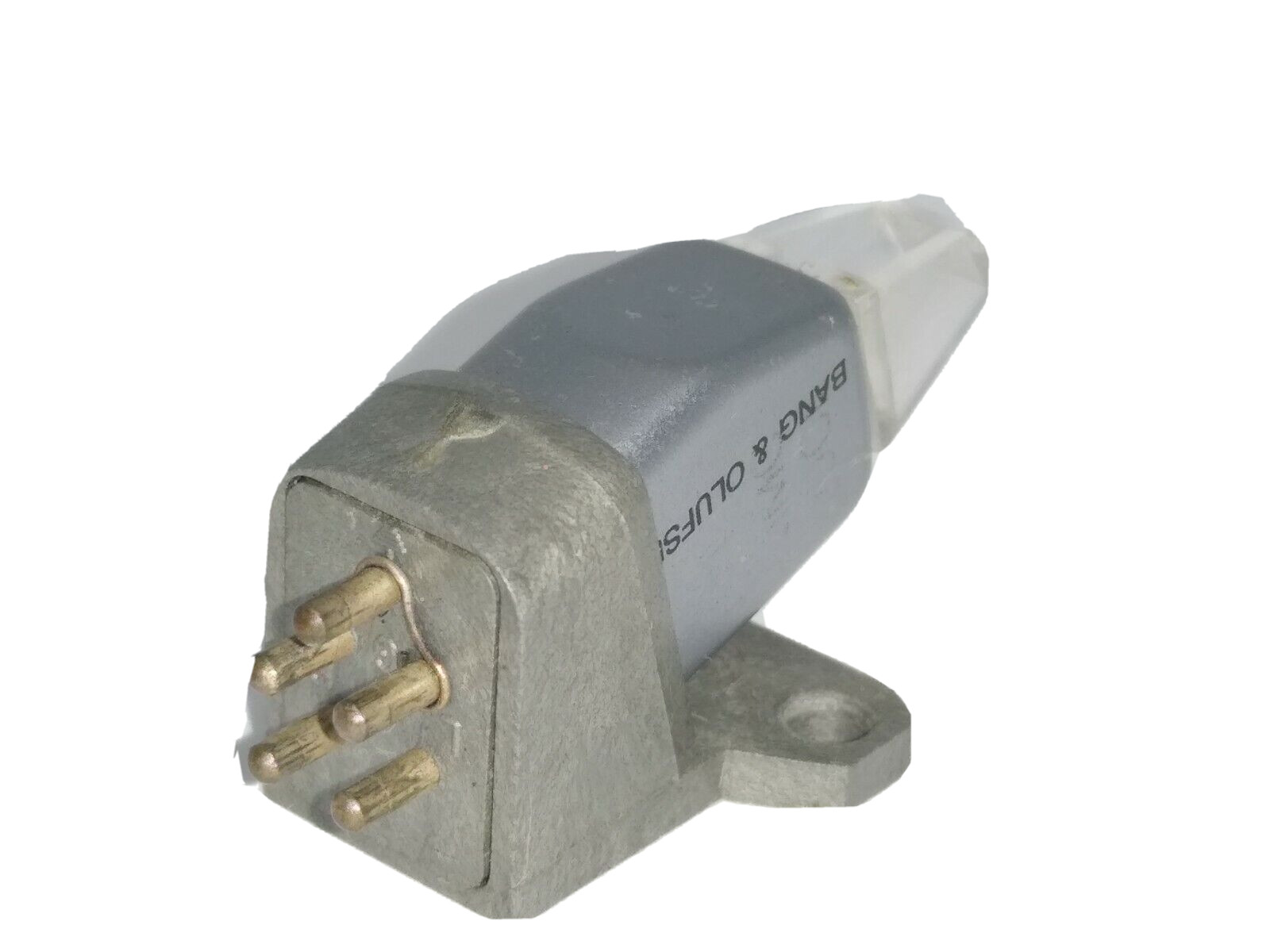
Bang & Olufsen MMC 20CL (c. 1979–1981)
The archive's fact sheet for the 20CL is essentially empty, so the record here comes from the period press. The press was fairly generous to this cartridge. It was a phono cartridge, B&O's moving-iron design of the late seventies/early eighties, and the surviving documentation runs from late 1979 to early 1981.
Audio (March 1980, p.78) reviewed the MMC 20CL and published full specifications. It tracked at one gram, used a nude contact-line diamond on a single-crystal sapphire cantilever, and had an effective tip mass of just 0.3 mg. Rated frequency response was 20-20,000 Hz ±1 dB, channel separation 30 dB at 1 kHz, and output above 0.6 mV/cm/s. The review listed the price at $200.
B&O's own advertising, also carried in Audio (January 1980, p.89; December 1980, p.73; March 1981, p.41), pitched the 20CL to people who already owned a serious turntable: "Your turntable probably deserves Bang & Olufsen." The company argued that a tonearm able to track at one gram with well-damped resonance was all that stood between an owner and the cartridge. It traced its research on effective tip mass back to 1958. One later ad showed the diamond-tipped sapphire cantilever at actual size and claimed it could resolve all 300 voices of the Mormon Tabernacle Choir. The same ad noted that the next three models in the MMC range met the same standards and offered "almost equivalent performance," which put the 20CL at the top of the line.
Known specifications from the Audio review:
- Type: moving iron; tracking force 1 g
- Stylus/cantilever: contact-line nude diamond on single-crystal sapphire
- Effective tip mass: 0.3 mg; static compliance 30 × 10⁻⁶ cm/dyne
- Frequency response: 20–20,000 Hz ±1 dB
- Channel separation: 30 dB at 1 kHz; ≥20 dB, 500 Hz–10 kHz
- Output: >0.6 mV/cm/s RMS; load 47 kΩ / 220 pF
- Price in 1980: $200
Beyond the review and the ad campaign, little is documented here. No production dates, collector prices, or owner impressions are in the record.
eBay Listings


As an eBay Partner, we earn from qualifying purchases. This helps support our independent vintage technology research.