Ariston RD11 (1971–1973)
Turn it on, drop the needle, and suddenly you’re in the middle of a 1970s audiophile’s dream—one that quietly shaped the future of high-end turntables.
Overview
There’s a certain hush that falls over a room when an Ariston RD11 spins up—part reverence, part disbelief. This isn’t just a vintage turntable; it’s a piece of audio folklore, a machine that hummed to life in a small Scottish workshop and, without fanfare, laid the blueprint for one of the most legendary decks in history. The RD11 doesn’t announce itself with flashy finishes or over-engineered flourishes. It’s understated, almost humble in its teak plinth and modest acrylic lid. But beneath that quiet exterior lies a design so influential that, for decades, audiophiles have debated whether the Linn Sondek LP12 was a revolutionary leap forward—or just a rebranded RD11 with a new badge.
Hamish Robertson, the mind behind Ariston, wasn’t chasing trends. He was building something that prioritized musicality over measurement, flow over flash. Teaming up with Castle Precision Engineering—yes, that Castle, the one run by Ivor Tiefenbrun’s father—the RD11 emerged in 1971 as a no-compromise belt-drive deck aimed squarely at the upper echelon of British hi-fi. It arrived at a time when Thorens still ruled the roost, and direct-drive turntables were still the domain of industrial labs and broadcast studios. The RD11 didn’t try to reinvent the wheel; it refined it. With a sprung subchassis, massive 3.2kg platter, and a 24-pole synchronous motor, it offered stability and isolation that few could match. And while it never achieved the commercial longevity of its spiritual successor, the LP12, the RD11 earned a cult following among those who heard it—and those who later realized they’d been listening to the same chassis under a different name.
Sonically, the RD11 delivers a presentation that’s lush, expansive, and forgiving—qualities that made it a favorite in an era when tube amps and warm-sounding cartridges were the norm. It doesn’t dissect recordings with clinical precision; instead, it wraps them in a velvety midrange, with bass that’s full-bodied and slightly soft around the edges. Treble is smooth, never harsh, and imaging, while not razor-sharp by modern standards, creates a believable soundstage that feels organic rather than artificially etched. It’s the kind of deck that makes you forget you’re listening to a machine. You don’t analyze the music—you live in it. And for many, that’s exactly the point.
Specifications
| Manufacturer | Ariston |
| Production Years | 1971–1973 |
| Original Price | £685 (GBP, 1979 Hi-Fi Year Book) |
| Drive Type | Belt drive, 24-pole hysteresis synchronous motor |
| Platter | Two-piece, 3.2kg (9.5 lbs) |
| Speeds | 33.33 and 45 RPM |
| Wow and Flutter | 0.06% (Ariston claim), 0.03% (measured in some RD11S units) |
| Rumble | –78dB (unweighted), –74dB (weighted) |
| Main Bearing | Single-point, precision-ground shaft with spherical ball bearing |
| Suspension | Free-floating subchassis on three coil springs with polyurethane dampers |
| Tonearm Mount | Custom armboard, compatible with SME, Grace, ADC, Rega, and other arms |
| Motor Control | Front-mounted trim knobs for speed adjustment |
| Power Requirements | 220/240V AC |
| Weight | 13 kg (28.6 lbs) |
| Dimensions | Not specified in research, but comparable to Linn LP12 |
| Plinth Material | Real wood (typically teak) |
| Lid | Detachable perspex (acrylic) with friction hinges |
| Belt Type | Square-section rubber belt (FRZ 19.6 for RD11) |
| Output | 5-pin DIN (often converted to dual RCA by owners) |
Key Features
The Motor That Didn’t Need Reinventing
The 24-pole AC synchronous motor wasn’t just a spec sheet bullet point—it was a statement. At a time when many manufacturers were still using 4- or 8-pole motors with noticeable cogging and speed instability, Ariston went all-in on smoothness. This motor, specially designed by the company’s engineers, delivered high torque and exceptionally low wow and flutter, figures that held up even against contemporary laboratory equipment. The square-section belt ensured consistent grip, and the motor’s placement on a silicone-isolated subframe minimized vibration transfer. Unlike later designs that chased exotic power supplies, the RD11’s motor ran directly off the mains—yet its performance belied that simplicity. It didn’t need a fancy speed controller because it didn’t need to correct for much in the first place.
Subchassis Suspension: The Foundation of Calm
The RD11’s suspension system—three coil springs supporting a rigid steel subchassis—wasn’t new in concept, but its execution was exemplary. Inspired by the Thorens TD150, it decoupled the critical components (motor, bearing, tonearm) from the outer plinth, effectively isolating them from floor vibrations and acoustic feedback. The springs were damped with polyurethane to prevent resonant ringing, and the entire assembly floated with a slight, deliberate wobble that felt reassuring rather than unstable. This wasn’t over-engineering; it was thoughtful engineering. The system worked so well that Linn adopted it wholesale, and decades later, audiophiles still debate whether the “Linn sound” was really just the sound of a properly tuned sprung subchassis—one that first appeared under an Ariston badge.
A Plinth With Personality—and Pin Striping
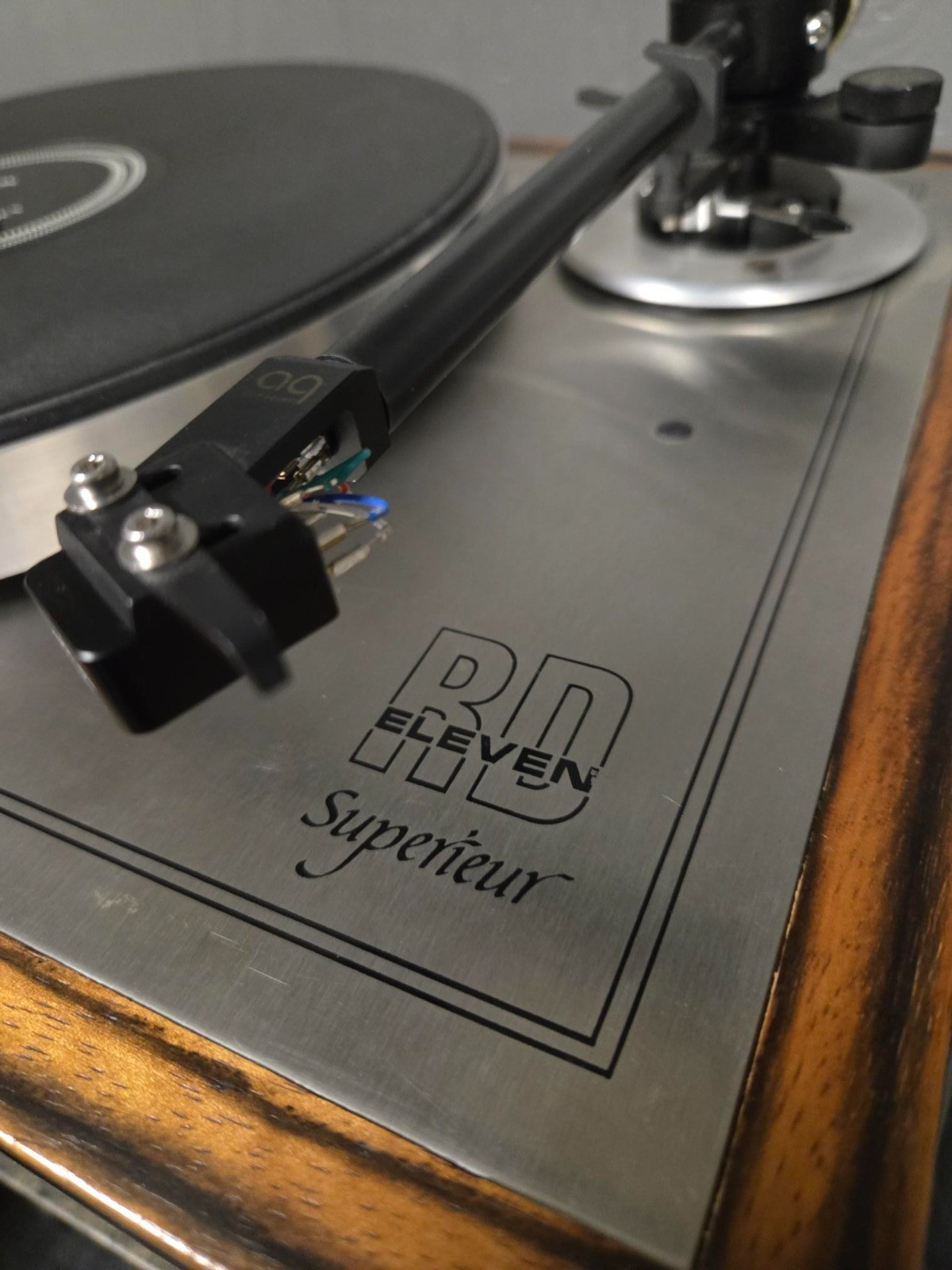
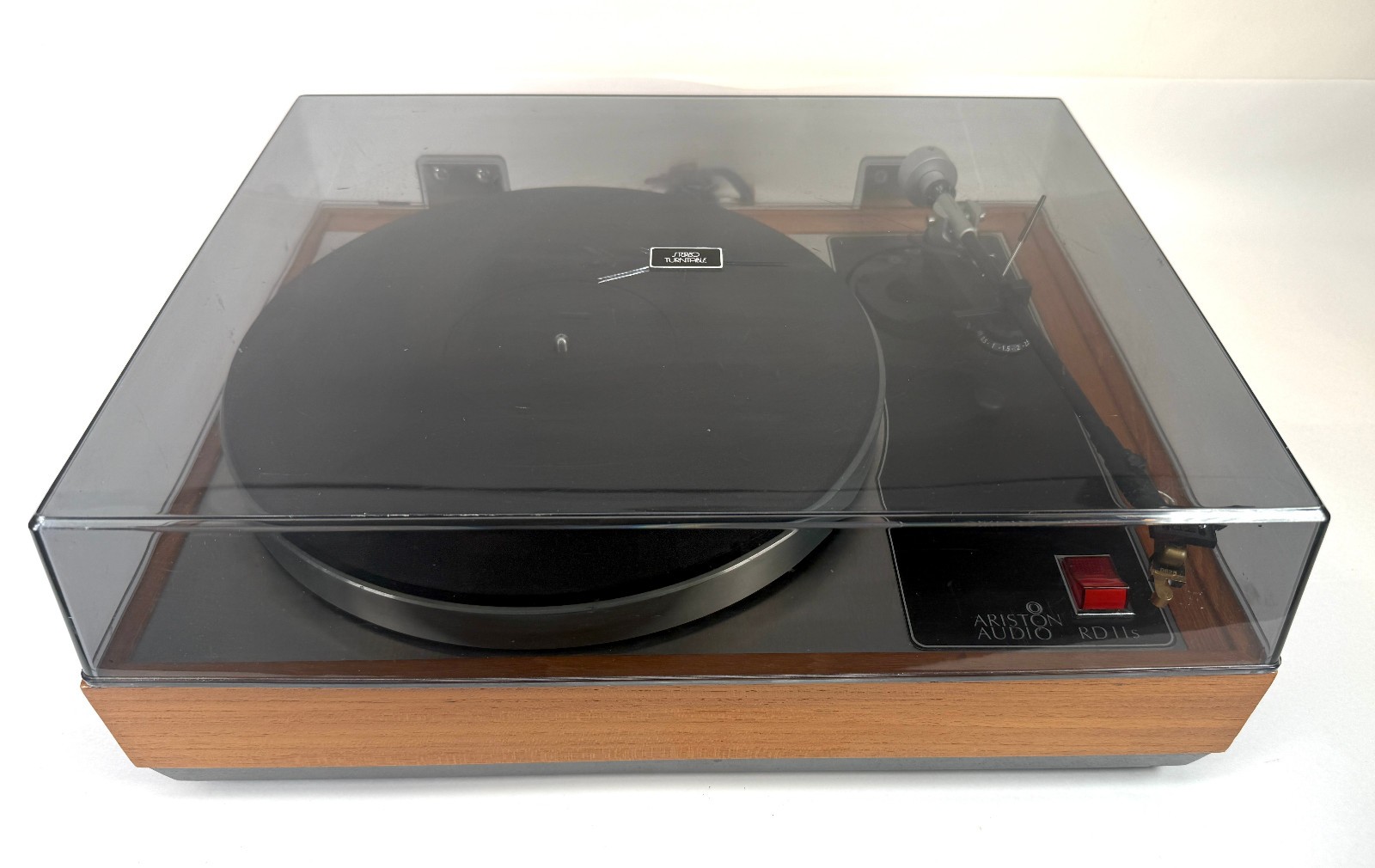
While the mechanics were serious, the aesthetics were unmistakably 1970s. The teak plinth, often finished with a warm, oiled sheen, featured a subtle but distinctive detail: pin-striping around the inner edge of the top panel. It was a small flourish, but one that set it apart from the stark minimalism of later high-end decks. The circular armboard, smaller than the LP12’s, gave the deck a slightly more compact footprint, and the front-mounted on/off switch—positioned on the right side—was a minor ergonomic quirk that longtime users either loved or quietly rewired. The acrylic lid, with its friction hinges, was robust and effective, though prone to fine scratches over time. Together, these details made the RD11 feel like a product of its time—not a sterile lab instrument, but a living room centerpiece built to be seen and touched.
Historical Context
The RD11 arrived at a pivotal moment in hi-fi history. The late 1960s and early 1970s saw a surge in demand for high-fidelity equipment from a growing middle class with disposable income and a passion for music. British audio brands like Lecson, Leak, and Bowers & Wilkins were gaining traction, and turntables were no longer just record players—they were precision instruments. Against this backdrop, Hamish Robertson’s vision for the RD11 was both ambitious and pragmatic. He didn’t try to out-Thorens Thorens; he built a deck that improved on existing principles with better materials, tighter tolerances, and a focus on real-world performance.
What makes the RD11’s story so compelling isn’t just its engineering—it’s the shadow it cast. When Linn Products launched the Sondek LP12 in 1973, it was, by multiple accounts, functionally identical to the RD11. The same factory (Castle Precision Engineering), the same subchassis, the same bearing, even the same motor. The differences were largely cosmetic: a rectangular armboard, a relocated switch, and a new name. Some early LP12s were even marketed as “the turntable previously available under the name Ariston RD11.” Whether this was a continuation, a betrayal, or simply business depends on who you ask. What’s undeniable is that the RD11’s DNA survived—and thrived—in the LP12, which would go on to become one of the most modified, upgraded, and revered turntables of all time.
Meanwhile, Ariston itself took a different path. After Dunlop Westayr Ltd acquired the company and Hamish Robertson departed, the brand shifted focus, eventually producing more affordable models like the RD40 and RD80. By the time CDs arrived in the 1980s, Ariston had faded into obscurity, a footnote in the rise of digital audio. But among those who remember, the RD11 remains a symbol of what could have been—a high-end contender that, for a brief moment, stood at the pinnacle of analog design.
Collectibility & Value
Today, the Ariston RD11 is a collector’s curiosity with real sonic substance. It’s not rare in the sense of being scarce—dozens still surface on the secondhand market—but it is rare in terms of awareness. Most audiophiles know the LP12, but far fewer recognize the RD11 as its progenitor. That obscurity works in buyers’ favor: a well-maintained RD11 can be had for £200–£350, depending on condition and whether it’s an early model or the later “Superieur” variant. That’s a fraction of the cost of even a base-model LP12, and for that price, you’re getting the same foundational design, just without the brand cachet.
But ownership comes with responsibilities. The most common failure point is the drive belt, which degrades over time and should be replaced every 10–15 years. Square-section belts (FRZ 19.6) are still available from specialist suppliers, but installing one requires platter removal and careful tensioning. The main bearing, while robust, can dry out or accumulate debris; a fresh lubrication with high-quality bearing oil is often part of a full service. The suspension springs, though durable, can sag or lose damping over decades, so checking for even float and replacing polyurethane dampers is wise.
Electrical upgrades are common, and here’s where the RD11’s legacy shines: many LP12 modifications fit. The Valhalla power supply, Nirvana spring kit, and even the Cirkus motor controller have been successfully adapted by enthusiasts. However, the main bearing and armboard differ slightly, so not every part swaps seamlessly. Buyers should inspect the subchassis for warping, the plinth for cracks (especially around mounting points), and the tonearm for wear—especially if it’s an SME 3009 or Grace G707, which were popular original fits.
For those seeking authenticity, a factory-original RD11 in good condition is a prize. But for the pragmatic listener, a well-serviced and thoughtfully upgraded example delivers performance that rivals far more expensive decks. It’s not a museum piece—it’s a turntable that wants to be played.
eBay Listings

As an eBay Partner, we earn from qualifying purchases. This helps support our independent vintage technology research.