Ariston RD-11 (1971–1973)
The turntable that started a legend—before the legend stole the show
Overview
Turn it on, drop the needle, and you’re not just hearing a record—you’re hearing the ghost of a rivalry that shaped high-end audio. The Ariston RD-11 doesn’t just spin vinyl; it spins history, controversy, and a sound that still holds up when you crave warmth over clinical precision. This isn’t some forgotten mid-fi also-ran. This is the machine that, for a brief moment, stood at the center of the British hi-fi universe, only to be eclipsed by a company that took its blueprint and ran with it. If you’ve ever admired a Linn Sondek LP12 and wondered how it got that way, the answer starts here, on a workbench in Glasgow, with Hamish Robertson and the Tiefenbruns.
By 1971, the idea of a high-performance turntable wasn’t new, but the execution was still evolving. Most decks were either heavy, idler-driven dinosaurs or flimsy belt-drive jobs that shook with every bass note. The RD-11 split the difference with a sprung subchassis design that isolated the platter, bearing, and tonearm from external vibrations—a concept borrowed from the Thorens TD150, yes, but refined with Scottish pragmatism. The subchassis, a minimalist steel cradle shaped like a kite, floated on three coil springs inside a dense real-wood plinth, usually teak. It looked simple, almost crude, but that was the point: remove everything that didn’t matter and obsess over what did. The platter was a two-piece, 3.2kg (7lb) hunk of metal driven by a square-section rubber belt from a 24-pole AC synchronous motor—overbuilt, torquey, and stable. Speeds were adjusted via tiny trim pots on the front panel, a detail that screamed “serious tool” rather than “consumer appliance.”
And then there was the bearing: a single-point design with a precision-ground, mirror-finished shaft and a perfectly spherical ball. Ariston’s literature at the time boasted “almost rumble-free sound,” and with a claimed rumble figure of -78dB and wow and flutter at 0.06%, they weren’t exaggerating for the era. That bearing wasn’t just a mechanical choice—it was a statement. It said this turntable wasn’t about looks or convenience. It was about minimizing friction, maximizing rotational stability, and getting out of the music’s way. The armboard was rectangular, unlike the later RD11s, and the on-off switch sat on the front right—a small but telling difference from what came after.
But let’s talk sound, because that’s where the RD-11 lives or dies. By modern standards, it’s not neutral. Imaging is broad rather than razor-sharp, the midrange has a slight coloration—like a warm tube amp’s glow—and the bass, while powerful, doesn’t have the taut control of today’s reference decks. But none of that matters when you’re listening to Coltrane or Zeppelin. The RD-11 doesn’t dissect; it envelops. It’s big, open, and euphonic in a way that makes even poorly recorded albums feel alive. It’s the sonic equivalent of a well-worn leather armchair: not the most precise fit, but deeply comfortable and impossible to dislike. Pair it with a good SME Series III or a Grace G707, and you’ve got a system that could shame far more expensive setups in 1972.
Specifications
| Manufacturer | Ariston |
| Production Years | 1971–1973 |
| Original Price | Not available |
| Turntable Type | Belt-drive, suspended subchassis |
| Platter | Two-piece, 3.2kg (7lb) |
| Motor | 24-pole AC synchronous, high-torque |
| Drive Belt | Square-section rubber |
| Main Bearing | Single-point, precision-ground shaft with spherical ball |
| Speeds | 33.333 RPM, 45 RPM |
| Speed Adjustment | Front-mounted trim pots |
| Wow and Flutter | 0.06% |
| Rumble | -78dB (unweighted), -74dB (weighted) |
| Suspension | Three coil springs with polyurethane dampers |
| Subchassis | Steel, kite-shaped, free-floating |
| Armboard | Rectangular, decoupled from subchassis |
| Plinth | Real wood (typically teak), with internal pin-striping |
| Dust Cover | Acrylic, hinged |
| Weight | 13kg (28.6 lbs) |
| Dimensions | Not available |
| Power Supply | Internal AC, line-powered motor |
Key Features
The Single-Point Bearing That Started a War
The RD-11’s bearing wasn’t just a component—it was the nucleus of a legal and cultural battle. While many turntables used captive ball bearings or oil-filled wells, the RD-11 went with a single-point design: a hardened steel shaft resting on a perfectly spherical ball, supported by a precision-machined housing. The goal was near-frictionless rotation with minimal lateral play. It worked. Owners report that a well-maintained RD-11 glides with a silence that makes you forget the platter is even spinning. But this bearing also became the flashpoint when Linn Products emerged in 1973, selling a nearly identical deck under the Sondek LP12 name. Jack Tiefenbrun, owner of Castle Precision Engineering (which built both), filed patent applications on the bearing design, and Linn would later fight to defend it against challenges from Hamish Robertson’s company. The irony? The RD-11 came first, but Linn won the war. Still, for collectors and historians, the RD-11’s bearing remains a symbol of what could have been—a legitimate claim to the throne of British turntable royalty.
Sprung Subchassis Done Right
The RD-11’s suspension system wasn’t revolutionary—Thorens had been doing it for years—but it was executed with a level of care that made a difference. The steel subchassis doesn’t just float; it’s tuned. The three coil springs are calibrated to isolate the critical components from floor vibrations, while polyurethane dampers control resonance. The armboard is isolated from the subchassis itself, a detail that matters when you’re chasing the last bits of detail. This isn’t passive isolation; it’s active tuning. And yes, it requires attention. Owners need to level the deck, adjust spring tension, and occasionally re-lubricate the bearing. But when it’s dialed in, the payoff is a sense of stillness—a platform so stable that the stylus can trace the groove without fighting its own hardware. It’s a philosophy: the turntable should disappear, and the RD-11, for all its mechanical complexity, manages to vanish into the music.
A Plinth With Personality
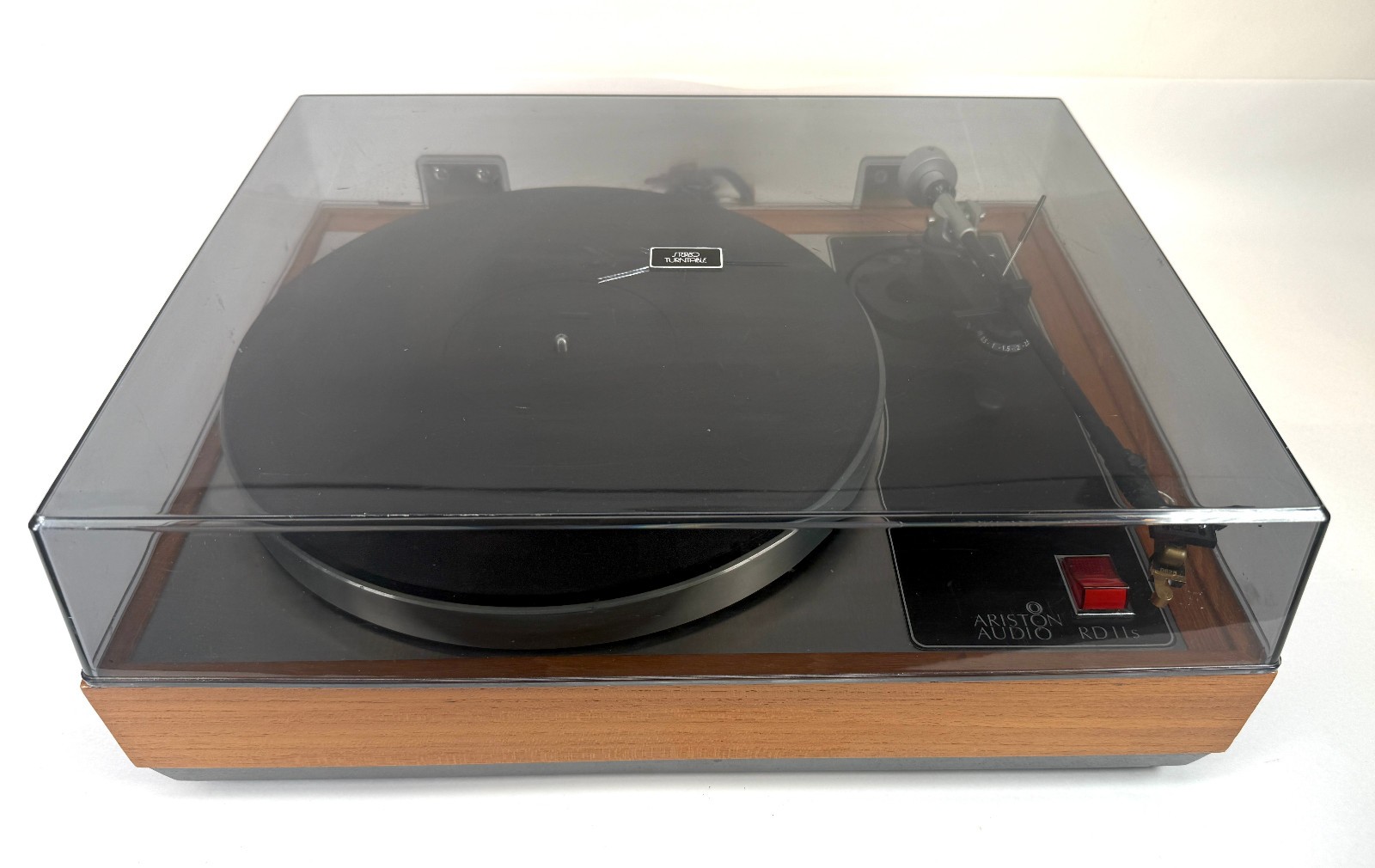
Look inside the plinth of an early RD-11 and you’ll see something no modern deck dares: pin-striping. Thin, contrasting lines painted around the inner edge of the wood top, like a 1970s sports car. It’s frivolous, yes, but it’s also charming—a reminder that high-end audio wasn’t always about stealth black boxes. The plinth itself is solid wood, usually teak, with a weight and density that contribute to the overall mass damping. The top plate extends to all four edges, unlike the later RD11s, which added a trim strip to simulate the older design. The acrylic dust cover isn’t just functional; it’s part of the aesthetic—clean, slightly retro, and just heavy enough to feel substantial when you lift it. This is a turntable that doesn’t hide its era. It wears it proudly.
Historical Context
The RD-11 was born at a turning point. In 1970, Hamish Robertson founded Ariston and contracted Castle Precision Engineering—run by Jack Tiefenbrun, father of Ivor Tiefenbrun—to build his vision. The collaboration worked. The RD-11 debuted at the Harrogate Hi-Fi Show in 1971 to strong reviews and a growing reputation. But by 1973, everything changed. Dunlop Westayr Ltd acquired Ariston, rebranded it as Ariston Audio Ltd, and Hamish Robertson left. Around the same time, Ivor Tiefenbrun launched Linn Products and began selling a turntable that looked, functionally, identical to the RD-11—the Sondek LP12. Castle Precision Engineering built both. The early LP12s were, by multiple accounts, “carbon copies” of the RD-11, with interchangeable parts and the same single-point bearing. Linn didn’t just copy the design; they perfected the narrative. They marketed the LP12 as a revelation, backed by relentless PR, dealer networks, and a stream of upgrades—Valhalla, Lingo, Keel—that kept the platform relevant for decades. Ariston, meanwhile, drifted into budget models and eventually folded, a casualty of the CD revolution. The RD-11 became a footnote—except among those who know the truth.
It’s tempting to paint this as a story of theft, but the reality is more nuanced. The RD-11 and early LP12 shared DNA, yes, but Linn’s genius wasn’t in the hardware—it was in the ecosystem. They created a culture of continuous improvement, where owners could upgrade their decks for decades. Ariston offered no such path. The RD-11 was a complete product, not a platform. And while that limited its longevity, it also gave it a purity. What you bought in 1972 is what you still have today—no mods, no kits, just a beautifully engineered machine that does one thing exceptionally well.
Collectibility & Value
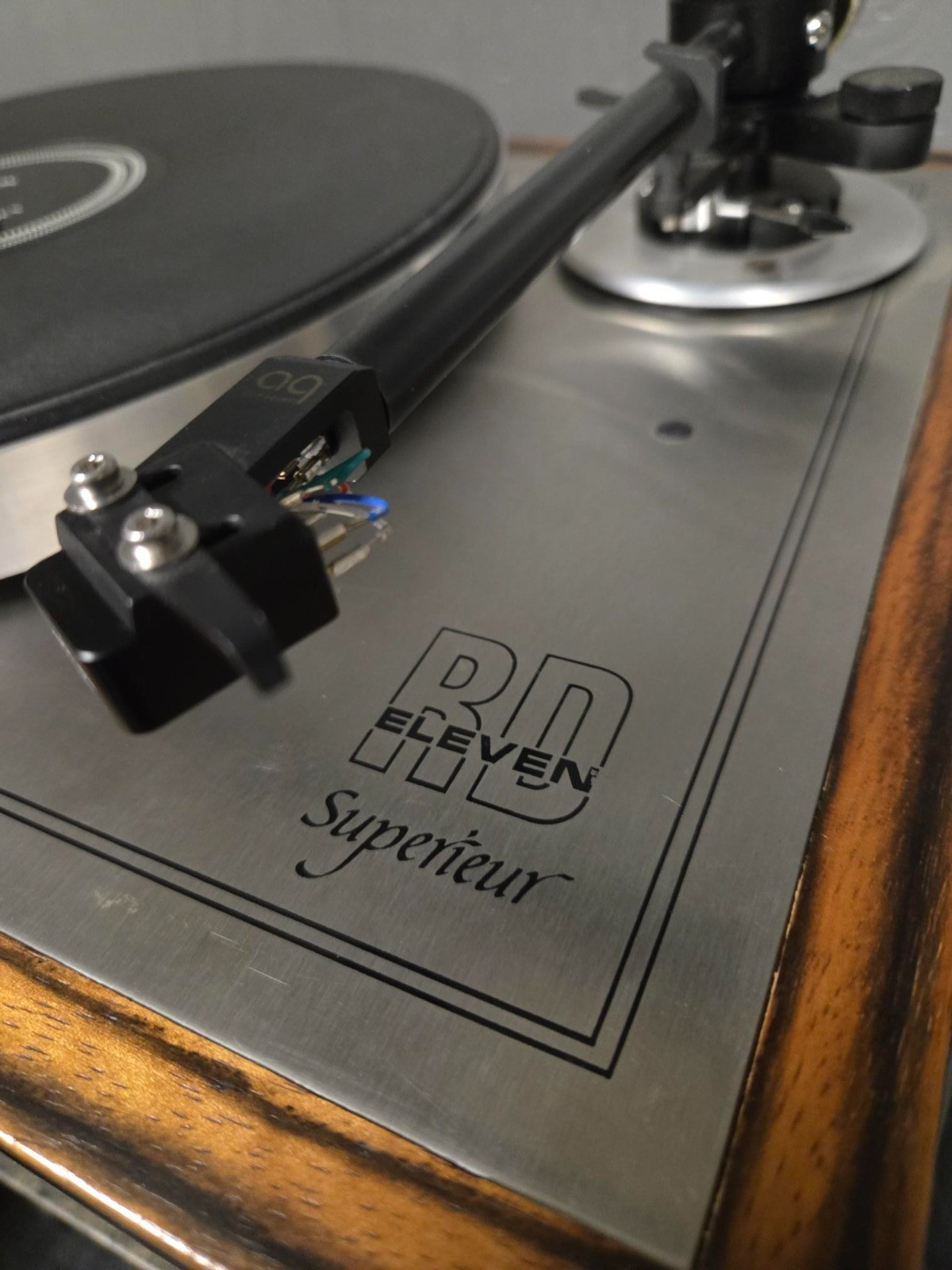
Original RD-11s are rare—rarer than early LP12s, ironically—and they’re not always easy to identify. The key is the bearing and the armboard. If it has a single-point bearing and a rectangular armboard, you’ve got the real deal. If it’s got a captive ball bearing and a circular armboard, it’s an RD11s, a later model made after Robertson’s departure. Don’t confuse the two. The RD-11 is the one with historical significance; the RD11s is a competent but less legendary sibling.
Prices reflect this. A clean, working RD-11 in good condition might fetch £800–£1,500 in the UK, depending on provenance and originality. That’s less than a comparable LP12, which can command £2,000 or more, but it’s still a serious investment for a deck that requires maintenance. The main risks? Dried-out suspension springs, hardened belts, and seized bearings. The square-section belt is still available, but the single-point bearing is a specialist job. If it’s seized, don’t try to force it—disassembly requires precision tools and cleanroom conditions. Many owners opt to keep them as-is, running them only occasionally to preserve condition.
Here’s the good news: if you can find a well-cared-for RD-11, it’s a turntable you can actually use. Unlike fragile vintage electronics, a properly maintained RD-11 sounds as good today as it did in 1972. And because so many Linn upgrades—Valhalla power supplies, Nirvana spring kits, even strengthened subchassis—fit the RD-11, you can modernize it without losing its soul. Just don’t expect dealer support. This is a DIY owner’s machine. You’ll need to learn how to re-level the subchassis, adjust motor speed, and re-lube the bearing. But if you’re willing to put in the work, the reward is a piece of audio history that sounds as good as it matters.
eBay Listings

As an eBay Partner, we earn from qualifying purchases. This helps support our independent vintage technology research.