AR XB91 (1972–1977)
It hums to life with a quiet thump, the platter gliding on oil like it’s floating—this isn’t hi-fi theater, it’s the real thing, stripped down and honest.
Overview
Turntables don’t come more emblematic of early 1970s American hi-fi pragmatism than the AR XB91. It’s not flashy, doesn’t boast a gimbaled arm or exotic plinth, but what it does—belt drive, suspended subchassis, precise speed control—it does with a quiet confidence that still turns heads in analog circles. Born in 1972 as a slightly upgraded sibling to the XB, the XB91 wasn’t a reinvention, but a refinement: a turntable built for people who wanted better sound without stepping into the boutique tier. And the “91” in the name? That’s the giveaway—it came factory-fitted with the Shure M91ED moving magnet cartridge, a serious upgrade over the budget plastic-headshell jobs common at the time. For an extra $55 over the base XB’s $130 price, buyers got a cartridge that tracked well, had decent output, and—most importantly—was replaceable. This wasn’t a sealed system; it was a gateway.
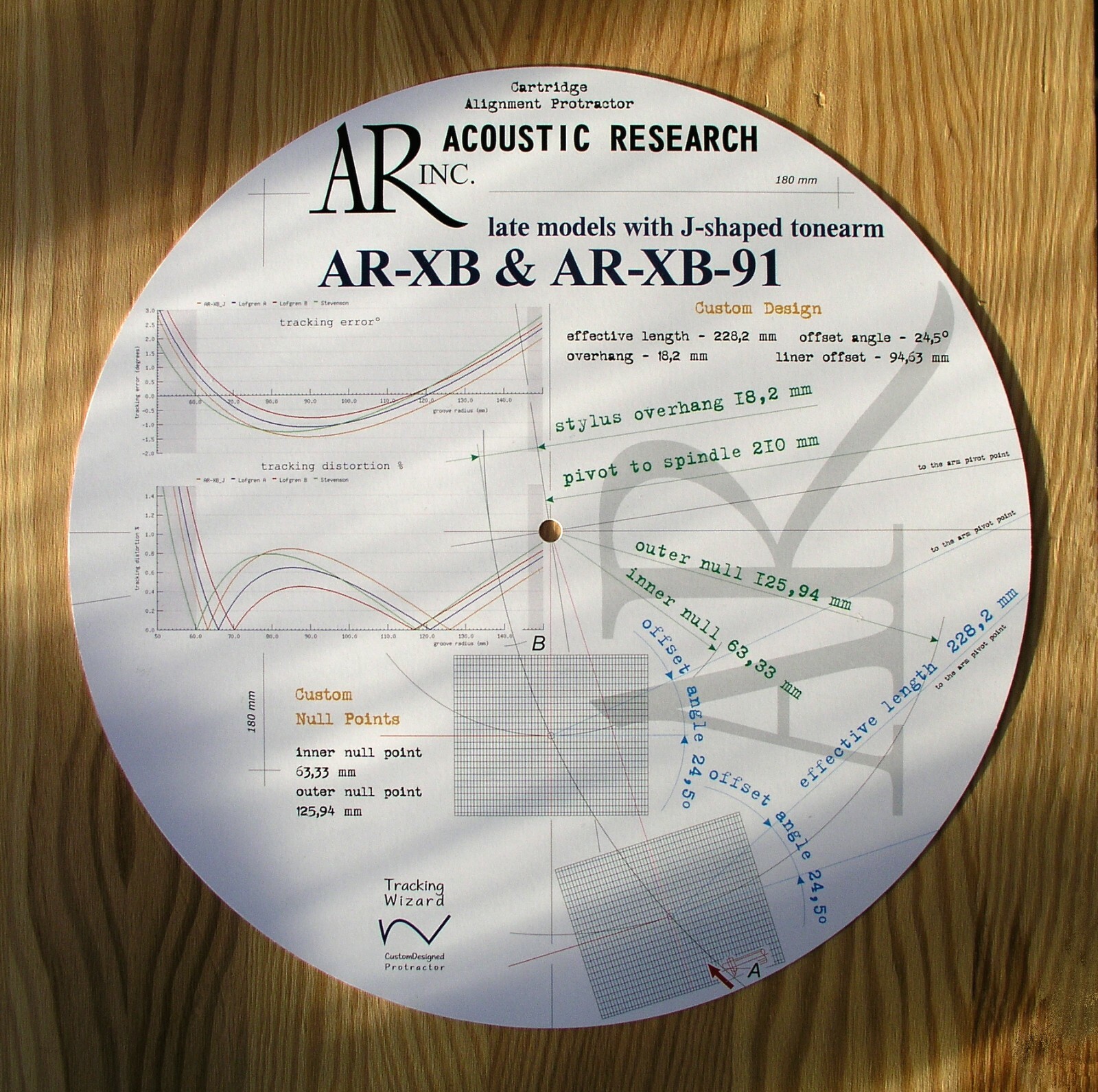
The XB91 shares the same DNA as the legendary XA, but where the XA was minimalist genius on a budget, the XB and XB91 were incremental improvements aimed at a market starting to demand more from mid-tier gear. It kept the suspended aluminum platter on an oil-damped bearing, the same three-point spring-suspended subchassis that isolated the platter and tonearm from cabinet vibrations—a Villchur innovation that became industry standard. But unlike the XA, the XB series used a 12-inch S-shaped tonearm in an oil-damped pivot, offering better geometry and lower effective mass. It wasn’t a unipivot or a linear tracker, but it was a noticeable step up from the XA’s T-bar arm, especially when paired with a good cartridge like the M91ED.
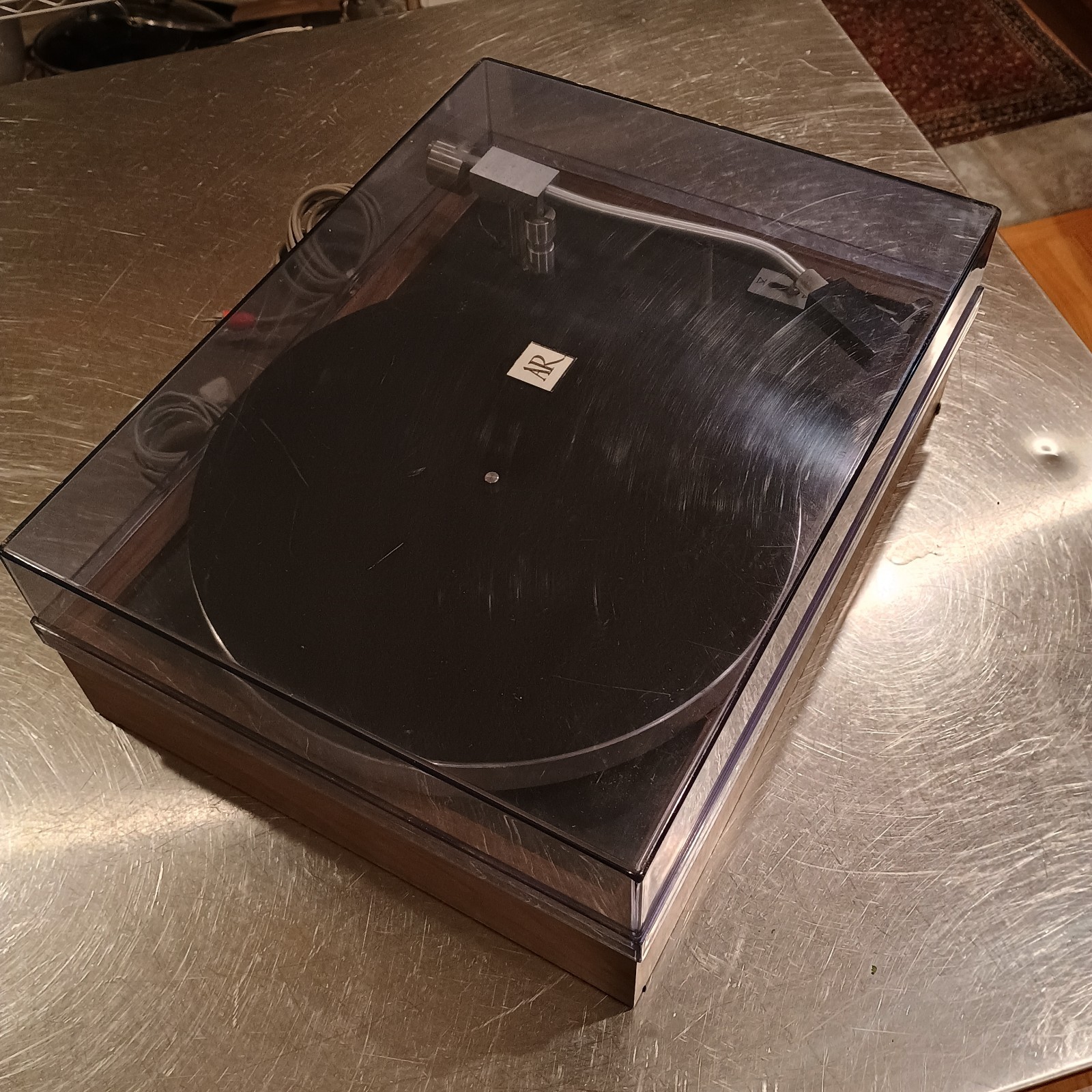
Visually, it’s all brushed aluminum logo badges, black textured metal top plate, and a vinyl-wrapped plywood base that says “serious audio” without screaming it. The power switch and cueing lever sit under that iconic AR badge—brushed steel or aluminum, depending on the batch—and the whole thing feels industrial but not cold. It’s the kind of turntable that would look at home in a wood-paneled rec room or a dorm basement, equally at ease with a stack of Motown 45s or a crate of early Zeppelin pressings. And while it lacks the cult status of the XA, the XB91 has quietly gained respect among collectors who actually use their gear. It’s not a museum piece—it’s a workhorse.
Specifications
| Manufacturer | Acoustic Research |
| Production Years | 1972–1977 |
| Original Price | $185 (with Shure M91ED cartridge) |
| Drive Type | Belt drive |
| Platter | Suspended aluminum platter, 3.9 lbs (1.8 kg), oil-damped bearing |
| Tonearm | 12" S-shaped tonearm, oil-damped pivot, cueing lever |
| Cartridge | Shure M91ED (factory installed) |
| Headshell | Black plastic with brass inserts |
| Counterweight | Stainless steel |
| Motor | AC synchronous motor, 110–120V, 60 Hz |
| Speeds | 33⅓, 45 RPM |
| Wow and Flutter | Less than 0.25% (weighted, per XA specifications) |
| Rumble | Better than 60 dB (per XA specifications) |
| Base Finish | Vinyl walnut-look veneer |
| Plinth Finish | Textured black metal |
| Power Switch | Rocker switch on right side |
| Dimensions | 16.5" × 5.5" × 14" (W×H×D) |
| Weight | Approx. 12 lbs (5.4 kg) |
Key Features
Suspended Subchassis and Oil-Damped Platter
The heart of the XB91’s performance lies in its isolation system. The entire platter and tonearm assembly rides on a subchassis suspended by three damped springs, decoupling it from the outer plinth. This wasn’t just marketing—it worked. In an era when many turntables transmitted motor noise and floor vibrations straight into the stylus, the XB91’s design kept rumble low and tracking stable. The aluminum platter, weighing in at nearly four pounds, rotates on an oil-damped bearing, contributing to speed stability and inertia. Belt drive further isolates the platter from motor jitter. Together, these elements create a playback platform that’s remarkably free of coloration. It won’t outperform a modern $2,000 turntable, but for its time and price, it delivered performance that punched above its weight.
Factory-Installed Shure M91ED
The “91” in XB91 isn’t arbitrary—it denotes the inclusion of the Shure M91ED cartridge, a moving magnet design known for its high compliance, low distortion, and excellent tracking ability. At a time when many mid-tier turntables shipped with generic, low-output cartridges, AR’s decision to bundle the M91ED was a statement. It meant buyers didn’t need to upgrade immediately to get good sound. The M91ED tracks at around 1.5 grams, works well with the XB91’s tonearm, and delivers a balanced, detailed sound with a slight warmth in the lower mids—perfect for vintage vinyl. It’s also a serviceable cartridge today; styli are still available, and recapping the internal coils can restore it to near-new performance. For many owners, it’s the ideal “set and forget” cartridge that still holds its own against modern budget MM offerings.
Simple, Functional Design
There’s no auto-return, no electronic speed control, no fancy feet or fancy platter mats—just a turntable that does what it needs to do. The rocker power switch and cueing lever are tactile and reliable. The metal tonearm rest feels solid, not like the flimsy plastic found on lesser decks. The base, while vinyl-wrapped, is structurally sound, and the black metal top plate resists warping. It’s a design that prioritizes function over form, but not at the expense of quality. Everything feels like it was engineered, not assembled. And while it lacks the minimalist elegance of the XA, the XB91 feels more substantial, more “finished.” It’s the difference between a prototype and a production model—still simple, but with the rough edges sanded down.
Historical Context
The early 1970s were a turning point for home audio. Stereo was no longer a luxury—it was mainstream. Consumers wanted better sound, but not at exotic prices. AR, already famous for its acoustic suspension speakers, had struck gold with the XA turntable in 1961, proving that a well-engineered, affordable turntable could compete with high-end gear. By 1972, the XA was aging, and competitors like Technics were pushing direct-drive designs. AR responded with the XB, a slightly more refined version of the XA with a better arm and updated aesthetics. The XB91 followed as a premium variant, targeting buyers who wanted a complete, high-performance package out of the box.
It wasn’t alone in the market. The Technics SL-1200 was gaining traction in DJ circles, and Thorens was still the choice for purists. But in the U.S. retail space—Sears, audio chains, department stores—the XB91 held its own. It competed with models like the Dual 1019 and the Garrard CB-100, offering better isolation than the Dual and more modern styling than the Garrard. It wasn’t the most advanced turntable of its time, but it was one of the most sensible. It represented a philosophy: good engineering, honest materials, no gimmicks. And while AR would eventually be eclipsed by Japanese brands, the XB91 remains a testament to American hi-fi’s golden age—when innovation wasn’t just about specs, but about accessibility.
Collectibility & Value
Today, the AR XB91 trades in a quiet, steady market. It’s not a unicorn, but it’s not common either. A fully functional XB91 in good cosmetic condition typically sells for $250–$400, with mint, all-original examples reaching $500 if they come with the dust cover and original packaging. The presence of the Shure M91ED adds value—replacing it with a new cartridge would cost nearly as much as the turntable itself. Units missing the cartridge or with worn belts and dried oil bearings are often sold for parts or restoration projects, fetching $100–$150.
Common failures are predictable: the rubber drive belt perishes over time, leading to speed instability or failure to start. Belts are readily available and easy to replace. More serious is the oil in the platter bearing drying out or becoming gummy, which can cause rumble or binding. This requires disassembly and re-oiling—doable by a skilled hobbyist or technician, but not trivial. The tonearm wiring can also degrade, especially at the pivot point, leading to intermittent channels. This is repairable but requires careful soldering.
When buying, check for a smooth, wobble-free platter rotation and consistent speed (use a strobe if possible). Test the cueing mechanism—it should lower and lift the arm smoothly. Inspect the cartridge: if the stylus is worn or missing, factor in the cost of replacement. Look for cracks in the vinyl base or warping in the metal plinth. And always ask if the belt has been replaced recently—this is the single most common point of failure.
Restoration is straightforward and affordable. A full service—belt replacement, bearing cleaning, tonearm inspection, and cartridge check—runs $100–$150 at a competent shop. For that investment, you get a turntable that sounds remarkably modern: quiet, stable, and musically engaging. It won’t rival a restored Thorens or a modern Rega, but it will outperform most budget belt-drive turntables sold today. And unlike many vintage decks, the XB91 wasn’t overproduced, wasn’t poorly maintained, and wasn’t discarded. Many still work, and those that don’t are worth fixing.
eBay Listings


As an eBay Partner, we earn from qualifying purchases. This helps support our independent vintage technology research.