AR XA (1961–1970s)
The turntable that redefined what affordable high fidelity could sound like—simple, isolated, and shockingly effective.
Overview
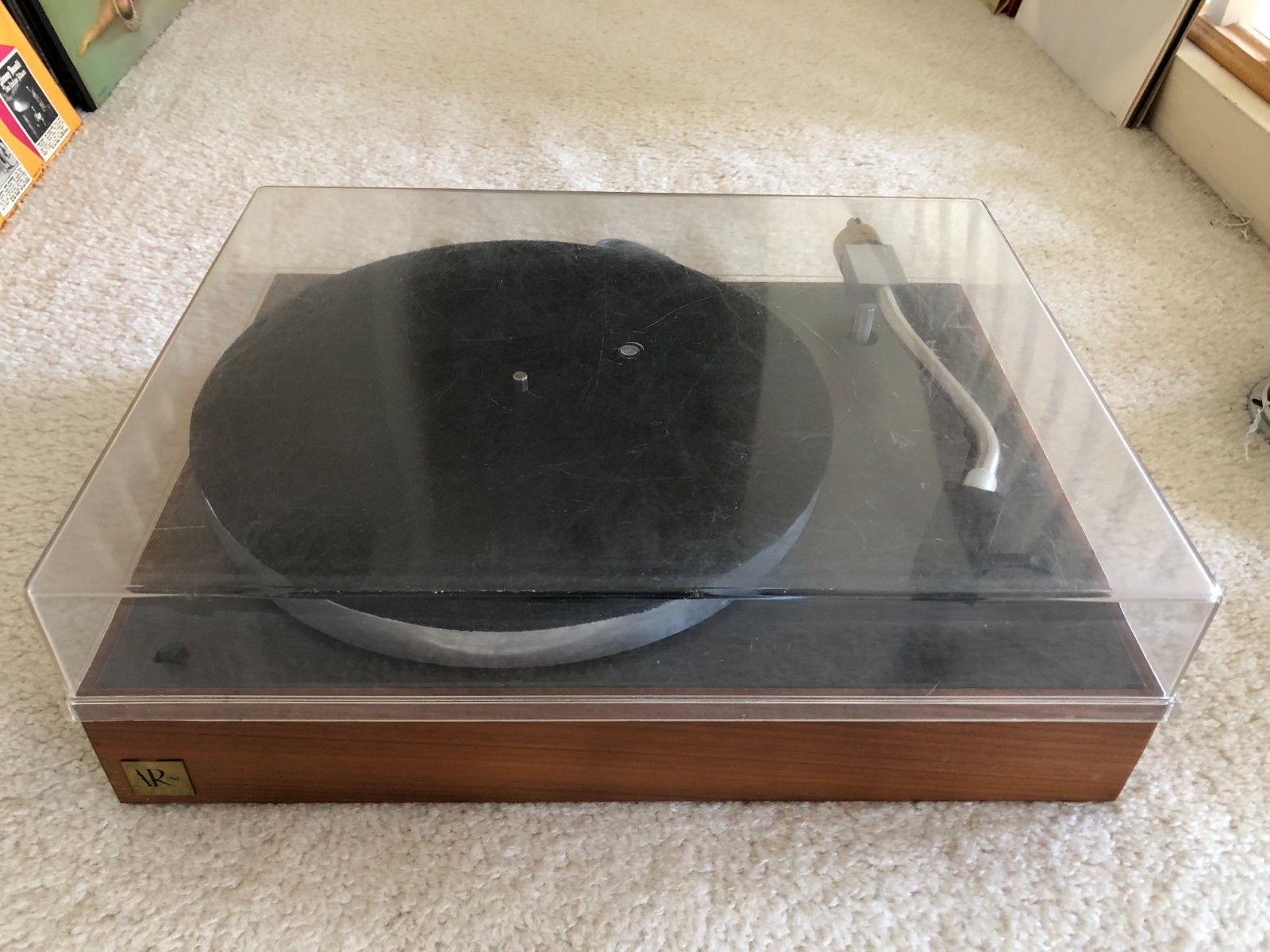
You can still find them in basements and attic clearances, tucked under dusty sheets in thrift stores or listed on eBay with vague descriptions like “old record player, works okay.” But when you lift the dust cover and see that minimalist plinth, the T-bar subchassis suspended on three damped springs, and the clean aluminum platter sitting like a silver disc on a cloud, you know you’re looking at something that changed everything. The AR XA didn’t just enter the hi-fi scene in 1961—it detonated it. At $58, it undercut the competition by hundreds of dollars, yet delivered performance that reviewers at the time called revelatory. No more rumble masking the quiet passages of a jazz trio. No motor noise bleeding into the left channel. Just music, clean and uncolored, floating above a silent background.
That silence wasn’t accidental. Edgar Villchur, the mind behind Acoustic Research’s legendary acoustic suspension speakers, applied the same obsessive attention to mechanical isolation here. He understood that a turntable isn’t just a record spinner—it’s a microphonic instrument, where every vibration, every footfall, every resonance from the speakers themselves could smear the groove’s information. So he decoupled the business end—the platter and tonearm—from the base using a three-point spring suspension system, a concept so effective that AR reps would famously demonstrate it by thumping the top plate with a hammer while the needle stayed locked in the groove. The motor? Mounted on the top plate, driving the platter via a belt, so its vibrations never reached the delicate playback assembly. The platter itself was lightweight—just 3.3 pounds of aluminum—spun by a low-torque synchronous motor that ran at subsonic rumble levels. No massive flywheel, no over-engineered motor, just precision timing and elegant physics.
It wasn’t perfect. The stock tonearm, while functional, was basic—no antiskating, minimal adjustability, and built with Delrin components that, over time, would seize up or bind. Speed changes meant manually shifting the belt between pulley steps. And early models came with two motors: one to start the main motor in the correct direction, a clever but ultimately unnecessary solution that was phased out. But none of that mattered to the thousands who bought it. For the first time, a true high-fidelity turntable wasn’t something you had to build from a kit or commission from a boutique manufacturer. It came in a box, ready to play, and it sounded better than most anything else under $300.
Specifications
| Manufacturer | Acoustic Research |
| Production Years | 1961–1970s |
| Original Price | $58 (1961), later raised to $78–$90 |
| Turntable Type | Belt-drive, suspended subchassis |
| Platter Weight | 3.3 lbs (1.5 kg) |
| Platter Material | Two-piece aluminum |
| Motor Type | Synchronous AC (single or dual motor in early versions) |
| Drive System | Flat belt |
| Rumble | –65 dB (A-weighted), subsonic 5 Hz |
| Wow and Flutter | Better than 0.1% (weighted) |
| Speeds | 33⅓, 45 RPM (manually selected via belt position) |
| Tonearm | Fixed-pivot, 9" effective length |
| Overhang | Adjustable via sliding base |
| Tracking Force | Adjustable via counterweight, 0–3 grams |
| Antiskating | None (recommended to increase tracking force by 15%) |
| Cartridge Compatibility | Standard ½" mount (Shure, Pickering, Ortofon, etc.) |
| Signal Cable | Fixed, low-mass stranded wire |
| Dimensions (W×D×H) | 15.5" × 5.5" × 4.5" |
| Weight | 5 lbs (2.3 kg) |
| Power Supply | 110–120 VAC, 60 Hz (50 Hz versions available) |
Key Features
A Suspended Subchassis That Actually Works
The genius of the XA wasn’t in complexity—it was in ruthless simplicity. The entire playback assembly—the tonearm and platter—was mounted to a rigid bearing plate, which hung from the top plate on three damped springs. This wasn’t just a vibration-absorbing gimmick; it was a tuned system with a resonant frequency so low (around 3–4 Hz) that it effectively decoupled the platter from every common source of mechanical noise. Footsteps, speaker cabinet vibrations, even someone setting a glass down nearby—none of it made it to the stylus. This isolation was so effective that it became the blueprint for nearly every high-end turntable that followed, from the Linn LP12 to the Thorens TD-150. And unlike some later suspended designs that felt overly soft or “floppy,” the XA’s system was taut and controlled, providing stability without sacrificing responsiveness.
Belt Drive Before It Was Cool
In 1961, most turntables were idler-wheel or direct-drive designs, both of which transmitted motor noise directly into the platter. The XA’s belt drive was revolutionary not because it was new—some broadcast decks used it—but because AR made it accessible. The motor, a low-power synchronous type, ran quietly and consistently, with speed accuracy derived from the AC line frequency. The belt itself was precision-ground rubber, thin and flexible, designed to absorb motor cogging and deliver smooth rotation. Early adopters noticed immediately: records sounded quieter, with deeper blacks between notes and a clarity that exposed the limitations of their amplifiers and speakers. The trade-off? A lightweight platter with minimal flywheel effect. But because the motor speed was so stable, the lack of mass didn’t hurt performance—quite the opposite. Speed consistency was excellent, and wow and flutter were among the lowest in its class.
The Minimalist Interface
There was no pitch control. No electronic speed selector. No cueing lever. Just an on/off switch and a felt pad to damp the platter. You changed speeds by lifting the belt and moving it to the appropriate step on the pulley—a process that took ten seconds but ensured you knew exactly what was happening. The tonearm had no antiskating mechanism, a deliberate omission by Villchur, who believed that properly aligned cartridges with adequate tracking force didn’t need it. Instead, the manual suggested increasing tracking force by 15% to compensate. Purists loved it. Tinkerers hated it. But the result was a turntable that did one thing superbly: keep the stylus in the groove, undisturbed.
Historical Context
The AR XA arrived at a moment when high fidelity was still a niche pursuit, dominated by expensive, hand-built European components or bulky American consoles. Most turntables were either record changers with poor tracking or professional broadcast decks that cost a small fortune. The XA shattered that dichotomy. It was designed for the growing middle-class audiophile—someone who wanted serious sound without selling a kidney. And it worked. AR sold hundreds of thousands of units, making it one of the most widely owned high-fidelity turntables of its era.
Its influence was immediate. The suspended subchassis concept, once considered radical, became standard in mid- to high-end designs. The belt-drive layout was copied endlessly. Even companies like Linn and Thorens, who would later dominate the high-end market, owed a debt to Villchur’s vision. The Museum of Modern Art recognized its industrial design significance by adding it to their permanent collection—a rare honor for consumer audio gear. By the time the XB replaced it in the 1970s (adding cueing and a redesigned dust cover), the XA had already cemented its legacy. It wasn’t just a product; it was a proof of concept that good sound didn’t have to be complicated or expensive.
Collectibility & Value
Today, the AR XA is both common and rare—common in that tens of thousands were made, rare in that few survived in original, unmodified condition. Prices reflect this duality. A project unit with seized bearings and frayed wiring might go for $50. A fully restored XA, with new motor, upgraded power cable, and recalibrated suspension, can fetch $250–$400. Mint-in-box examples, especially with original accessories like the stylus force gauge or dust bug, have sold for over $500.
But buying one requires caution. The early models used Delrin plastic for the platter bearing well and tonearm post—material that degrades over time, absorbing moisture and expanding, leading to seized bearings. Every vintage XA should be inspected for this. If the platter doesn’t spin freely or the arm binds, assume a full teardown is needed. The original wiring, especially the delicate tonearm leads, is prone to breakage—repairable, but fiddly. The motor, while generally reliable, can lose torque or hum if not cleaned and lubricated.
Restoration is a well-trodden path. Companies like Vinyl Nirvana specialize in servicing XAs, and the “Merrill Mods”—after audio technician Merrill Bergmann—remain popular: upgraded motors, acrylic platter mats, improved power supplies, and even full rewiring. Some owners replace the arm with a Rega 2400 or SME 3009, though purists argue that the stock arm, when properly set up, performs admirably with modern cartridges like the Ortofon OM5 or Shure M97xE.
The one design choice that still sparks debate? The dust cover. Early XAs were designed to be used without it—Villchur believed any cover could resonate and degrade sound. Later owners added “dust bugs,” brush-like cleaners that rode across the record during play. If you see a pedestal-mounted cleaner on an XA, that’s why. The XB fixed this by allowing cover use during playback, but many argue it was a step backward in performance.
eBay Listings

As an eBay Partner, we earn from qualifying purchases. This helps support our independent vintage technology research.