AR AR-91 (1979–1980s)
The moment you hear deep, articulate bass from a sealed box this size, you understand why some swear by AR’s late-era engineering.
Overview
You don’t just hear an AR-91—you feel it settle into the room. It doesn’t shout, but when fed the right power, it fills space with a coherence that few floorstanders of the late '70s could match. Standing nearly three feet tall with a warm walnut finish that catches the light just right, the AR-91 looks like a serious speaker, and it demands to be taken seriously. It’s not flashy, but there’s a quiet confidence in its proportions, a sense that it was built for longevity, not trendiness. This was Acoustic Research’s answer to the evolving high-fidelity market—a 3-way acoustic suspension design that carried the torch from the legendary AR-3a but aimed for broader accessibility without sacrificing too much of the magic.
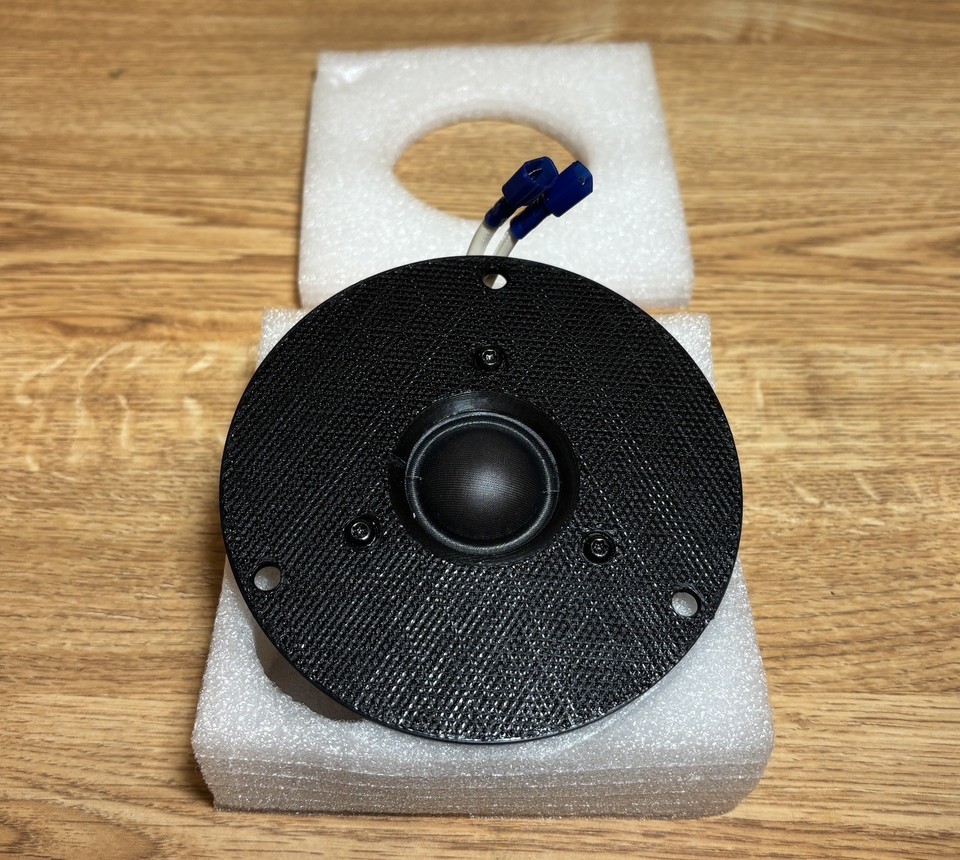
Under the skin, the AR-91 is a direct descendant of AR’s research-driven philosophy. The 30 cm (12-inch) cone woofer dominates the low end, working within a fully sealed 46.8-liter cabinet that leverages air compliance for tight, controlled bass response down to 35 Hz (-3dB). That’s impressive for a speaker that doesn’t rely on porting or passive radiators. The midrange is handled by a 3.8 cm (1.5-inch) dome unit, paired with a 1.9 cm (0.75-inch) dome tweeter above—both components shared with the more expensive AR-9 series, a detail not lost on purists. The crossover network, designed with input from NASA-inspired engineering (specifically, material placed between the voice coil and yoke to reduce off-axis movement), aims to minimize distortion and maintain linear response. Air-core inductors, computer-grade capacitors, and non-inductive resistors were used throughout—a thoughtful parts selection for the era, especially at its price point.
But here’s the catch: the AR-91 is a power hog. It’s rated at 87 dB/W/m sensitivity, which is modest, and presents a 4-ohm nominal load with a minimum dip to 3.2 ohms. That means it doesn’t just want wattage—it demands current. Owners consistently report that the speaker stays closed-in and “muddy” with underpowered or low-current amplifiers. One user noted that a Denon rated at 55 watts per channel left the AR-91 sounding flat, while a 300-watt-per-channel high-current amp transformed it into something “like the king of rock and roll.” Another confirmed the transformation when upgrading from a Kenwood KR-7400 to a McIntosh C2205—the sound opened up, gaining depth, clarity, and dynamic punch. This isn’t a speaker for passive listening; it rewards amplification that can drive it hard and clean.
Despite its technical lineage, the AR-91 never quite achieved the mythic status of the AR-3a. It arrived during a transitional period for Acoustic Research, when the company was navigating shifts in ownership and market expectations. Still, among those who’ve lived with them, the AR-91 has quietly earned respect. Some even argue it’s the definitive AR three-way, benefiting from the same midrange and tweeter technology as the AR-9 while offering a more practical footprint than the massive AR-3a. It’s not a relic—it’s a fully realized expression of AR’s acoustic suspension philosophy at a moment when the company still prioritized measured performance over mass-market appeal.
Specifications
| Manufacturer | Acoustic Research (AR) |
| Production Years | 1979–1980s |
| Original Price | ¥158,000 (Japan, ~1980, per unit) |
| Model Type | 3-way, 3-speaker, acoustic suspension, floorstanding |
| Woofer | 30 cm (12-inch) cone type |
| Midrange | 3.8 cm (1.5-inch) dome type |
| Tweeter | 1.9 cm (0.75-inch) dome type |
| Frequency Response | 27 Hz – 30 kHz |
| Low-Frequency Response | 35 Hz (-3dB) |
| System Q | 0.6 |
| Output Sound Pressure Level | 87 dB/W/m |
| Nominal Impedance | 4 Ω |
| Minimum Impedance | 3.2 Ω |
| Continuous Maximum Input | 125 W |
| Peak Input Power | 300 W |
| Crossover Frequencies | 700 Hz, 7.5 kHz |
| Level Controls | 3-step switchable for midrange and high frequency |
| Internal Volume | 46.8 L |
| External Dimensions | 356 mm (W) × 800 mm (H) × 290 mm (D) |
| Weight | 24 kg (52.9 lbs) per speaker |
Key Features
The Acoustic Suspension Legacy
The AR-91 carries the DNA of Edgar Villchur’s revolutionary 1954 acoustic suspension design—the sealed cabinet that uses trapped air as a spring to control cone movement. Unlike ported designs that can boom or overhang, the AR-91 delivers bass that’s tight, accurate, and free of resonance artifacts. That sealed-box discipline means it doesn’t need to be placed against a wall to sound full; in fact, it’s designed to perform well in open space, with crossover tuning that accounts for 180-degree front radiation. This makes it unusually flexible for a speaker of its era—equally at home in a dedicated listening room or a large living space. The 46.8-liter cabinet volume is carefully calculated to optimize the 12-inch woofer’s excursion and damping, achieving deep bass without sacrificing transient response. It’s a design that favors precision over sheer volume, but when properly powered, it surprises with both authority and finesse.
High-Current Demands and Amplifier Synergy
The AR-91 doesn’t just want power—it wants high-current amplification. Its 4-ohm load and low impedance dips mean that amplifiers with weak current delivery will struggle, resulting in flabby bass and compressed dynamics. This isn’t a speaker for vintage receivers with 20–50 watt ratings unless they’re known for robust output stages (think McIntosh, Harman Kardon Citation series, or high-end Sansui). Solid-state amps with large power supplies or tube amps with output transformers designed for low impedance perform best. The payoff is significant: when driven properly, the AR-91 reveals a three-dimensional soundstage, with instruments placed distinctly in space and bass that’s both deep and articulate. It’s not uncommon for owners to describe the transformation as “night and day” when upgrading from marginal to capable amplification. This dependency on amp quality is both a limitation and a strength—it forces the listener to build a system, not just plug in a pair of speakers.
Crossover Design and Sonic Tuning
The crossover is where the AR-91’s engineering ambition becomes tangible. Using air-core inductors (which avoid magnetic saturation), computer-grade electrolytic capacitors (still found in good condition after 40 years in some units), and non-inductive ceramic resistors, the network is built for longevity and low distortion. The dual 3-step level controls for midrange and treble allow fine-tuning to room acoustics or listener preference—rare in factory speakers of this era. Owners report that adjusting these can dramatically improve integration, especially in reflective or overly dampened rooms. The 700 Hz and 7.5 kHz crossover points are carefully chosen to keep the midrange dome driver out of the upper bass muddiness and to let the tweeter operate within its most linear range. Combined with the acoustic blanket lining the cabinet—designed to absorb internal reflections—the result is a speaker that avoids the boxy coloration that plagues many sealed designs.
Historical Context
The AR-91 emerged in 1979, a time when Acoustic Research was still riding the reputation of its golden era but facing increasing competition from both domestic and Japanese manufacturers. The AR-3a had set a benchmark in the 1960s, but by the late '70s, companies like JBL, Klipsch, and Advent were offering dynamic, ported designs that measured louder and sold cheaper. AR responded with a tiered lineup: the AR-9 as the new flagship, the AR-3a in gradual phaseout, and the AR-91 as a more accessible alternative that still leveraged the same midrange and tweeter technology. It was a strategic move—offering near-flagship performance in a slightly more compact, less expensive package.
This was also the dawn of the “high-power” amplifier era. Solid-state amps were now delivering 100+ watts per channel, and speaker designs were adapting. The AR-91’s appetite for current reflects that shift—it was engineered to thrive in a world where amplifiers were becoming more robust. Yet it remained true to AR’s measured, natural sound philosophy, avoiding the hyped highs and boosted bass of some contemporaries. Compared to the JBL L110, a popular competitor, the AR-91 trades some immediacy for greater tonal accuracy and bass control. One owner noted that while the JBL grabs attention, the AR-91 “reveals more detail over time.” It wasn’t the flashiest speaker on the floor, but it was built for long-term listening, not showroom impact.
Collectibility & Value
Today, the AR-91 occupies a quiet niche in the vintage speaker market. It’s not as sought-after as the AR-3a or AR-4, but it’s respected among those who know its potential. Pairs in good cosmetic condition with original grilles and unmodified crossovers typically sell between $400 and $800, depending on region and local demand. Fully restored units—refoamed, recapped, and professionally serviced—can fetch $1,000 or more, especially if paired with original documentation or rare finishes.
The biggest threat to longevity is foam degradation. The original foam surrounds on the 12-inch woofers typically disintegrate after 40+ years, leading to flapping cones and distorted bass. Refoaming is a common and necessary restoration step, with kits readily available. While some owners report success doing it themselves, misalignment or poor adhesion can ruin the driver’s performance. Service technicians observe that the midrange and tweeter domes are more durable, but their foam rings can also degrade, so a full refoam is often recommended.
Crossover capacitors are another concern. While the “computer-grade” electrolytics were high-quality for their time, they still age. Symptoms of failing caps include dull highs, weak bass, or imbalance between drivers. Recapping the crossover—especially the midrange and tweeter sections—is a standard part of any serious restoration. Labor and parts typically run $150–$300 per speaker if done professionally.
Buyers should inspect for cabinet damage, especially at the base where the weight concentrates. The walnut veneer is durable but can show wear on edges. Original grilles are a plus—many were discarded over the years. When testing, listen for buzzing or rattling at moderate volumes, which may indicate loose drivers or internal bracing. Most importantly: don’t judge the sound on a weak amp. A poor audition with an underpowered receiver will misrepresent the speaker entirely. If possible, ask the seller about amplifier history—knowing it was driven by a high-current amp adds confidence.
eBay Listings


As an eBay Partner, we earn from qualifying purchases. This helps support our independent vintage technology research.
Service Manuals & Schematics
- Manual (1794) — archive.org
- Manual (1900) — archive.org