Acoustic Research AR-9 (1978–1982)
The kind of speaker that makes you forget you're listening to hi-fi—until you walk into the next room and realize the bass is still shaking the floor.
Overview
You don’t just hear an AR-9—you feel it in your ribs, your spine, the way it pushes air like a slow, controlled tide. Standing over four feet tall and weighing in at nearly 130 pounds, this isn’t a speaker you casually tuck into a corner. It’s a statement, a piece of acoustic architecture built during the twilight of Acoustic Research’s golden era, when the company was still under Teledyne ownership but hadn’t yet faded into the licensing purgatory that would define its later years. The AR-9 arrived in 1978 as the last true flagship of the AR lineage before the brand’s identity began to blur, and it carried the torch with a rare blend of scientific rigor and sonic grace.
What sets the AR-9 apart isn’t just its size or complexity—it’s the obsessive engineering that went into making it disappear sonically. With two 12-inch acoustic suspension woofers mounted on the sides of the cabinet, AR tackled the “wall dip” problem head-on: that frustrating cancellation of bass energy caused by boundary reflections. By placing the woofers near the floor and flanking the enclosure, they pushed the interference zone up above 500 Hz—well out of the bass range—so the low end could breathe. The result? A system that achieves -3 dB at 28 Hz with a Q of just 0.5, meaning tight, controlled, and deeply extended bass that doesn’t boom or ring. Julian Hirsch, the dean of audio measurement, called it “the widest and flattest frequency-response curve we have yet obtained from a speaker system,” and that wasn’t marketing fluff—it was lab data.
But the AR-9 isn’t just about bass. Its four-way design stacks an 8-inch lower-midrange driver, a 1.5-inch liquid-cooled soft-dome upper-mid, and a 0.75-inch liquid-cooled tweeter in a vertical array, all wrapped in what AR called the “Acoustic Blanket”—a felt-and-foam baffle treatment patented to absorb internal reflections and diffraction. This wasn’t just cosmetic; it was a direct result of early digital impulse testing done on a DEC PDP-11/40 minicomputer, one of the first uses of computer modeling in loudspeaker development. Engineers James Kates and Robert Berkovitz used it to map out how sound waves bounced around the cabinet, then designed the blanket to smooth out the response. The payoff is a midrange so clean and transparent that vocals sound unnervingly present, like the singer is in the room but just out of sight.
Still, the AR-9 isn’t for everyone. Its 4-ohm nominal impedance (dipping to 3.2 ohms) and 87 dB sensitivity mean it demands a strong amplifier—one that can deliver current without flinching. It’s not the kind of speaker that rewards bright, forward electronics; it wants tube warmth or a solid-state amp with deep reserves. And while its vertical dispersion is excellent, it needs space—side-to-side and front-to-back—to breathe. In a small room, it can overwhelm. But in the right environment, with the right gear, it doesn’t just play music—it suspends disbelief.
Specifications
| Manufacturer | Acoustic Research |
| Production Years | 1978–1982 |
| Original Price | $1,800 per pair (1978) |
| System Type | Floor-standing, 4-way, 5-driver |
| Bass Drivers | 2 x 30 cm (12") acoustic suspension woofers |
| Low Midrange Driver | 1 x 20 cm (8") cone in sealed sub-enclosure |
| High Midrange Driver | 1 x 3.8 cm (1.5") liquid-cooled soft-dome |
| Tweeter | 1 x 1.9 cm (0.75") liquid-cooled dome |
| Frequency Response | 18 Hz – 30 kHz (-3 dB) |
| Efficiency | 87 dB SPL (1W, 1m, on-axis) |
| Power Handling | 400W peak (10% duty cycle), 175W DIN continuous, 275W DIN max |
| Nominal Impedance | 4 ohms |
| Minimum Impedance | 3.2 ohms |
| Crossover Frequencies | 200 Hz, 1,200 Hz, 7,000 Hz |
| Crossover Network | LC filters with air-core chokes, computer-grade capacitors, non-inductive resistors; includes bass extension and impedance equalization |
| Cabinet Finish | Oiled walnut veneer |
| Cabinet Volume | 120 liters (4.24 cu ft) |
| Dimensions (H×W×D) | 134 × 38 × 40.2 cm (52.75 × 15 × 15.8 in) |
| Weight | 59 kg (130 lbs) per speaker |
Key Features
The Side-Firing Woofer Solution
Mounting two 12-inch woofers on the sides of the cabinet wasn’t just a styling choice—it was a calculated acoustic maneuver. By positioning the bass drivers near the floor and away from the front baffle, AR minimized early reflections that interfere with bass clarity. The larger 120-liter cabinet (nearly three times the volume of the AR-3a) allowed for lower system resonance and greater output, while the dual-woofer setup doubled the radiating surface. The crossover includes an LCR circuit that boosts output by 6 dB at resonance to counteract the natural roll-off of a critically damped system. The result is bass that’s deep, articulate, and free of the “one-note” bloat that plagued many floorstanders of the era.
Liquid-Cooled High-Frequency Drivers
At a time when most tweeters were passive and prone to thermal compression, AR went radical: both the 1.5-inch upper-mid and 0.75-inch tweeter used liquid cooling to dissipate heat from the voice coils. This wasn’t just overkill—it allowed sustained high-volume playback without distortion or power compression. The upper-mid also features a “semi-horn” top plate that improves loading between 3 kHz and 7 kHz, extending response and reducing breakup. Combined with the vertical array, this setup delivers a coherent wavefront that minimizes lobing and creates a stable, three-dimensional soundstage.
The Acoustic Blanket and Computer-Aided Design
Before digital modeling became standard, AR was already using a PDP-11/40 minicomputer to analyze impulse response and diffraction patterns. This research led directly to the “Acoustic Blanket”—a felt-and-foam pad covering the baffle around the mid and high drivers. It’s not just padding; it absorbs short-wavelength reflections that cause phase anomalies and small response ripples. The effect is a smoother on-axis and off-axis response, especially in the critical 2–8 kHz range where the ear is most sensitive. This was one of the earliest practical applications of computer-aided loudspeaker design, predating modern tools like Klippel and LEAP by over a decade.
Historical Context
The AR-9 emerged at a turning point. The 1970s had seen AR’s dominance wane as competitors like JBL, Infinity, and Advent introduced more colorful, dynamic designs that appealed to a broader market. The AR-3a, once the benchmark for transparent sound, was aging. AR needed a flagship that could reclaim its engineering crown—and the AR-9 was it. Designed under Tim Holl and influenced by Roy Allison’s boundary-loading research, the AR-9 represented the peak of AR’s in-house innovation. It wasn’t just a bigger AR-3a; it was a complete rethinking of how a speaker interacts with a room.
The late 1970s also saw the rise of quadraphonic sound and early home theater concepts, and AR briefly explored a quad-amped version of the AR-9 with Ken Kantor, who later helped design the legendary NAD 3020. That amplifier, derived from the AR-9’s intended drive electronics, would go on to become one of the best-selling integrated amps in history—ironic, given that the AR-9 itself remained a niche product due to its price and power demands. By the mid-1980s, AR would be sold off, rebranded, and eventually reduced to licensing its name to budget electronics. The AR-9, then, stands as the last great original AR speaker before the brand’s long decline.
Collectibility & Value
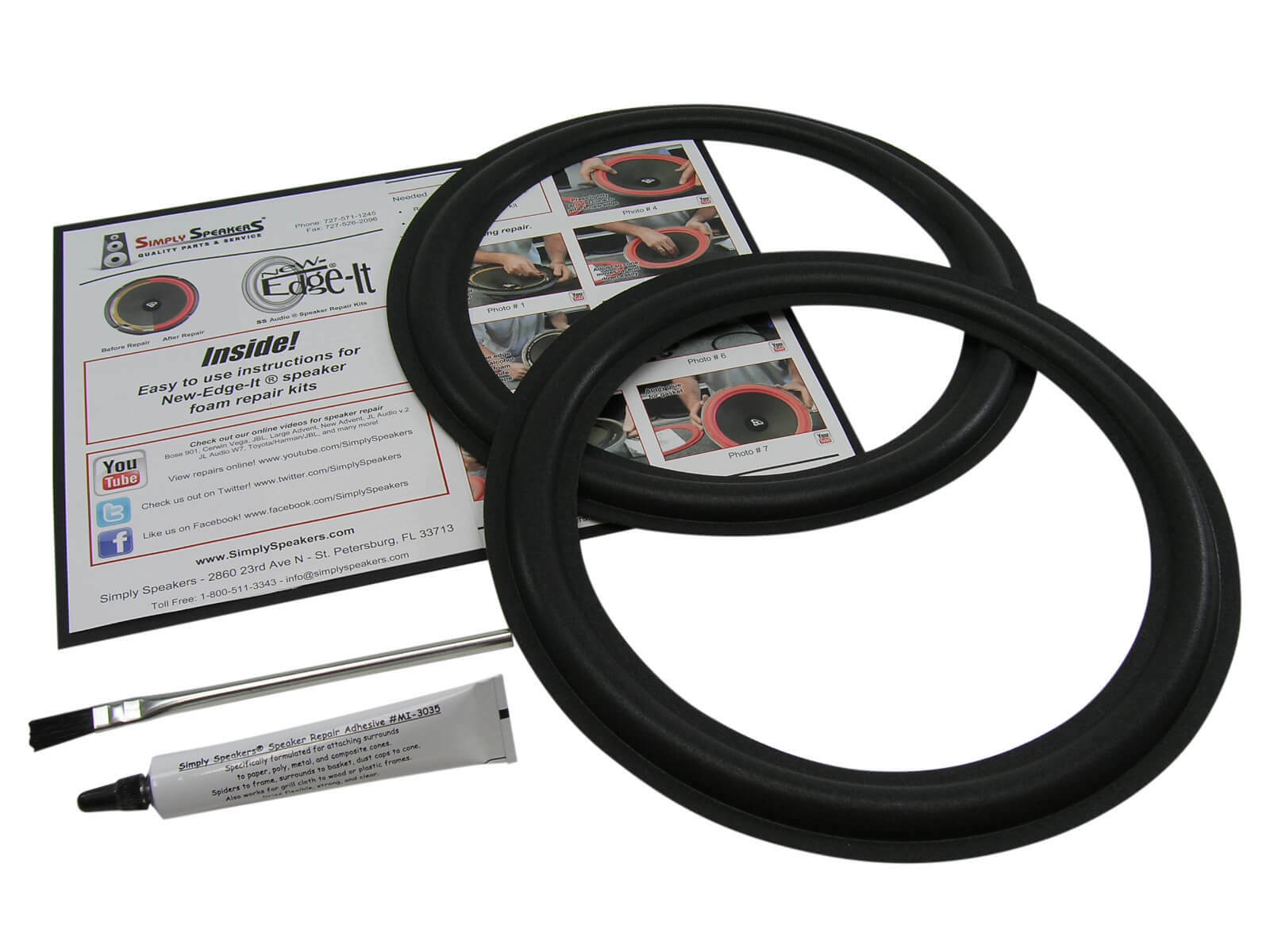
Today, the AR-9 is a prized relic among vintage audio collectors, but it’s not without its challenges. Prices vary widely: a pair in excellent cosmetic and electrical condition with original drivers can fetch $3,000–$4,500, while tired examples with delaminated foam or damaged crossovers might go for $700–$1,200. The oiled walnut veneer is durable, but many cabinets show wear at the edges or have been poorly refinished. More critical are the internal components—especially the foam surrounds on the woofers and midrange drivers, which degrade over time and require refoaming. This isn’t a simple DIY job; the side-mounted woofers are difficult to access, and the crossover boards are heavy and complex, with air-core inductors and high-quality capacitors that can drift or fail.
Owners report that the liquid cooling in the high-frequency drivers is generally reliable, but the fluid can leak if the speakers are moved improperly or stored on their side. The three-position EQ switches on the rear panel—resistor networks for fine-tuning the upper-mid and tweeter output—should be checked for crackling or open circuits. Amplifier compatibility remains a real concern: while the AR-9 can sound magical with a high-current solid-state amp like a Mark Levinson ML-2 or a tube monoblock, it will expose any weakness in drive electronics. It’s not a speaker for beginners or those with modest gear.
If you’re hunting for a pair, check the serial numbers and match them to production records—some late units had minor component changes. And be wary of “cosmetic only” listings; these speakers need to be functional, not just pretty. A fully restored AR-9, with refoamed drivers, recapped crossovers, and verified performance, is a lifetime investment. It won’t appreciate like a mint Linn Sondek, but it will deliver a listening experience that few modern speakers can match—especially in the way it renders acoustic bass, piano, and orchestral music with authority and finesse.
eBay Listings


As an eBay Partner, we earn from qualifying purchases. This helps support our independent vintage technology research.