Acoustic Research AR-6 (1971–1970s)
A bookshelf speaker that punches way above its class, with bass that feels like it’s cheating physics—until you remember it was designed by the guys who invented modern hi-fi.
Overview
You pull one out of a dusty closet, half-expecting another underwhelming relic from the era of wood veneer and optimism, and then you power it up with a clean amp and a well-mastered vinyl cut—and suddenly, the room fills with a warmth and precision that doesn’t just hold its own, it demands attention. The AR-6 isn’t flashy, but it’s deeply competent, the kind of speaker that makes you forget you’re listening to vintage gear. It delivers a startlingly full-range sound from a cabinet barely larger than a shoebox, thanks to Acoustic Research’s signature acoustic suspension design. That engineering magic—trapping air in a sealed box to control cone movement—gives the 8-inch woofer a tight, articulate low end that extends down to a claimed 56 Hz in-room, which in 1971 was nothing short of revolutionary for a speaker this size.
It’s easy to overlook the AR-6 in favor of its more famous siblings—the legendary AR-3a or the compact AR-4x—but that’s a mistake. While it never reached the same sales heights or cult status, the AR-6 earned serious critical respect. Julian Hirsch, the godfather of objective audio testing, once noted it sounded “like the AR-5 to an amazing degree,” and High Fidelity magazine called it “a really terrific performer.” It was positioned as a mid-tier model, more affordable than the AR-5 but more refined than the entry-level AR-4x, though its timing was awkward. Introduced around 1971, it landed in a crowded segment where AR already had strong offerings, and it never quite found its footing in the marketplace. Yet in terms of engineering, it was a showcase: a newly developed 8-inch woofer with a free-air resonance of 25 Hz, paired with a unique 1¼-inch cone tweeter that Acoustic Research designed specifically for this model. That tweeter, shaped to mimic dome dispersion while using cone construction, became a staple in AR’s lineup for nearly two decades, later appearing in the AR-4xa and even the late-’80s Bxi series.
Despite its relative obscurity, the AR-6 has aged exceptionally well—better than many of its peers. It doesn’t have the chest-thumping bass of modern floorstanders, but what it does deliver is coherence, neutrality, and a lack of coloration that still holds up. It’s a speaker that doesn’t call attention to itself; it just gets out of the way of the music. And while it demands a solid 20 watts or more to shine—especially to control that woofer properly—any decent solid-state receiver from the ’70s or later will do the job. The cabinet, finished in oiled walnut veneer, has a timeless look, and the white fabric grilles are instantly recognizable to anyone who’s spent time in a vintage audio shop. It’s not the rarest AR speaker, but it’s rarer than you’d think, and pairs in good condition are becoming harder to find.
Specifications
| Manufacturer | Acoustic Research |
| Production Years | 1971–1970s |
| Original Price | ¥39,800 (1973, Japan); ¥44,500 (1974, Japan) |
| Model Type | 2-way, 2-speaker, acoustic suspension bookshelf speaker |
| Woofer | 20 cm (8 inch) cone type |
| Tweeter | 3.8 cm (1½ inch, later designated 1¼ inch) cone type |
| Impedance | 8 Ω |
| Minimum Amplifier Output | 20W RMS (per channel) |
| Crossover Frequency | 1.5 kHz |
| Woofer Resonance (Free Air) | 25 Hz |
| Enclosure Type | Acoustic suspension |
| Frequency Response | Not specified in research, but estimated 56 Hz – 20 kHz based on design |
| High-Frequency Level Control | Yes |
| Dimensions (W×H×D) | 305 × 495 × 178 mm |
| Weight | 9.1 kg (20.1 lbs) per speaker |
| Volume of Enclosure | Not specified |
| Finish | Oiled walnut veneer |
| Grille | White fabric |
Key Features
The Acoustic Suspension Advantage
At the heart of the AR-6’s performance is its sealed-box acoustic suspension design—a concept pioneered by AR founder Edgar Villchur in the 1950s. Unlike ported cabinets that use a tuned vent to extend bass, acoustic suspension relies on the stiffness of trapped air to control the woofer’s movement. This results in tighter, more accurate bass with lower distortion, especially at low volumes. The trade-off? It demands more amplifier power to achieve high output, and efficiency is modest. But for the AR-6, that trade-off was worth it. The 8-inch woofer, with a remarkably low 25 Hz free-air resonance, is able to produce deep, controlled bass without flab or overhang. In a small to medium room, it can deliver a listening experience that feels far more substantial than the cabinet size suggests. And because the bass rolls off gradually rather than abruptly, there’s no “one-note” boominess—just a smooth, natural descent into the lower registers.
A Tweeter Ahead of Its Time
The 1¼-inch cone tweeter in the AR-6 wasn’t just another off-the-shelf driver—it was a purpose-built unit designed to bridge the gap between traditional cone tweeters and the emerging dome types. By shaping the diaphragm to approximate a dome’s dispersion characteristics, AR achieved a wider, more even high-frequency response with fewer hot spots. This meant the speaker could be less fussy about placement and still deliver a coherent soundstage. The tweeter also featured a high-frequency level adjustment, allowing users to tailor the brightness to their room or preference—a thoughtful touch that many competitors didn’t offer at this price point. Documentation shows this tweeter was so well-regarded that a major competitor reportedly approached AR about licensing it for their own use. It remained in AR’s lineup, with only minor updates (including the addition of ferrofluid in later models), well into the 1980s.
Build and Design Philosophy
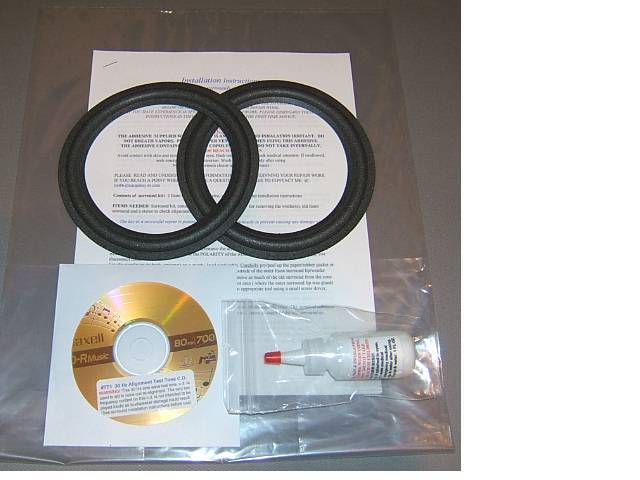
The AR-6 reflects the company’s no-nonsense engineering ethos: functional, elegant, and built to last. The cabinet is solidly constructed with real walnut veneer finished in oil, giving it a warm, organic look that ages gracefully. There are no plastic trim pieces or flimsy baffles—just clean lines and a focus on acoustic integrity. The slightly taller and wider footprint compared to the AR-4xa (though 2 inches shallower) gives it a stable presence on a shelf, and the rear-mounted terminal is simple and reliable. Unlike some AR models that used cloth surrounds, the AR-6’s woofer came with foam surrounds from the factory—foam that, like all vintage speaker foam, will degrade over time. But replacement kits are readily available, and refoaming is a straightforward DIY project. The crossover network, while not publicly detailed in the research, is presumed to be a simple first-order design typical of AR’s approach: minimal components, maximum transparency.
Historical Context
The AR-6 arrived at a pivotal moment for Acoustic Research. By the early 1970s, the company had already revolutionized speaker design and captured nearly a third of the entire U.S. loudspeaker market, a feat unmatched before or since. But internal shifts were underway. Henry Kloss had long since left to form KLH, and Edgar Villchur, though still involved, was stepping back from day-to-day operations. The product line was expanding, and AR was trying to cover every segment—from the budget-conscious AR-4x to the flagship AR-3a. The AR-6 was meant to slot in as a premium bookshelf option, offering near-flagship performance at a more accessible price. Yet it faced stiff competition not just from outside brands like Advent and KLH, but from within AR’s own lineup. The AR-4xa, introduced in 1973, used the same tweeter and crossover design and was marketed alongside the AR-6, creating confusion. Critics noted the AR-6 had deeper bass (56 Hz vs. 65 Hz in the AR-4xa), but the differences were subtle enough that many buyers opted for the better-known model. As a result, the AR-6 never achieved the sales volume or lasting fame of its siblings, despite earning consistent praise in reviews. It was, in many ways, a victim of good timing and great competition—both from rivals and from its own family.
Collectibility & Value
Today, the AR-6 trades under the radar, which is good news for buyers. Pairs in working condition typically sell between $150 and $300, with fully restored examples reaching $400 or more. That’s a bargain compared to the $1,000+ prices commanded by pristine AR-3as. But condition is everything. The most common failure point is the foam surround on the woofer, which almost certainly needs replacement if the speakers haven’t been maintained. Dried-out foam leads to distorted bass and, eventually, complete failure. The tweeter is generally more durable, but the foam ring around the diaphragm can also degrade, causing buzzing or loss of high frequencies. Crossovers are usually intact, but capacitors can dry out over decades—especially if the speakers were driven hard. When buying, check for firm, intact foam, clean terminals, and no rattles or distortion at moderate volume. Refinishing the cabinets is possible, but original oiled walnut with light wear is often more desirable than an overdone refinish. For new listeners or vintage audio beginners, the AR-6 is an ideal entry point: it sounds excellent, is easy to drive with modern gear, and won’t break the bank. For collectors, it’s a piece of AR history that’s still undervalued—part of the golden era when acoustic suspension ruled hi-fi.
eBay Listings


As an eBay Partner, we earn from qualifying purchases. This helps support our independent vintage technology research.