AR AR-4x (1965–1966)
The kind of speaker that makes you forget you're listening to vintage gear—until you lift one and realize your arms are on strike.
Overview
There’s a moment when you power up a pair of AR-4x speakers and hear that first clean, uncolored note—a cello bow catching string, a brush stroke on a snare—where you understand why people still hunt for these 60-year-old boxes. They don’t just play music; they unfold it, layer by layer, with a neutrality that feels almost surgical, yet never sterile. These are the bookshelf speakers that helped define high fidelity in the mid-60s, not with flash or hype, but with engineering rigor and a refusal to flatter. They’re compact enough to tuck on a shelf, but don’t let the size fool you: the 8-inch woofer in its acoustic suspension cabinet delivers bass you feel in your ribs, not just your ears. And that tweeter—2.5-inch cone, not dome—spreads high frequencies like butter, airy and diffuse, avoiding the "hot spot" effect that plagues so many contemporaries.
But here’s the catch: the AR-4x isn’t a speaker for everyone. It doesn’t punch you in the chest with bass like a modern ported design, nor does it sparkle with the etched brilliance of some metal-dome tweeters. Its magic lies in balance. The crossover, set at 1,600 Hz, is modest by today’s standards, but it’s executed with care—first-order slopes, minimal parts, nothing flashy. That simplicity means fewer failure points, though time still takes its toll on the capacitors. Owners report that when those caps go, the tweeters often go silent, not because the drivers failed, but because the signal path is broken. It’s a fixable issue, but one that’s nearly guaranteed if the speakers haven’t been serviced in decades. Still, when everything’s working, the result is a soundstage that feels wider than the room, with instruments placed precisely, not smeared. It’s the kind of clarity that makes you hear mistakes in recordings you’ve known for years—missed harmonies, tape hiss you never noticed, a cymbal that’s slightly out of time.
Specifications
| Manufacturer | Acoustic Research |
| Production Years | 1965–1966 |
| Original Price | $140–$200 (depending on condition at time of sale) |
| Drive Units | 8-inch acoustic suspension woofer, 2.5-inch cone tweeter |
| Crossover Frequency | 1,600 Hz |
| Impedance | 8 ohms nominal |
| Amplifier Power Handling | Up to 100 watts per channel |
| Frequency Response | Not specified in research |
| Woofer Resonance | Free air: 30 Hz, in enclosure: 65 Hz |
| Volume of Enclosure | 18.5 liters (0.65 cu ft) |
| Dimensions | 10 x 19 x 9 inches |
| Weight | 18.5 lbs per speaker |
| Controls | High-frequency level adjustment |
| Enclosure Type | Acoustic suspension (sealed) |
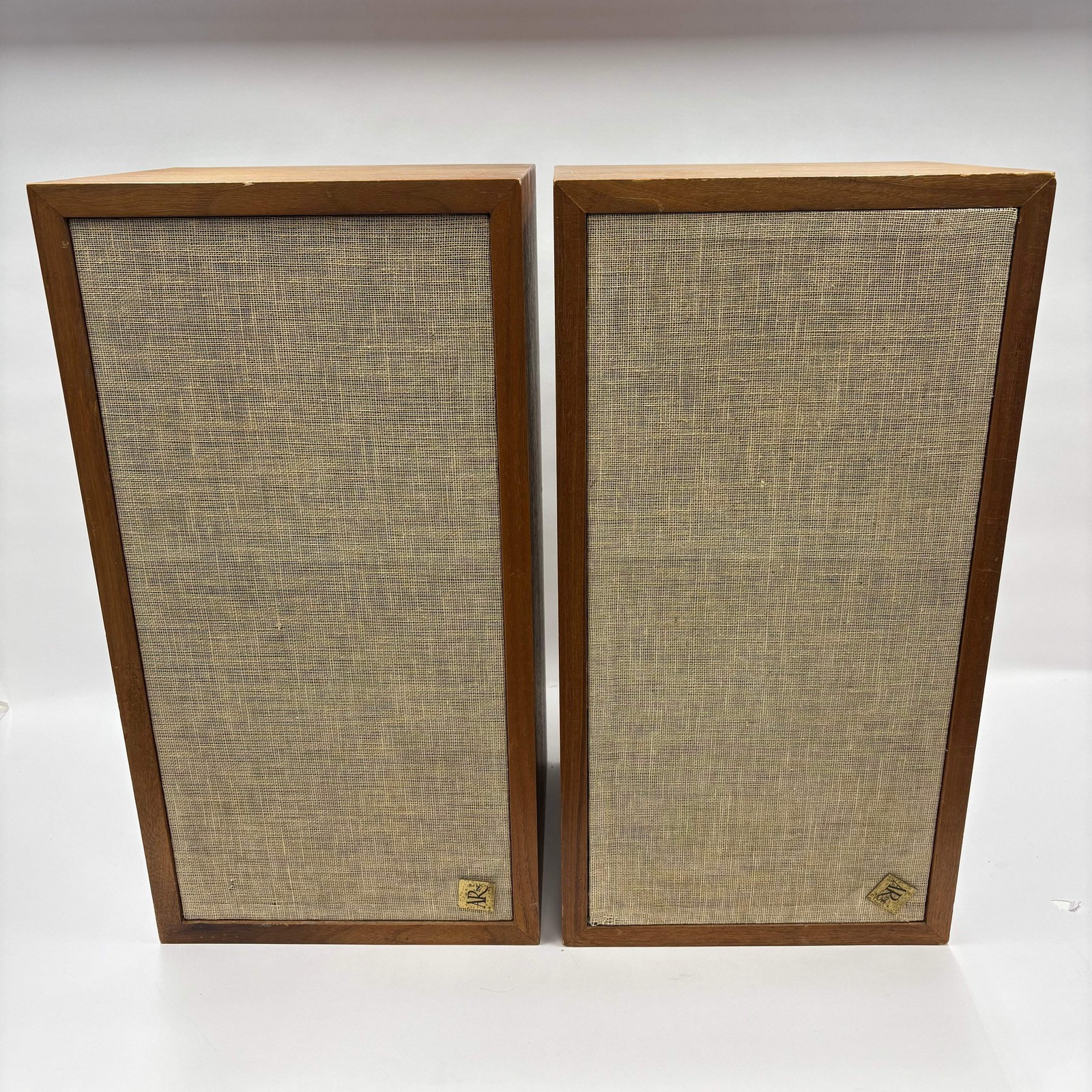
| Grille Material | White Acoustic Research cloth |
| Available Finishes | Walnut veneer, unfinished birch, pine |
Key Features
The 2.5-Inch Cone Tweeter That Changed the Game
Most bookshelf speakers of the 1960s relied on small dome tweeters or, worse, compression drivers that could screech like a banshee at volume. The AR-4x took a different path: a 2.5-inch cone tweeter, same family as the one in the legendary AR-3a, but slightly smaller. This wasn’t a miniaturized woofer—it was a purpose-built high-frequency driver with a paper cone and cloth surround, designed for dispersion, not efficiency. The result? A wide, even high-frequency response that doesn’t collapse when you step off-axis. You can walk across the room and the cymbals don’t vanish. Critics at the time called it “effortless,” and that still holds. Modern tweeters might go higher, but few spread sound so naturally. And because it’s a cone, not a dome, it lacks that “etched” quality that can make vintage recordings sound harsh. Instead, it softens the edges just enough to be forgiving, without losing detail.
Acoustic Suspension: The AR Signature
If you know anything about Acoustic Research, you know they practically invented the modern sealed-box speaker. The AR-4x doesn’t use ports or passive radiators—it’s a pure acoustic suspension design, meaning the air inside the cabinet acts as the spring for the woofer. This gives tight, controlled bass down to around 65 Hz in-room, which was impressive for a bookshelf speaker in 1965. There’s no overhang, no blooming—just clean, articulate low end that integrates seamlessly with the midrange. It won’t rattle your floorboards like a subwoofer, but it delivers bass you can trust, not just feel. And because it’s sealed, it’s less sensitive to placement. You don’t need to pull it a foot into the room or fire it into a corner. Stick it on a shelf, point it at your ears, and it’ll sing. This design also meant AR could use smaller cabinets than competitors relying on bass reflex designs, making the AR-4x a favorite in apartments and dorm rooms where space mattered.
Build and Serviceability
These aren’t fragile museum pieces. The cabinets are solid wood—walnut veneer over plywood—with real heft. At 18.5 pounds each, they’re dense, not hollow-sounding when you tap them. The grilles are held on with old-school hook-and-loop (the original kind, not Velcro®), and while they yellow with age, they’re replaceable. More importantly, the internals are accessible. The crossover is mounted on a simple terminal board, not buried under foam or glued in place. That means recapping—swapping out old electrolytic capacitors—is a weekend project, not a surgery. And unlike later models like the AR-4xa, the AR-4x uses cloth surrounds on both woofer and tweeter, which last far longer than foam. You’ll still find examples with dried-out tweeter surrounds, but those are repairable with careful reattachment, not full reconing. It’s a design that assumes you’ll maintain it, not just plug it in and forget it.
Historical Context
The AR-4x arrived in late 1965 as a refinement of the original AR-4, which had debuted the year before. The key upgrade? The tweeter. The AR-4 used a 3.5-inch version, which was already advanced, but the switch to the 2.5-inch cone in the 4x improved dispersion and reduced mid-treble coloration. This wasn’t just a parts swap—it was part of AR’s broader philosophy that accuracy trumped excitement. At a time when many manufacturers were chasing loudness and bass extension, AR stuck to measured, flat response. They weren’t trying to sell speakers that “sounded big”—they wanted ones that told the truth.
Competitors like Advent, KLH, and JBL were pushing ported designs or horn-loaded tweeters, often trading accuracy for impact. The AR-4x stood apart: smaller, more neutral, and less showy. It wasn’t the flagship—AR had the AR-3a for that—but it was the sweet spot for audiophiles who wanted 90% of the performance at half the price. And it worked: reviews from the era called it “astonishingly good” and “a benchmark for its class.” By 1973, AR would update it to the AR-4xa, swapping in a 1.25-inch tweeter and new crossover, but sales stayed low—many buyers preferred the proven 4x, especially since the sonic improvements were subtle. Some even argue the 4xa was a solution in search of a problem, especially with the AR-6 and AR-7 already covering similar ground.
Collectibility & Value
Today, the AR-4x trades in a narrow but passionate market. A pair in working condition with original drivers and decent cabinets will go for $150–$250 on the open market. But that price assumes everything works—and that’s a big assumption. The most common failure point is the crossover capacitor, which can dry out and block high frequencies. If the tweeters are silent, don’t assume they’re blown; check the caps first. Refoaming isn’t usually needed—the cloth surrounds last decades—but if the woofer cone is torn or the surround detached, a recone kit from a specialist like The Speaker Exchange or Parts Express can restore it for under $100 per driver.
What to watch for when buying: check the cabinet corners for water damage or warping. These are wood cabinets, not MDF, so they can swell or split if stored poorly. Look under the grilles for mold or insect damage—especially if they’ve been in a basement or attic. Test both speakers at moderate volume; listen for buzzing (loose surround), distortion (failed capacitor), or weak bass (air leak in cabinet). And if the high-frequency control is scratchy, that’s a sign of oxidation—clean it with DeoxIT, not replace the whole unit.
Restored pairs—recapped, cleaned, with fresh grilles—can fetch $350 or more, especially if they’re in rare finishes like unfinished birch. But unless they’re museum-grade, don’t expect to double your money. These aren’t rare like an AR-1 or exotic like an AR-LST. They’re common enough to find, but good ones are still prized. And while they won’t outperform a modern $500 bookshelf speaker in raw specs, they deliver a vintage character that’s hard to replicate: honest, unvarnished, and deeply musical.
eBay Listings



As an eBay Partner, we earn from qualifying purchases. This helps support our independent vintage technology research.