Acoustic Research AR-4 (1959–1966)
The moment you hear one, you understand why dorm rooms and apartments across America once trembled with deep, controlled bass from a speaker no bigger than a shoebox.
Overview
There’s a reason you still hear whispers about the AR-4 in hushed audiophile circles—it was the first compact speaker that didn’t apologize for its size. Introduced in 1959 as a smaller, more affordable sibling to the legendary AR-1 and AR-2, the AR-4 brought acoustic suspension technology into living rooms and college dorms where space and budget were tight but expectations weren’t. This wasn’t some stripped-down compromise; it was a precision-engineered bookshelf speaker that delivered bass so taut and articulate, it made larger, ported designs sound flabby by comparison. It didn’t roar, but it spoke with authority—clean, neutral, and startlingly detailed for its era.
The magic was in the sealed cabinet and the air cushion behind the woofer, a concept pioneered by Edgar Villchur. While other speakers relied on ports to extend bass, often at the cost of timing and clarity, the AR-4 used a tightly controlled air spring to rein in cone movement. The result? Bass that started and stopped on a dime, with minimal distortion even at moderate volumes. For the first time, a small speaker could play low—not just rumble, but render pitch and texture in the lower octaves. That made it a favorite among classical and jazz listeners who valued accuracy over boom.
But let’s be clear: this isn’t a speaker for rock at high volume or modern electronic music. It’s rated for just 15 watts RMS, and pushing it beyond that risks damaging the delicate foam surrounds or overdriving the modest tweeter. Yet in the right system—paired with a clean tube amp or a modest solid-state receiver from the '60s—it sings with a coherence that feels almost modern. The midrange is open and natural, voices float in space, and the highs, though not extended by today’s standards, are smooth and never fatiguing. It’s the kind of speaker that makes you forget you’re listening to vintage gear.
Specifications
| Manufacturer | Acoustic Research |
| Production Years | 1959–1966 |
| Original Price | $125 per pair (1959) |
| System Type | 2-way, acoustic suspension |
| Woofer | 10-inch |
| Tweeter | 3.5-inch cone (direct radiator) |
| Frequency Response | 45 Hz – 15,000 Hz (±3 dB) |
| Power Handling | 15 watts RMS continuous |
| Impedance | 8 ohms nominal |
| Sensitivity | 86 dB (1W/1m) |
| Crossover Frequency | 2,200 Hz |
| Cabinet Material | Teak veneer over particle board |
| Dimensions (H×W×D) | 18.5 × 11.5 × 9.5 inches |
| Weight | 28 lbs per speaker |
| Grille | Fabric-covered, removable |
| Connections | Single binding posts (no bi-wiring) |
| Recommended Amplifier Power | 10–50 watts |
| Design Origin | Edgar Villchur |
Key Features
Acoustic Suspension: The Quiet Revolution
Before the AR-4, small speakers either lacked bass or faked it with ports that smeared transients. The AR-4’s sealed cabinet changed that. By using the air inside the box as a spring to control the woofer’s motion, it achieved bass response down to 45 Hz with exceptional linearity. This wasn’t just a technical win—it transformed how people experienced music in small spaces. You could hear the resonance of a double bass, the pitch of a cello’s low C, without the cabinet itself shaking apart. It was a revelation in 1959, and it still holds up when properly restored.
3.5-Inch Cone Tweeter: Smooth, But Limited
The AR-4’s most controversial feature is its 3.5-inch cone tweeter—a full octave larger than typical tweeters of the era. While most manufacturers were moving toward smaller domes for better dispersion and extension, AR stuck with a larger cone for integration with the woofer. The result? A seamless mid-to-high transition with no harshness, but a roll-off above 15 kHz that makes cymbals and strings sound slightly muted. It’s not inaccurate—just polite. For the kind of music popular in the early '60s (jazz, vocal, acoustic), it was ideal. For modern recordings with wide-bandwidth detail, it’s a soft focus filter.
Teak Veneer & Compact Cabinet: Design That Endured
At a time when most speakers were either massive floor-standers or flimsy console units, the AR-4’s teak cabinet was a statement. The warm wood grain, gently rounded edges, and minimalist front baffle made it a natural fit in mid-century modern homes. It wasn’t just pretty—it was functional. The cabinet was heavily braced and internally damped, minimizing resonance. And at under two feet tall, it could sit on a bookshelf, desk, or credenza without dominating the room. This blend of form and function helped make AR a household name.
Historical Context
The AR-4 arrived at a pivotal moment in audio history. In the late 1950s, high-fidelity was transitioning from a niche hobby to a mainstream aspiration. More people were buying turntables, tape decks, and receivers—but few could fit or afford the massive speakers that dominated audiophile setups. Acoustic Research saw the gap. The AR-1 had already proven the viability of acoustic suspension in a full-range floor-standing design, but it was expensive and large. The AR-2 cut costs with a simpler cabinet, but still wasn’t compact. The AR-4 was the answer: a true bookshelf speaker that didn’t sacrifice low-end performance.
Its success was explosive. By 1966, AR speakers accounted for nearly one-third of all high-end speaker sales in the U.S.—a market share no company has matched since. The AR-4 played a key role in that dominance, appealing to younger buyers, students, and urban dwellers who wanted serious sound without the footprint. It also faced growing competition. KLH, founded by AR co-founder Henry Kloss, released the Model Six and Seven around the same time, also using acoustic suspension. But the AR-4 had the edge in bass control and brand recognition. It wasn’t just competing with other speakers—it was redefining what a small speaker could do.
Collectibility & Value
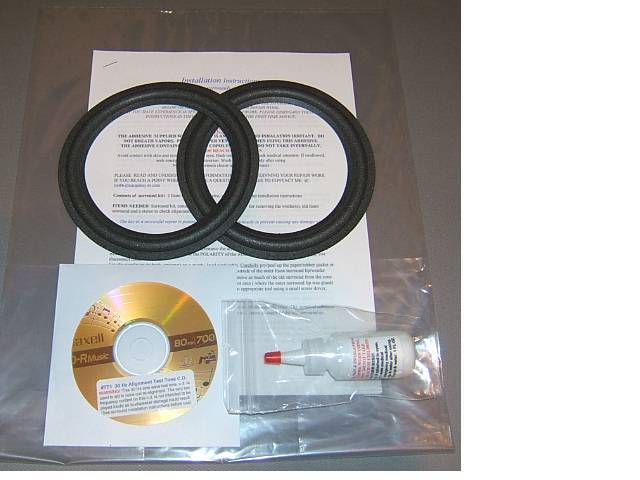
Today, the AR-4 is a prized vintage piece, but its value hinges entirely on condition and restoration. Unrestored pairs with original foam surrounds are ticking time bombs—the rubberized foam degrades after 40–50 years, crumbling into dust and leaving the woofer flapping loosely. Once that happens, the speaker is silent until reconed or refoamed. Re-foaming a pair typically costs $150–$250, depending on the shop, and while kits are available, it’s not a beginner project. The tweeters are more durable, but their foam surrounds can also deteriorate, leading to buzzing or limited output.
Original, unrestored AR-4s in working condition sell for $250–$400 per pair on eBay. Fully restored pairs—refoamed, reconed if needed, and cleaned—command $500–$800. Exceptional examples with flawless cabinets and original grilles can reach $1,000, especially if sold as part of a matching AR system (like with an AR-3a or XA turntable). But beware: many “vintage” AR-4s listed online are actually later AR-4x or AR-4xa models, which have 2.5-inch tweeters and slightly different cabinets. The original AR-4’s 3.5-inch tweeter is a key identifier.
Buyers should inspect the cabinet for water damage, warping, or veneer lifting—common in older particle board enclosures. The binding posts are simple but functional; replacements are easy to find. And while the speakers are 8 ohms and work with most vintage amps, pairing them with a low-powered tube receiver (10–20 watts) brings out their best: warmth without strain, clarity without glare.
eBay Listings



As an eBay Partner, we earn from qualifying purchases. This helps support our independent vintage technology research.