AR AR-3 (1958–1967)
The speaker that made high fidelity stop pretending and start measuring up—literally.
Overview
Turn one on, and you’re not just hearing music—you’re hearing the moment audio engineering pivoted from guesswork to science. The AR-3 doesn’t roar or thump; it reveals. There’s no drama in its presentation, no exaggerated bass or sparkly highs to seduce you. Instead, it delivers sound with the quiet confidence of a ruler laid flat across a drafting table: precise, unyielding, and eerily natural. When the Fine Arts Quartet played live in a hall one night and their anechoic recording played back through AR-3s the next, audiences couldn’t tell the difference. That wasn’t marketing fluff—it was a documented, cross-country series of concerts in the early 1960s designed to test the limits of recorded sound. And the AR-3 passed, again and again.
Introduced in 1958, the AR-3 wasn’t just another step forward—it was a declaration. Edgar Villchur, the mind behind Acoustic Research, had already revolutionized bass response with the acoustic suspension woofer in the AR-1. But the AR-3 married that innovation with another first: the world’s first commercially available direct-radiator dome tweeter. Before this, high frequencies were mostly handled by horns or ribbons, both of which had narrow dispersion and a tendency to shout. The AR-3’s 2-inch phenolic-dome tweeter spread sound evenly, with smooth off-axis response that made sweet spots irrelevant. You could sit anywhere, and the music stayed consistent. That’s still a benchmark today.
Positioned above the AR-2 but below the floor-standing AR-4, the AR-3 was the sweet spot for serious listeners who wanted full-range accuracy without going all-in on size or price. It wasn’t cheap—$275 in 1958, which is over $3,000 today—but it wasn’t meant to be. This was studio-grade gear for home use, the kind of speaker engineers trusted to reveal flaws in recordings because it added so few of its own. Its three-way design used a 12-inch woofer, a 5-inch midrange, and that pioneering tweeter, all managed by a passive crossover that, for its time, was remarkably transparent. The cabinet, a sealed acoustic suspension design, stood 25 inches tall with a modest 14-inch width—compact enough for bookshelves, but with bass that belied its size.
Specifications
| Manufacturer | Acoustic Research |
| Production Years | 1958–1967 |
| Original Price | $275 |
| Speaker Type | Three-way, acoustic suspension |
| Woofer | 12-inch |
| Midrange | 5-inch |
| Tweeter | 2-inch phenolic dome (direct-radiator) |
| Crossover | Passive, 500 Hz and 3,500 Hz |
| Frequency Response | 45 Hz – 18,000 Hz (±3 dB) |
| Sensitivity | 86 dB (1W/1m) |
| Nominal Impedance | 8 ohms |
| Dimensions (H×W×D) | 25 × 14 × 11.5 inches (635 × 356 × 292 mm) |
| Weight | 47 pounds per cabinet |
| Cabinet Finish | Walnut veneer with black cloth grille |
| Recommended Amplifier Power | 20–50 watts |
| Dispersion | Wide, uniform off-axis response |
| Patents | US 2,775,309 (acoustic suspension), US 3,033,045 (dome tweeter) |
Key Features
The Dome Tweeter That Changed Everything
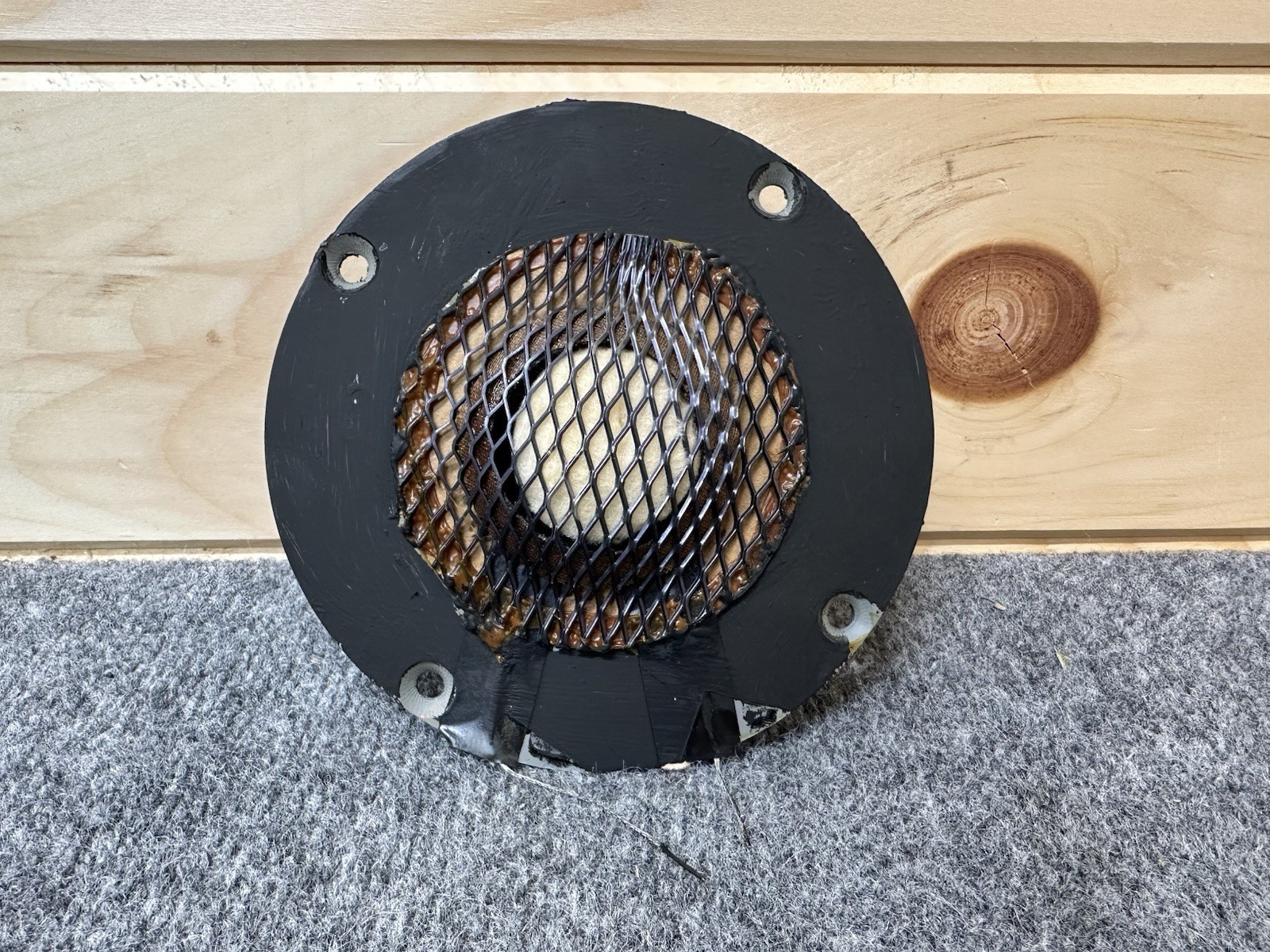
Before the AR-3, high-frequency drivers were either too directional or too harsh. Horns focused sound like a spotlight, creating a narrow listening window. The AR-3’s dome tweeter, based on Villchur’s patent, radiated sound broadly and evenly, mimicking the way instruments naturally project. Made from phenolic resin, the dome was rigid yet lightweight, resisting breakup modes that plague cheaper materials. It didn’t sound “detailed” in the modern sense—no artificial etch or sizzle—but it revealed detail by not obscuring it. Engineers still cite its dispersion pattern as a model of neutrality. And because it was a direct-radiator design (no compression chamber), it avoided the coloration common in horn-loaded tweeters of the era.
Acoustic Suspension Bass with Authority
The 12-inch woofer wasn’t just sealed—it was engineered. The air inside the cabinet acted as a spring, controlling cone movement with precision that mechanical suspensions couldn’t match. This allowed deep, low-distortion bass down to 45 Hz, remarkable for a cabinet of its size. Unlike ported designs that can “overhang” and muddy transients, the AR-3’s bass was tight, articulate, and shockingly fast. It didn’t shake the floor, but it didn’t need to—what it did was render pitch and timing with uncanny accuracy. Jazz bass lines walked with purpose; cellos resonated with body. It’s the kind of bass that makes you forget to measure it because it simply feels right.
A Crossover That Stayed Out of the Way
Passive crossovers in the late 1950s were often crude, sacrificing phase coherence and power handling for simplicity. The AR-3’s crossover split at 500 Hz and 3,500 Hz using carefully selected inductors and capacitors, designed to preserve time alignment and minimize insertion loss. It wasn’t perfect by modern standards—there’s no bi-wiring, no user adjustments—but it was transparent. The midrange and tweeter levels weren’t adjustable on the AR-3 (that came later with the AR-3a), which speaks to AR’s confidence in the voicing. When everything is balanced at the design stage, why give users a knob to unbalance it?
Historical Context
The late 1950s were a turning point. High fidelity was shifting from a hobbyist’s curiosity to a serious pursuit, and the AR-3 arrived at the perfect moment. Before its debut, most speakers either boomed in the bass or fizzled in the highs. The AR-3 didn’t just improve on that—it redefined what “accurate” meant. Its use in live-vs.-recorded concerts wasn’t a gimmick; it was a mission. AR wasn’t selling speakers, it was selling truth in reproduction. That ethos attracted not just audiophiles, but recording engineers, broadcasters, and even institutions. The Smithsonian now houses a pair, donated in 1993, as part of its Information Age exhibit—a rare honor for any consumer audio product.
Competitors scrambled to catch up. KLH, founded by AR co-founder Henry Kloss, used the same acoustic suspension principle under license. But no one else had the dome tweeter, and that gave AR a sonic edge. Even as companies like JBL and Altec focused on efficiency and volume for PA systems, AR doubled down on accuracy. The AR-3 wasn’t the loudest, flashiest, or cheapest speaker—but for those who valued realism over showmanship, it was the one that mattered.
Collectibility & Value
Finding a working AR-3 today is like uncovering a time capsule—one that might need serious restoration. These speakers are over 60 years old, and most haven’t been maintained. The foam surrounds on the woofers and midranges are almost certainly disintegrated—original foam doesn’t survive decades, and replacement kits are available but require skill to install. The tweeters are more durable, but phenolic domes can develop micro-cracks or delaminate if exposed to humidity or physical shock. Crossovers often need recapping; old capacitors can leak, drift in value, or short out.
Restoration isn’t cheap. A full recone with OEM-spec parts and crossover recapping can run $400–$600 per speaker if done professionally. But done right, the payoff is immense. Original AR-3s in mint, unrestored condition are rare and command $1,500–$2,500 per pair. Restored pairs sell for $1,000–$1,800, depending on finish and provenance. Beware of “cosmetic only” restorations—new grilles and cleaned cabinets don’t mean the drivers are functional. Always ask for sound tests or in-person auditioning. And if the price seems too good to be true? It probably is—someone already tried to fix it and gave up.
For collectors, the AR-3 isn’t about convenience. It’s about owning a milestone. It’s heavy, inefficient, and demands quality amplification (avoid weak receivers; these want clean watts). But if you care about where high fidelity began, and you’re willing to invest in its revival, few speakers connect you more directly to the roots of accurate sound.
eBay Listings



As an eBay Partner, we earn from qualifying purchases. This helps support our independent vintage technology research.