AR AR-2a (1959–1964)
A whisper-quiet midrange and a tweeter that floats like breath above the music—this is where acoustic suspension grew up and learned to sing.
Overview
Pull one of these walnut-clad relics onto your shelf and you’re not just placing a speaker—you’re installing a moment in audio history. The AR-2a isn’t flashy, doesn’t tower like a monument, and won’t dominate a room with bass thump. But play a well-recorded vocal, a solo piano, or a chamber string passage, and suddenly the air in front of you feels different—charged with clarity, presence, and a startling lack of coloration. This was Acoustic Research’s statement in the early 1960s: that accuracy wasn’t just possible, it was essential. And the AR-2a, born in 1959 as an evolution of the original AR-2, was their proof.
It’s a three-way acoustic suspension design, sealed tight to exploit the springiness of trapped air behind the woofer—a hallmark of AR engineering. But what sets the 2a apart from its siblings isn’t just the cabinet or the tuning; it’s the marriage of proven bass performance with a new, elevated high-frequency chain borrowed from the flagship AR-3. That means a 1.375-inch phenolic dome super-tweeter, suspended in its own chamber, sitting above two 5-inch midrange cones that fire in a push-pull configuration. This cross-firing midrange assembly—also carried over from the AR-2—helps cancel cabinet vibrations and delivers a focused, almost holographic center image. The result? A speaker that doesn’t call attention to itself, yet pulls you into the recording with unnerving neutrality.
Compared to the original AR-2, the 2a is a refinement, not a reinvention. It keeps the 10-inch woofer with its durable cloth surround—no foam to rot, no ticking time bomb under the dust cap. That woofer reaches down to 42 Hz with authority, and stays flat within ±3 dB, dipping to -10 dB at 30 Hz. That’s serious low-end for a compact bookshelf speaker in 1960. But the real magic happens above 500 Hz. The addition of the AR-3’s tweeter gives the 2a a top-end extension to 20 kHz (±5 dB) that most contemporaries couldn’t touch without harshness or sibilance. It’s not bright—it’s *revealing*. It exposes tape hiss, yes, but also the breath behind a vocalist’s phrase, the bow on a cello’s string, the subtle reverb of the recording space.
And it does so without fatigue. That’s the surprise for first-time listeners. Modern speakers often trade clarity for aggression, but the AR-2a’s phenolic dome tweeter disperses high frequencies widely and smoothly, avoiding the “beaminess” of larger domes. It’s why, decades later, owners still describe the sound as “clean with tone controls flat”—a rare compliment in the vintage world, where EQ is usually needed to tame a peak or fill a dip.
Still, this isn’t a speaker for rock concerts or movie explosions. It’s a listener’s speaker, designed for critical auditioning in a quiet room. It demands good amplification—solid-state or tube, but with enough current to control that 8-ohm load—and it rewards with transparency that few speakers, vintage or modern, can match at any price.
Specifications
| Manufacturer | Acoustic Research |
| Production Years | 1959–1964 |
| Original Price | $125 per pair (1960) |
| System Type | 3-way acoustic suspension |
| Woofer | 10-inch paper pulp cone, AlNiCo magnet, cloth surround |
| Midrange | 2 x 5-inch paper cones, push-pull configuration |
| Tweeter | 1.375-inch phenolic dome, suspended |
| Frequency Response | 42 Hz – 20 kHz (±5 dB) |
| Power Handling | 20 watts minimum |
| Nominal Impedance | 8 ohms |
| Crossover Frequencies | 2,000 Hz / 7,500 Hz |
| Enclosure Type | Sealed (acoustic suspension) |
| Dimensions (H×W×D) | 17.5 × 11.5 × 10.5 inches |
| Weight | 38 lbs per speaker |
| Woofer Resonance (in cabinet) | 42 Hz |
| Midrange Level Control | Yes (rear panel, potentiometer) |
| Tweeter Level Control | Yes (rear panel, potentiometer) |
| Grille | Removable cloth, stapled to front baffle |
Key Features
The Cloth-Surround Woofer That Lasts
Unlike later AR models that succumbed to foam decay, the AR-2a’s 10-inch woofer uses a cloth surround impregnated for durability. That means these drivers often survive over 60 years with minimal degradation—no refoaming required, no flaking rubber to clean up. The AlNiCo magnet provides a warm, dynamic low end without the brittleness of ceramic magnets found in budget speakers of the era. Combined with the acoustic suspension design, it delivers tight, controlled bass that doesn’t boom or rattle. Owners report that even unrecapped units often play with surprising authority—though the real transformation comes with fresh capacitors.
AR-3’s Super-Tweeter, Now in a Compact Cabinet
The 1.375-inch phenolic dome tweeter wasn’t just a minor upgrade—it was a technological leap. Borrowed directly from the flagship AR-3, it offered smoother dispersion and lower distortion than most dome tweeters of the time. Its wide horizontal dispersion fills a room without “hot spotting,” and its low mass allows it to track transients with precision. It doesn’t shout; it reveals. And because it’s not overextended—thanks to a 7,500 Hz crossover point—it avoids the fatigue that plagues many vintage tweeters. This is one of the few high-frequency drivers from the period that still sounds modern, even when driven by today’s high-resolution sources.
Push-Pull Midrange: The Secret to Transparency
The two 5-inch midrange drivers are mounted back-to-back, wired in push-pull. This clever design cancels out cabinet resonance and reduces harmonic distortion in the critical vocal range. It also creates a more focused soundstage, with instruments appearing in precise locations rather than smeared across the front. The crossover network ensures smooth handoff to the tweeter, but it’s the mechanical symmetry of the midrange pair that gives the AR-2a its uncanny clarity. It’s a design that AR never fully replicated in later models—once they switched to single midrange drivers, something of that neutrality was lost.
Historical Context
The AR-2a arrived at a pivotal moment. In 1958, Acoustic Research had stunned the audio world with the AR-1, the first practical acoustic suspension speaker. By 1959, the formula was being refined and scaled. The AR-2 brought the technology to a more affordable size, and the AR-2a elevated it with the high-end parts bin. This wasn’t just engineering for engineering’s sake—it was a direct challenge to the prevailing wisdom that small speakers couldn’t sound full, or that accuracy required massive horns or infinite baffles.
At the time, competitors like Advent, KLH, and Fisher were still chasing efficiency and loudness. AR went the other direction: lower sensitivity (around 86 dB), sealed cabinets, and a focus on time-domain accuracy. The AR-2a, priced at $125 per pair in 1960 (about $1,200 today), sat just below the AR-3 in the lineup but offered 90% of its top-end performance at half the cost. It was a strategic sweet spot—enough of the AR-3’s magic to impress audiophiles, but compact and affordable enough for serious listeners in smaller rooms.
The design also reflected a broader shift in hi-fi culture. The late 1950s and early 1960s saw the rise of the “critical listener”—someone who valued fidelity over flash, who compared recordings, who tweaked placement and cables. The AR-2a catered to that audience. It didn’t impress at a glance, but it won people over through sustained listening. And in an era when many speakers colored the sound with boom or brightness, the AR-2a’s neutrality was revolutionary.
Collectibility & Value
Today, the AR-2a is a sleeper in the vintage speaker market. It doesn’t command the prices of an AR-3a or AR-4x, but it offers a remarkably similar listening experience at a fraction of the cost. Pairs in original condition, unrecapped and with working controls, typically sell for $400–$600. Fully restored units—with new capacitors, cleaned pots, reclothed grilles, and recalibrated levels—can fetch $800–$1,200, especially if the cabinets are in excellent shape with minimal finish wear.
But buying an AR-2a requires caution. The biggest enemy isn’t the drivers—it’s the level controls. The midrange and tweeter attenuators are small wire-wound potentiometers mounted inside the cabinet, exposed to decades of humidity and temperature swings. Corrosion is common, and when it sets in, the pots become noisy, crackle, or cut out entirely. Some owners bypass them entirely, wiring the speakers at full level and adjusting tone externally. Others replace them with modern L-pads mounted on the rear panel—a clean fix, but one that alters originality.
Recapping is strongly recommended. The original capacitors, while robust, are now 60+ years old. Replacing them with modern film capacitors (Dayton Audio offers kits specifically for AR crossovers) restores clarity and dynamics. The woofer rarely needs work, but the midrange drivers can develop voice coil rub if the alignment has shifted—worth checking before purchase.
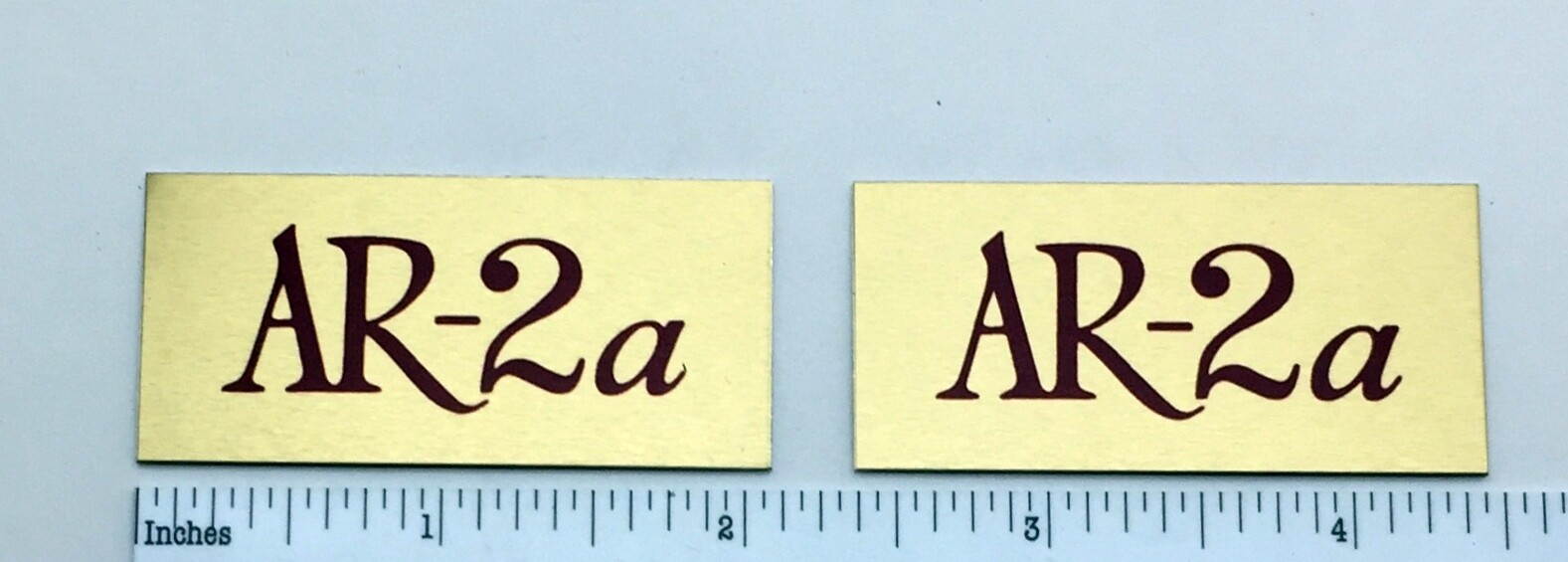
Cabinets are usually in good shape, thanks to real walnut veneer and sturdy construction. But the grille cloth is often torn or missing, and original replacement fabric is hard to find. Many restorers use period-correct weave patterns, but exact matches are rare. Also, the AR badges—especially the early metal ones—are frequently missing or damaged. Replicas are available, but originals add value.
If you’re hunting for a pair, prioritize units with clean grilles, intact badges, and confirmed working pots. Avoid anything advertised as “tested with phone”—that usually means only the woofer works. And if the seller claims the speakers are “fully restored,” ask for details: recapped? Pots cleaned? Grille reclothed? The difference between a $500 and $1,000 pair often comes down to those details.
eBay Listings


As an eBay Partner, we earn from qualifying purchases. This helps support our independent vintage technology research.
Service Manuals & Schematics
- Manual (2012) — archive.org
- Manual (2012) — archive.org
- Manual — archive.org
- Manual (2015) — archive.org
- Manual (2015) — archive.org