AR AR-11 (1976–1979)
That moment when you fire up a pair of these and realize the mid-’70s might have been the peak of polite, detailed, and effortlessly natural hi-fi.
Overview
You don’t so much hear an AR-11 as step into its world—a space where bass is taut and articulate, not boomy, where voices occupy their own physical place in the room, and cymbals shimmer without turning into scalp-razors. These aren’t speakers that jump out and grab you; they invite you in. They’re the kind of loudspeaker that made people in 1977 believe high fidelity had finally grown up. Standing just over two feet tall, with a gently curved baffle and that unmistakable AR walnut veneer, the AR-11 looks like the sensible older sibling of the legendary AR-3a—because that’s exactly what it is. It doesn’t shout its lineage, but it wears it with quiet confidence.
Born in 1976, the AR-11 arrived when the acoustic suspension revolution was no longer news—it was gospel. Acoustic Research had spent over two decades proving that a sealed box with a precisely engineered air spring could deliver bass that was deep, clean, and free of the one-note boom that plagued reflex designs. The AR-11 wasn’t a radical departure, but a refinement: a three-way system that borrowed the 12-inch woofer from the original AR-1 (updated) and the hemispherical dome midrange and tweeter from the AR-3a, then rehoused them in a slightly more compact cabinet. It wasn’t cheaper to build, but it was priced to move—around $495 per pair at launch, a full $200 less than the AR-3a. That made it the sweet spot for serious listeners who wanted flagship-level performance without the flagship price.
And make no mistake, this is a serious speaker. It doesn’t play loud like a modern tower, but what it does at moderate levels is mesmerizing. The bass rolls down to a rated 27Hz, and in-room response often dips even lower thanks to boundary reinforcement. That 12-inch woofer—305mm of butyl-rimmed pulp cone—is slow to anger but never sluggish. It’s the kind of bass that lets a double bass walk across the floor without dragging, that gives kick drum its thump without turning it into a foghorn. Up top, the 19mm hemispherical dome tweeter delivers smooth, airy highs with none of the grain or peakiness that plagued many dome tweeters of the era. Between them, the 38mm midrange dome—a design Acoustic Research pioneered—handles the critical vocal range with startling clarity. There’s no veil, no hollowness, just a direct line to the performance.
Still, these aren’t flawless. Owners report a narrow dip around 2.5kHz in the on-axis response—likely a crossover artifact—and a wider dispersion issue in the 3kHz–9kHz range, where horizontal off-axis response gets ragged. This isn’t due to poor engineering so much as the limits of 1970s baffle design; that squared-off front panel, necessary for the removable grille, causes diffraction that modern time-aligned designs have long since solved. But vertically? Remarkably consistent. Whether you're seated, standing, or lying on the floor, the tonality stays coherent—a trait that surprised even modern measurement enthusiasts who’ve tested them. If you value stable imaging over a wide horizontal sweet spot, the AR-11 delivers.
Specifications
| Manufacturer | Acoustic Research |
| Production Years | 1976–1979 |
| Original Price | $495 per pair (1976) |
| Type | 3-way, 3-driver loudspeaker system |
| Frequency Response | 27 Hz – 30 kHz |
| Recommended Amplifier Power | 25 – 225 watts |
| Crossover Frequencies | 525 Hz, 5000 Hz |
| Woofer | 1 x 305 mm (12 in) acoustic suspension |
| Midrange | 1 x 38 mm (1.5 in) hemispherical dome |
| Tweeter | 1 x 19 mm (0.75 in) hemispherical dome |
| Impedance | 8 ohms nominal |
| Sensitivity | 88 dB (1W/1m) |
| Dimensions (H×W×D) | 635 × 354 × 273 mm (25 × 13.9 × 10.7 in) |
| Weight | 22.7 kg (50 lbs) per speaker |
| Enclosure Type | Acoustic suspension (sealed) |
| Grille Compatibility | AR-10pi, AR-11, other mid-1970s AR models |
| Finish Options | Walnut veneer |
| Connections | Single pair of binding posts |
Key Features
The Acoustic Suspension Legacy
The AR-11 carries the torch of Edgar Villchur’s 1954 acoustic suspension breakthrough—the idea that a sealed cabinet with a controlled air spring could deliver tight, distortion-free bass without the port noise or time lag of bass-reflex designs. By 1976, this wasn’t novel, but it was still superior for accurate low-end reproduction. The 12-inch woofer, while sharing DNA with the original AR-1, benefits from two decades of refinement: improved surround materials, better damping, and a more linear motor structure. The result is bass that starts and stops on a dime. It won’t shake your floorboards like a modern sub, but it renders pitch and texture with a clarity that few vintage speakers match. In a time when many manufacturers were chasing loudness and efficiency, AR stuck to accuracy—and it shows.
Hemispherical Dome Drivers: A Quiet Revolution
While dome tweeters are common now, AR was among the first to perfect the hemispherical design for both midrange and high frequencies. The 38mm midrange driver is a marvel of its era—lightweight, rigid, and free of breakup modes in the vocal band. It’s why strings and voices sound so present and uncolored. Paired with the 19mm tweeter, which uses the same dome technology, the transition between drivers is seamless when the crossover is in good health. These aren’t hyper-detailed like some modern metal domes; they’re smooth, organic, and fatigue-free over long listening sessions. And because they’re direct-radiator designs (no horns or waveguides), they integrate naturally into the room without the beaming or hot spots common in directional drivers.
Crossover and Cabinet Integration
The crossover, while not externally accessible, is a carefully tuned second-order network that manages the handoff between the woofer, midrange, and tweeter with precision. It uses film and electrolytic capacitors—some of which have since dried out in surviving units—and air-core inductors to minimize distortion. The cabinet itself is a study in restraint: medium-density fiberboard (MDF) with a real walnut veneer, internally braced to reduce resonance. The gently curved front baffle isn’t just for looks—it helps reduce edge diffraction, though not completely, as the hard edges for the grille frame still cause some high-frequency scattering. Still, for its time, this was high-end construction, built to last. And many have—though condition varies wildly today.
Historical Context
The AR-11 arrived at a turning point. By the mid-1970s, the audiophile boom was in full swing, and companies like KLH, Advent, and JBL were pushing the limits of affordability and performance. AR, once the undisputed leader—accounting for nearly a third of all speaker sales in 1966—was facing stiffer competition and shifting tastes. The AR-3a remained the halo product, but its $700 price tag put it out of reach for many. The AR-11 was AR’s answer: a no-compromise design in a slightly smaller footprint, priced for the upper-mid market. It competed directly with the Advent Large, the JBL L100, and the KLH Model Eleven, all of which offered different sonic philosophies—Advent with its ribbon tweeter and ported bass, JBL with its bold midrange and high efficiency, KLH with its acoustic suspension lineage.
What set the AR-11 apart was its neutrality. While others leaned into coloration—JBL’s “honk,” Advent’s forwardness, KLH’s warmth—the AR-11 aimed for transparency. It didn’t flatter bad recordings, but it elevated good ones. It was the speaker for the listener who cared more about timbre than thunder, about nuance than noise. And in an era when quadraphonic sound and disco were pushing systems toward spectacle, the AR-11 was a quiet act of rebellion.
Collectibility & Value
Today, the AR-11 trades in a narrow but passionate market. Pairs in original, unmodified condition with intact grilles and clean cabinets typically sell between $300 and $600, depending on restoration status. Fully restored pairs—with reconed woofers, replaced foam surrounds, and recapped crossovers—can fetch $800 or more, especially if paired with the correct vintage stands. But caveat emptor: these are 50-year-old speakers, and age has not been kind to all of them.
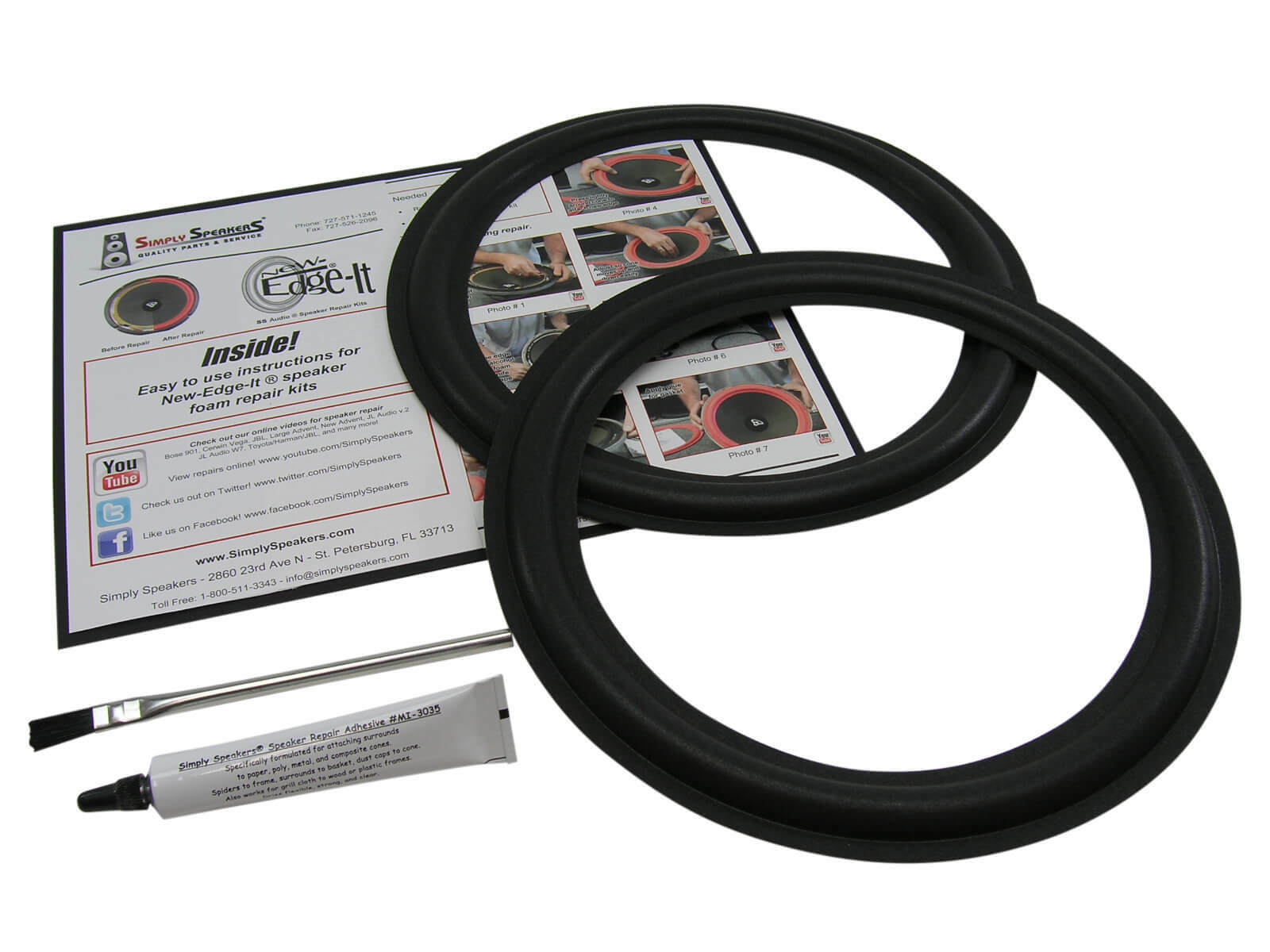
The most common failure points are the woofer surrounds, which dry out and crack, and the crossover capacitors, which degrade and cause tonal imbalances—often a dull midrange or harsh treble. The foam around the tweeter, meant to absorb rear-wave reflections, is also long gone on most units, though replacements are available. Service technicians observe that the midrange domes are generally robust, but the original adhesives can fail, leading to buzzing if the driver becomes loose.
Before buying, check for cabinet integrity—chipped corners are common, and refinishing walnut veneer well is expensive. Ensure the grilles are present (they’re fragile and often missing), and verify that the binding posts are tight and corrosion-free. If the speakers sound thin or lack bass, the woofers likely need reconing. A full professional restoration can cost $400–$600 per pair, so factor that into any purchase.
Despite their age, well-maintained AR-11s still hold their own against modern bookshelf speakers. They won’t play as loud or go as deep as a powered design, but in terms of midrange clarity and imaging precision, they remain competitive. For the vintage collector or the listener who values refinement over raw power, they’re a compelling choice—less mythologized than the AR-3a, but just as capable in the right setting.
eBay Listings



As an eBay Partner, we earn from qualifying purchases. This helps support our independent vintage technology research.