AR The Turntable (1984–1987)
A walnut-bodied resurrection of a legend—quiet, elegant, and built to float above vibration, but with a motor that might one day start growling like a caged animal.
Overview
You don’t hear it first—you feel it. The stillness. Place your palm on the oiled walnut top of the AR The Turntable, cue up a record, and even when you’re stomping around the room, the needle stays locked in the groove like it’s playing in a vacuum. That’s the magic of the suspended subchassis, a design philosophy AR pioneered in the 1960s and resurrected here in 1984 with a quiet confidence. This isn’t a flashy comeback; it’s a reintroduction to sanity in a market starting to go overboard with plinth mass and exotic materials. The AR The Turntable arrived at a time when audiophiles were rediscovering analog, and Acoustic Research—riding the legacy of the legendary XA—offered not a reinvention, but a refinement: a clean, elegant, no-nonsense belt-drive turntable that prioritized isolation, simplicity, and musical honesty.
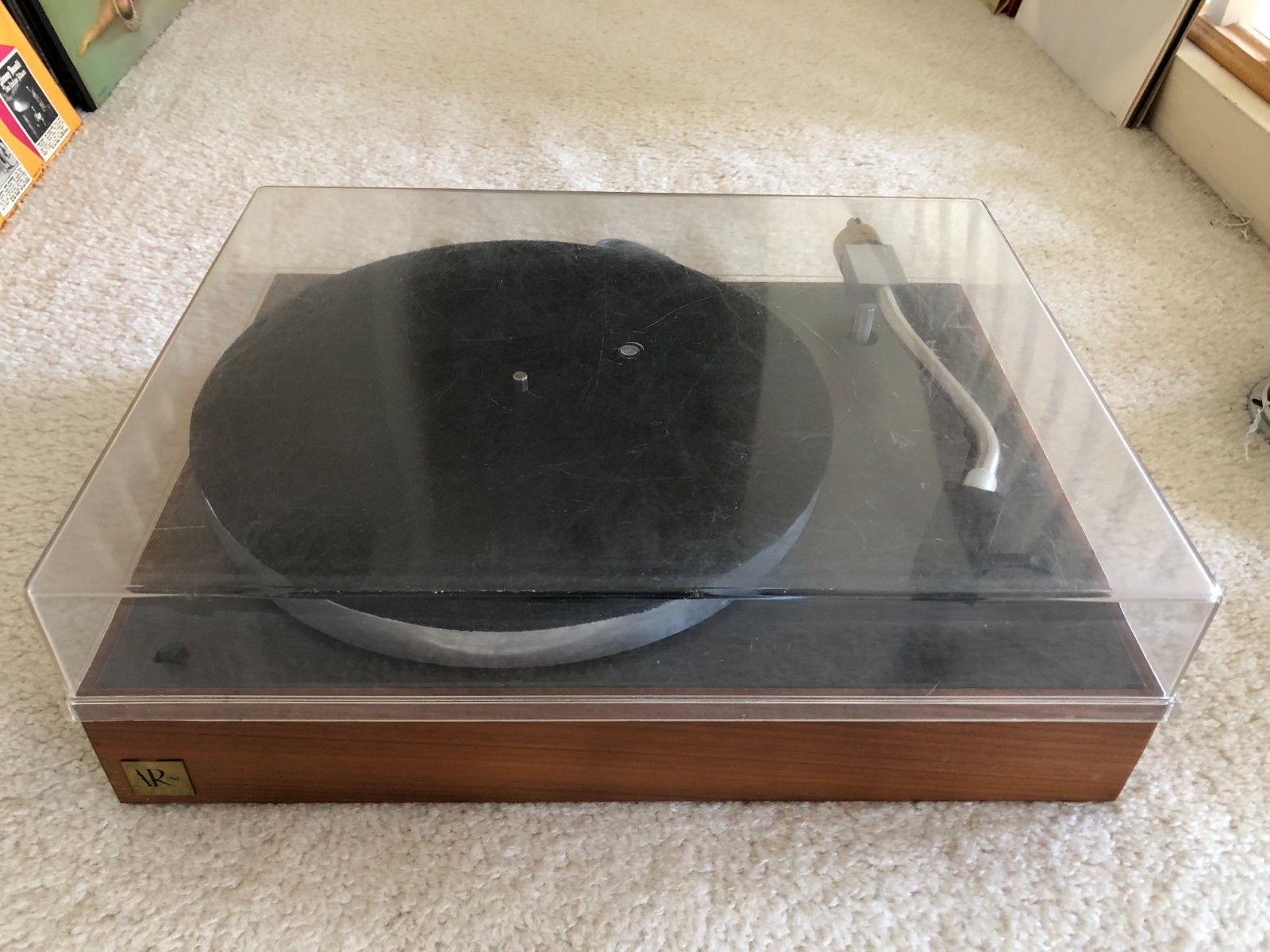
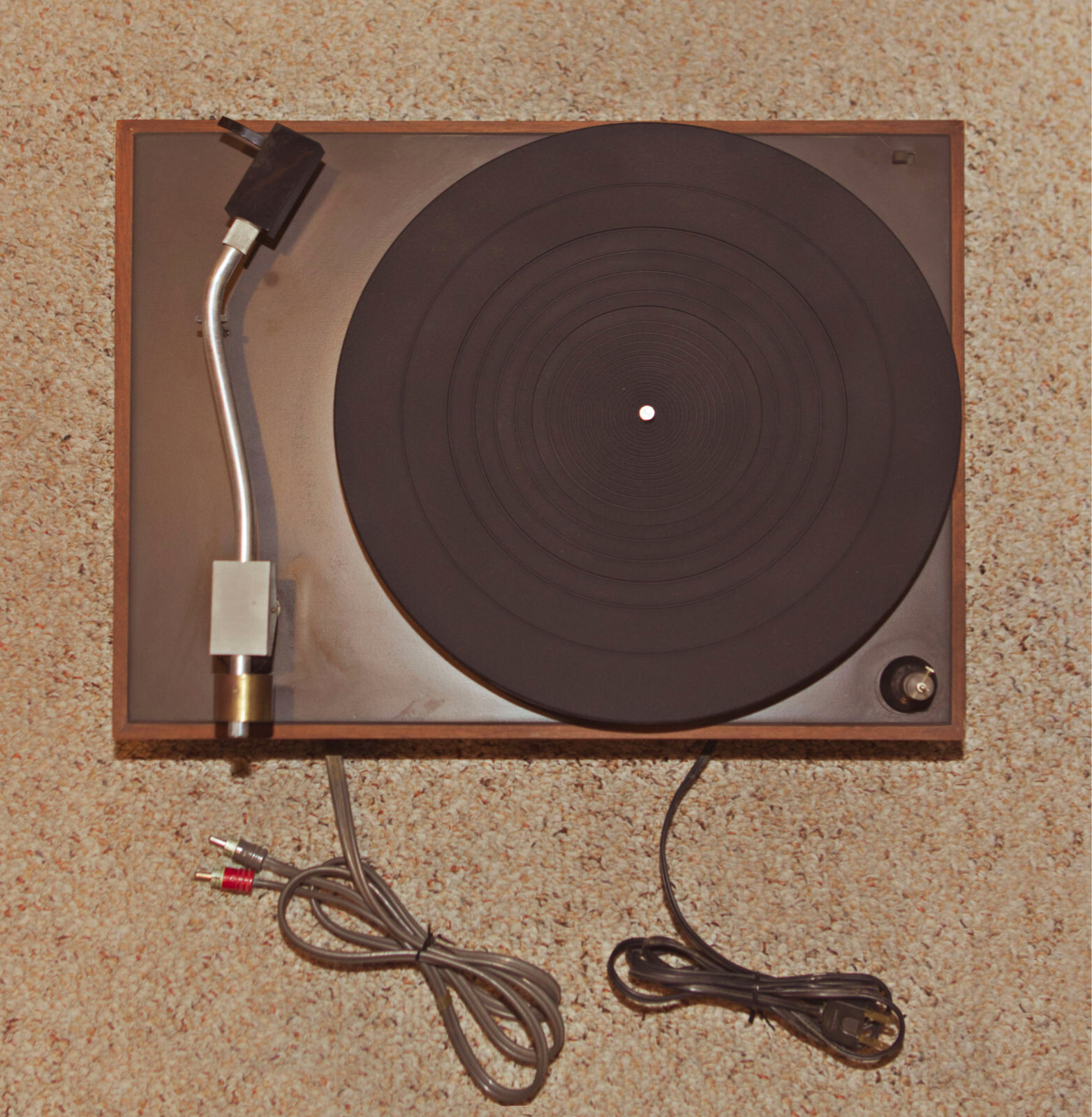
It shared DNA with the earlier AR XA, but visually and structurally, it belonged to the mid-80s. The rounded edges, full veneer, and crescent-shaped armboard gave it a warmer, more contemporary presence than the boxy, utilitarian XA. It came in two configurations: $350 without a tonearm (just a blank mounting board), or $475 with a removable-headshell tonearm—an upgrade over the fixed-headshell arms of previous generations and a nod to the growing aftermarket. The tonearm itself was competent, low-mass, and designed to work well with popular cartridges of the era like the Shure V15, but it wasn’t the star. The star was the platform: a T-bar subchassis suspended on three damped springs, isolating the platter and tonearm from external vibrations with surgical precision. Reviewers at the time were stunned by its immunity to feedback—pounding the top plate produced no skip, no thump, just uninterrupted music. That’s not marketing hyperbole; it’s physics, perfected.
But perfection came with caveats. The vertical pivot point of the tonearm sat nearly half an inch above the record surface, a design choice that, according to Audio magazine’s Peter Mitchell in 1984, could make warp-induced wow more audible on less-than-flat vinyl. It wasn’t a dealbreaker, but it was a trade-off—stability over absolute geometric idealism. And while the turntable itself was a model of isolation, the motor wasn’t immune to time. Early units used a motor that, after years of service, could develop bearing noise—owners report a low grinding or buzzing that creeps in after thousands of hours. A revised motor arrived in 1985 with improved materials, but replacements today are scarce and often require sourcing from the dwindling pool of vintage AR parts.
Specifications
| Manufacturer | Acoustic Research |
| Production Years | 1984–1987 |
| Original Price | $350 (armless), $475 (with tonearm) |
| Drive Type | Belt drive |
| Motor | AC synchronous motor |
| Speeds | 33-1/3, 45 RPM |
| Platter | Aluminum with felt mat |
| Subchassis | T-bar cast aluminum, suspended on three damped springs |
| Tonearm | Straight tubular, removable headshell |
| Pivot to Stylus Distance | 9 inches |
| Effective Arm Mass | 9 grams (measured), 13 grams (rated) |
| Cable Capacitance | 82 pF (measured), 85 pF (reported) |
| Antiskating | Calibrated dial on arm base |
| Cueing | Viscous-damped lever |
| Dimensions | 18-3/16" W × 15-1/4" D × 7" H (cover closed) |
| Weight | 18 lbs |
| Plinth Material | Oiled walnut veneer |
| Power | 120V AC, rocker switch on base |
| Resonant Frequency (suspension) | Approx. 2–3 Hz |
Key Features
The Floating Subchassis: Isolation Perfected
The AR The Turntable didn’t invent suspended subchassis design—that credit goes to Edgar Villchur and the original XA in 1961—but it refined it for a new generation. The entire platter and tonearm assembly is mounted to a rigid T-bar casting, which hangs from the main plinth on three spring-damped isolators. This system resonates at around 2–3 Hz, far below the audible range, meaning floor vibrations, speaker feedback, or even someone leaning on the cabinet are effectively nullified. It’s not just about skipping; it’s about clarity. When the stylus isn’t fighting micro-motions caused by external energy, it can track the groove with greater accuracy, revealing low-level detail and spatial cues that lesser turntables smear. Laboratory tests from the era confirmed its superiority: 20 to 40 dB better isolation than competing models. In practical terms, that means you can place it on a modest shelf, not a $1,000 isolation platform, and still get reference-grade performance.
Armboard and Tonearm: Simple, But Not Flawless
The tonearm, while not a masterpiece of engineering, was a significant step up from AR’s earlier fixed-headshell designs. The removable headshell made cartridge swaps painless, a feature increasingly expected by 1984. With an effective mass of 9 grams (as measured), it paired well with medium-compliance cartridges like the Shure V15 or Sumiko MMT. The arm’s resonance with the V15 was measured at a near-ideal 10 Hz, placing it safely in the optimal 8–12 Hz range for vinyl playback. However, the arm’s vertical pivot height—nearly half an inch above the record—was a compromise. While it didn’t cause tracking issues, it meant that vertical record warps could induce more audible wow than on arms with lower pivot points. This wasn’t a flaw in execution, but in geometry, and it’s something owners should be aware of when playing less-than-perfect pressings.
Build and Aesthetics: Warmth Meets Precision
Where the original XA looked like a lab instrument, the AR The Turntable looked like furniture. The oiled walnut veneer, rounded edges, and clean lines gave it a domestic elegance that fit better in living rooms than the angular, industrial XA. It was completely veneered, unlike the ES-1, which featured solid wood sides—a subtle but telling difference in construction quality and cost. The dust cover opened fully and stayed up, a small but thoughtful touch. Internally, it was all business: minimal wiring, straightforward layout, and a focus on mechanical integrity over cosmetic flair. The motor, mounted to the main plinth, drove the platter via a rubber belt, keeping motor vibrations away from the critical playback components. It was a design that valued function, but didn’t sacrifice form.
Historical Context
The AR The Turntable arrived in 1984 at a curious moment. Vinyl was in retreat—CDs were ascendant, and many manufacturers had abandoned turntable production altogether. Acoustic Research, which had exited the turntable market in the late 1970s, saw an opportunity. Audiophiles hadn’t given up on analog, and many were rediscovering the warmth and depth of LPs. AR didn’t try to compete with the exotic, high-mass turntables from Linn or Thorens; instead, they doubled down on their heritage: isolation, simplicity, and value. The result was a turntable that felt both nostalgic and modern—a bridge between the analog golden age and the digital present.
It wasn’t alone. By 1984, the suspended subchassis had become a benchmark—Thorens’ TD-150 and Linn’s LP12 were direct spiritual successors to the AR XA, and their influence was clear. But AR offered something those brands didn’t: accessibility. At $475 with a tonearm, it undercut most serious competitors while delivering 90% of the performance. It was joined in AR’s lineup by the EB-101 (a budget option at $399), the ES-1 (an upgraded version with a Hurst motor and sapphire bearing), and the ETL-1 (a larger, 9.5-inch pivot-to-spindle model at $700). The AR The Turntable sat at the sweet spot—more refined than the EB-101, less expensive than the ES-1, and available in finishes like oiled walnut and a deeper cherry for the UK market.
Collectibility & Value
Today, the AR The Turntable trades in a quiet corner of the vintage market—respected, but not hyped. Prices reflect its age and quirks: unrestored units sell for $150–$250, while fully serviced models with motor replacements and new belts fetch $350–$500. The ES-1, with its superior motor and bearing, commands a premium, often selling for $100–$150 more than the standard model. The biggest risk in buying one? The motor. Early units (pre-1985) are prone to bearing noise, and once that starts, it’s not a simple fix. Replacement motors are rare, and rewinding or refurbishing the original unit requires specialized knowledge. The suspension springs can also go out of balance over decades, requiring careful adjustment—something most DIYers aren’t equipped to handle.
That said, when a The Turntable is properly maintained, it’s a revelation. The isolation is still competitive with modern turntables under $1,000. The sound is clean, open, and free from coloration—no boom, no glare, just honest reproduction. Owners who’ve kept theirs running report decades of service with only annual oiling of the motor and subplatter bearings. The belt should be replaced every 5–7 years, and the dust cover hinges are known to crack over time, but these are minor issues. If you’re buying, insist on a working demo. Listen for motor noise at startup and during play. Check that the cueing lever operates smoothly and that the arm doesn’t stick. And if the springs haven’t been balanced in years, budget for a professional setup.
eBay Listings


As an eBay Partner, we earn from qualifying purchases. This helps support our independent vintage technology research.