AR Acoustic Research AR-8s (1981–1987)
Small enough to tuck beside a bookshelf, but with a bass punch that’ll rattle your coffee table—and a soundstage that opens up like it’s not playing by the rules.
Overview
Pull one of these walnut-clad little boxes out of a dusty closet and you might mistake it for just another forgettable early-’80s bookshelf speaker—another casualty of the transition from wood veneer to vinyl wrap, from audiophile obsession to mass-market compromise. But plug in a decent amp, cue up some Bill Withers, and within seconds you’ll realize the AR-8s isn’t playing defense. It’s throwing punches. This isn’t the polite, measured sound of the AR-3a or the clinical precision of later monitors. The AR-8s is raw, immediate, and alive—like someone turned up the room and forgot to turn down the emotion.
Born in the twilight of AR’s golden era, the AR-8s arrived in 1981 as part of the “Post-Classic Series,” a lineup that carried the AR badge but not always the same engineering rigor of the Villchur years. By this point, Edgar Villchur had long stepped back, and the company was navigating shifting ownership and market pressures. Yet somehow, in this climate, they built a speaker that punches way above its size and price. It’s a 6.5-inch two-way with a sealed cabinet—classic acoustic suspension DNA—but tuned for a livelier, more dynamic response than its predecessors. The woofer fills nearly the entire baffle, giving it a bold, almost aggressive presence, and the dome tweeter (a direct-radiator type, a Villchur invention) delivers crisp highs without the brittleness that plagues many paper tweeters of the era.
What makes the AR-8s special isn’t just its sound, but its timing. It landed just as home audio was pivoting: receivers were getting fancier, cassette decks were peaking, and rock, funk, and early hip-hop demanded more low-end thump than the delicate AR-3a could deliver. The AR-8s answered that call. It’s not the most accurate speaker AR ever made—no one’s using it to mix albums—but it’s one of the most *engaging*. It’s the kind of speaker that makes you forget you’re listening to hi-fi and just makes you *feel* the music. That’s no small feat.
Compared to the AR-7, its smaller sibling with an 8-inch woofer, the AR-8s trades some deep bass extension for tighter control and faster transient response. And unlike the AR-9, which aimed for high-end refinement, the AR-8s feels like the sweet spot for real-world listening: compact enough for small rooms, efficient enough for modest amplifiers, and robust enough to handle 60 watts without breaking a sweat. It’s the AR for people who actually play records, not just admire them.
Specifications
| Manufacturer | Acoustic Research |
| Production Years | 1981–1987 |
| Original Price | $199 per pair (1982 USD) |
| Power Handling | 60 watts RMS |
| Recommended Amplifier Power | 10–60 watts per channel |
| Frequency Response | 74 Hz – 20,000 Hz (±3 dB) |
| Impedance | 8 ohms nominal |
| Sensitivity | 86 dB (1W/1m) |
| Crossover Frequency | 2,500 Hz |
| Woofer | 6.5-inch polypropylene cone, rubber surround |
| Tweeter | 1-inch dome, direct-radiator design |
| Cabinet Type | Acoustic suspension (sealed) |
| Dimensions (H×W×D) | 13.5 × 8.5 × 8.75 inches |
| Weight | 14 lbs (6.35 kg) per speaker |
| Inputs | Single pair of 5-way binding posts |
| Grille | Fabric-covered foam, removable |
| Finish | Walnut veneer or black vinyl wrap |
| Design Series | Post-Classic Series |
Key Features
Acoustic Suspension, Re-Tuned for Energy
The AR-8s carries the torch of AR’s foundational innovation: the acoustic suspension woofer. Unlike ported designs that rely on tuned resonance, the sealed cabinet uses air pressure as a linear restoring force, minimizing distortion and delivering tight, controlled bass. But where earlier AR models like the AR-3a prioritized neutrality, the AR-8s leans into a more forward, dynamic presentation. The 6.5-inch woofer is overhung and heavily damped, which sacrifices some ultimate efficiency but gains punch and clarity in the mid-bass—perfect for kick drums and electric bass. It won’t shake walls like a floorstander, but in a small to medium room, it delivers a surprising sense of weight and authority.
Dome Tweeter Clarity Without Harshness
Many budget speakers of the early ’80s used paper or mylar tweeters that sizzle and fatigue over time. The AR-8s avoids that trap with a 1-inch dome tweeter based on Villchur’s original direct-radiator design. It’s smooth through the upper mids and crisp without being edgy—ideal for vocals, acoustic guitar, and cymbals. There’s no peaky “hi-fi” glare here. Instead, the treble integrates naturally with the midrange, creating a cohesive sound that stays listenable at higher volumes. It’s not as refined as the tweeter in the AR-9, but it’s leagues ahead of the paper domes found in competing models from Advent or KLH.
Compact Cabinet, Big Soundstage
Measuring just over 13 inches tall, the AR-8s fits easily on shelves or stands, but it projects a soundstage that feels much larger. Imaging is precise, with instruments locked in space, and there’s a sense of depth that belies the speaker’s size. This isn’t studio-monitor flatness—it’s more like a live performance in a small club. The wide baffle and centered driver layout help minimize diffraction, and the sealed design eliminates the phase issues that can plague ported speakers. Position them a few feet from the wall, toe them in slightly, and they disappear, leaving only the music.
Historical Context
The AR-8s emerged during a turbulent time for Acoustic Research. By the early 1980s, the company had been acquired by Teledyne, and the original engineering vision of Edgar Villchur was fading into legacy. The market was shifting: Japanese receivers dominated, and consumers wanted convenience over purity. AR responded with the Post-Classic Series—a line that kept the brand visible but often compromised on materials and voicing. The AR-8s, however, stands out as a rare success in this era. It didn’t try to be a mini-AR-3a. Instead, it embraced the energy of contemporary music and the realities of real-world listening spaces.
It competed with models like the Advent 300, KLH Model Eleven, and Polk Audio’s early bookshelf designs—speakers that often prioritized bass boost or bright highs to stand out in crowded showrooms. The AR-8s took a different path: honest bass, smooth mids, and a natural balance that aged far better than its peers. While it never achieved the cult status of the AR-3a, it found a loyal following among college students, apartment dwellers, and anyone who wanted good sound without a big footprint.
This was also the era when AR’s acoustic suspension patent had long expired, and the entire industry had adopted the principle. Companies like Bose and Cambridge SoundWorks were now selling sealed-box speakers with AR’s DNA, but without the same attention to crossover design or driver matching. The AR-8s, then, was both a product of its time and a quiet rebuke to the trend toward sonic exaggeration.
Collectibility & Value
Today, the AR-8s is a sleeper hit among vintage speaker collectors. It’s not rare—thousands were made—but good pairs in original condition are getting harder to find. The most common failure point is the woofer surround, which tends to dry out and crack after 30+ years. Fortunately, replacement surrounds are widely available, and refoaming a pair is a straightforward DIY job or a $100–$150 service. The tweeters are generally more durable, though some early units show signs of oxidation on the dome.
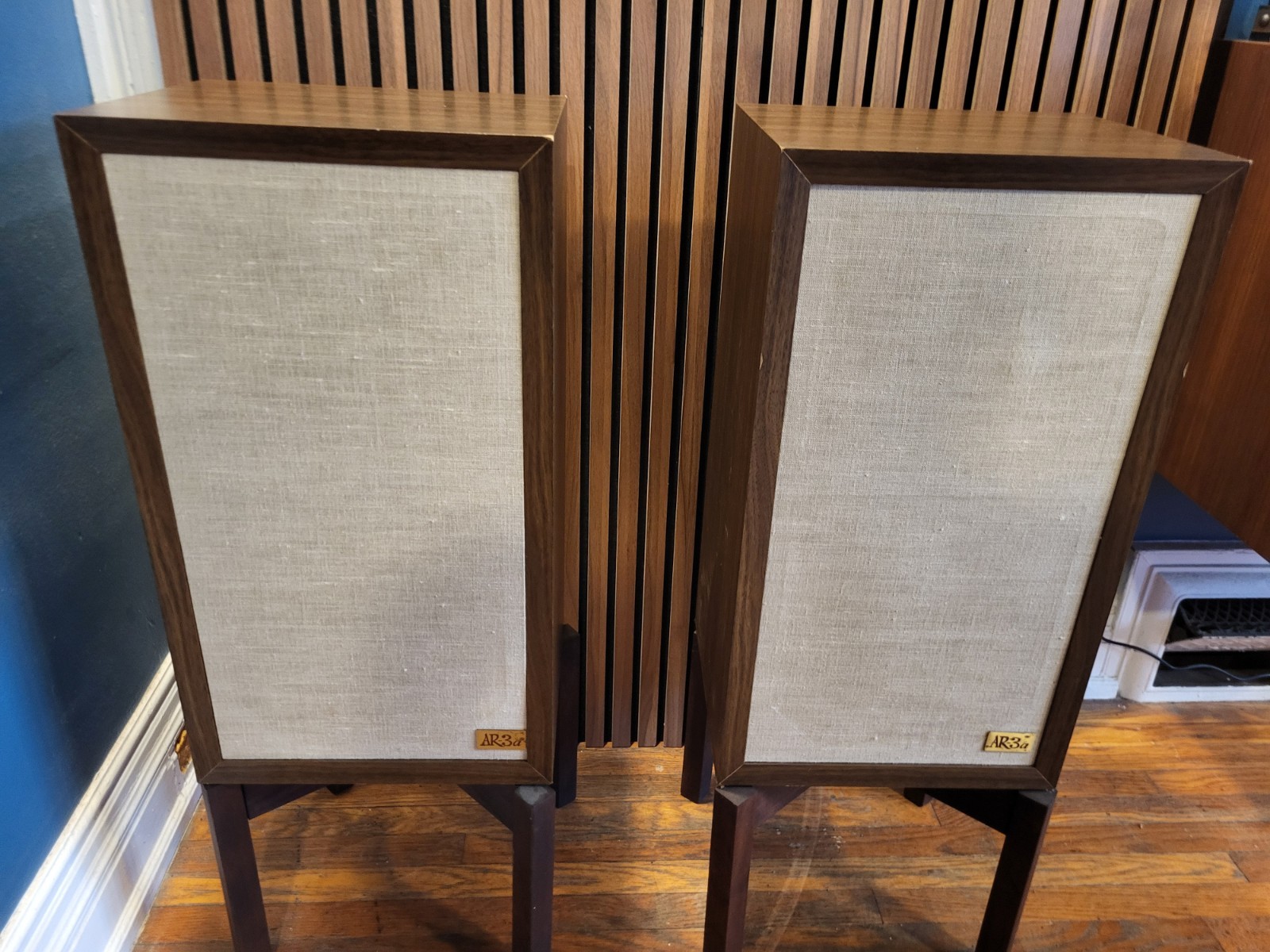
When shopping, look for speakers with intact grilles, clean binding posts, and cabinets free of water rings or warping. The walnut veneer models are more desirable than the black vinyl wrap, though both are functional. Avoid pairs with replaced drivers unless you know they’re original-spec units—some rebuilds use modern woofers that alter the tonal balance.
In terms of value, a fully refoamed, working pair typically sells for $125–$200. Unrestored pairs in good cosmetic condition go for $75–$125, while mint, unopened NOS pairs can fetch $300 or more. That’s a bargain compared to the $500+ prices of AR-3a pairs, and the AR-8s delivers a more practical, modern-friendly sound for most listeners.
One caveat: don’t expect deep sub-bass. The -3 dB point at 74 Hz means it rolls off before the lowest notes on a bass guitar or pipe organ. But in a small room, with proper placement, it sounds full and balanced. Pair it with a modest solid-state amp—NAD, Marantz, or even a vintage receiver—and you’ve got a system that’s both nostalgic and musically satisfying.
eBay Listings


As an eBay Partner, we earn from qualifying purchases. This helps support our independent vintage technology research.