AR Acoustic Research AR-6 (1971–1978)
A bookshelf speaker that punches way above its class, with deep, taut bass and a tweeter that rewrote the rules—just don’t expect it to survive neglect.
Overview
Pull one out of a dusty closet, power it up with a modest receiver, and within seconds you’ll understand why the AR-6 earned quiet reverence from reviewers who’d heard just about everything. It doesn’t roar or dazzle—it settles into the music like it belongs there. The bass is shockingly deep for a compact cabinet, tight and articulate in a way that still feels modern, not boomy or loose like so many of its era. There’s a calm authority to the way it handles acoustic bass lines or the kick drum in a jazz trio, a sense of control that speaks directly to Edgar Villchur’s original acoustic suspension breakthrough. But it’s the top end that surprises most: smooth, detailed, never shrill, even when cranked. That 1.5-inch cone tweeter—later rebranded as 1.25-inch, same physical driver—was a revelation in 1971, and its legacy stretched well into the 1980s across AR’s lineup. It wasn’t just good for its time; it was good, period.
Positioned as AR’s more affordable alternative to the legendary AR-3a and AR-5, the AR-6 wasn’t a budget speaker in compromise—it was a budget speaker in accessibility. It shared engineering DNA with the higher-end models but fit in smaller rooms and tighter budgets. Compared to the AR-4xa, the AR-6 had a lower system resonance (56 Hz vs. 65 Hz), meaning it dug deeper into the bass register despite a slightly smaller internal volume. Visually, it stood a bit taller and wider than the 4xa but traded two inches of depth, making it less of a shelf hog. This wasn’t a cost-reduced model; it was a rethought one, aiming for a sweet spot between performance and practicality.
Still, it never caught fire in the marketplace. Sitting between the compact AR-2ax and the more established AR-4x/AR-7 in AR’s lineup, the AR-6 became a cult favorite rather than a sales juggernaut. Audiophiles who knew about it praised it—High Fidelity magazine likened its transient response to that of an amplifier, and Julian Hirsch noted its astonishing similarity to the AR-5 in both sound and bass performance. But its moment was brief. By the late 1970s, AR had shifted focus, and the AR-6 quietly disappeared. Today, it’s a sleeper in the vintage speaker world—undervalued, underappreciated, and often found in rough shape, which is both its tragedy and its opportunity.
Specifications
| Manufacturer | Acoustic Research |
| Production Years | 1971–1978 |
| Original Price | $130–$150 per pair (approx. $900–$1,050 today) |
| Speaker Type | 2-way acoustic suspension |
| Woofer | 8-inch |
| Tweeter | 1.5-inch cone (later designated 1.25-inch) |
| Impedance | 8 ohms nominal |
| Frequency Response | 56 Hz – 18,000 Hz |
| Woofer Resonance (in enclosure) | 56 Hz |
| Crossover Frequency | 1,600 Hz |
| Recommended Amplifier Power | Up to 100 watts per channel |
| Dimensions (H×W×D) | 19 × 10 × 7 inches |
| Weight | 18.5 lbs per speaker |
| Cabinet Finish | Walnut veneer, unfinished birch, pine |
| Grille | White cloth with foam backing |
| Enclosure Volume | 0.65 cubic feet (18.5 liters) |
| Inputs | Single pair of 5-way binding posts |
| Country of Manufacture | United States |
Key Features
The 1.5-Inch Cone Tweeter That Changed Everything
Most companies in the early 1970s were still wrestling with harsh, fatiguing dome tweeters or fragile ribbons. AR went a different route: a small cone driver made of lightweight material with excellent dispersion and low distortion. Introduced with the AR-6, this tweeter was so well-engineered that a major competitor reportedly approached AR about licensing it. It wasn’t flashy—it didn’t scream detail—but it integrated seamlessly with the woofer, avoiding the “shouty” peak around 2–4 kHz that plagued so many contemporaries. Later versions would add ferrofluid for cooling and longevity, but even the original non-ferrofluid units hold up remarkably well if they’ve been kept away from excessive power or humidity. Its sound is best described as natural: strings don’t grate, cymbals don’t pierce, and vocal sibilance stays under control. For a speaker that cost a fraction of what high-end models did, this tweeter alone elevated the AR-6 into a different conversation.
Acoustic Suspension Done Right
The 8-inch woofer operates in a sealed cabinet tuned to 56 Hz, giving it a bass response that feels more like a larger speaker. Unlike ported designs that can sound boomy or one-note, the AR-6’s bass is fast and well-damped, tracking complex passages without flubbing. This is the Villchur legacy in action: small cabinet, deep output, no port noise. But it comes with a trade-off—efficiency. These are not easy speakers to drive. Sensitivity is modest, and the acoustic suspension design demands current. Low-powered tube amps can work if they have strong output transformers, but solid-state receivers from the late 1970s and beyond—especially those with 40+ watts per channel—are a better match. The payoff is worth it: when properly powered, the AR-6 delivers a cohesive, time-aligned soundstage with excellent imaging for a speaker of its size and era.
Build and Cabinet Design
The cabinet is simple but well-executed: ¾-inch MDF with solid internal bracing, finished in attractive walnut veneer. Early units were made in the USA with high build quality, though later production saw some cost-cutting in trim and finish options. The slightly taller profile compared to the AR-4xa gives it a more commanding presence on a bookshelf, but the reduced depth makes it easier to place close to a wall. The white cloth grilles are iconic, though they yellow over time and often go missing. Replacement foam backing is available, but original grilles with clean foam are a plus for collectors. Mechanically, the binding posts are basic but functional—no bi-wiring, no exotic materials, just solid connections that have held up for decades on surviving units.
Historical Context
The AR-6 arrived in 1971, just as the high-fidelity market was expanding beyond wealthy audiophiles into middle-class living rooms. AR, already famous for the AR-3a and its acoustic suspension innovation, needed a speaker that retained engineering integrity without the flagship price. The AR-6 was that answer—a no-compromise design scaled down in size, not quality. It shared the new 1.5-inch tweeter with the AR-7 and AR-4xa, creating a unified top-end voice across the mid-tier lineup. But timing worked against it. The AR-4x was still widely available and beloved, the AR-2ax offered a smaller footprint for tight spaces, and the AR-5 loomed above as the “affordable AR-3a.” The AR-6, despite critical acclaim, never found a strong marketing identity. It wasn’t the smallest, the cheapest, or the most powerful—just the most balanced. By 1973, AR had introduced the AR-4xa, which siphoned attention, and by the late 1970s, the company was shifting toward more commercial designs. The AR-6’s production run ended quietly, a footnote in a catalog full of legends.
Still, its influence lingered. That tweeter design lived on in AR’s Bxi series into the late 1980s. And the philosophy—deep, controlled bass from a compact cabinet—remains a benchmark. Competitors like Advent and KLH tried to match AR’s bass performance, but few achieved the same blend of speed and extension. The AR-6 wasn’t trying to beat the market—it was trying to refine it.
Collectibility & Value
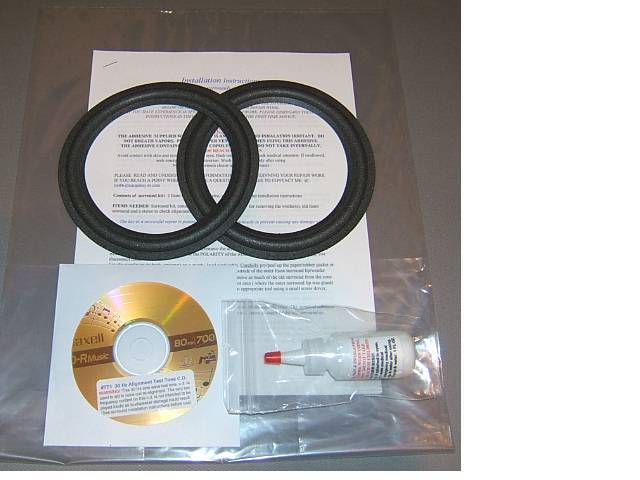
Today, the AR-6 trades under the radar, which is good news for buyers. Pairs in working condition with original drivers typically sell between $150 and $300, depending on cosmetics and whether they’ve been refoamed. Fully restored units with upgraded crossovers and fresh grilles can command $400–$500, but that’s still a bargain compared to AR-3a prices. The biggest threat to value isn’t rarity—it’s neglect. Foam surrounds on the woofers degrade over time, and if they’ve crumbled, the speaker is functionally dead unless repaired. Refoaming is straightforward and costs $30–$50 per pair in DIY kits, but it’s a must-do for any vintage AR-6. More concerning are blown tweeters—while less common, they’re harder to replace. No modern off-the-shelf tweeter matches the original’s response curve, and sourcing NOS units is a gamble.
When buying, check for cabinet integrity—water damage or warping can ruin the seal and kill bass response. Look for original drivers; replaced woofers (especially with modern foam-rimmed units) often don’t match the original tuning. Crossovers should be inspected for cracked capacitors or brittle wiring, though many have held up surprisingly well. If the speaker has been refoamed, ask when and with what kit—cheap foam can disintegrate in five years. And always listen before buying: the bass should be tight, not flabby, and the tweeter should remain smooth even at high volumes.
For new collectors, the AR-6 is a perfect entry point: affordable, repairable, and sonically rewarding. For veterans, it’s a reminder that greatness doesn’t always come in the most famous package. It’s not the rarest AR speaker, nor the most expensive, but it might be the most consistently satisfying for the price.
eBay Listings


As an eBay Partner, we earn from qualifying purchases. This helps support our independent vintage technology research.