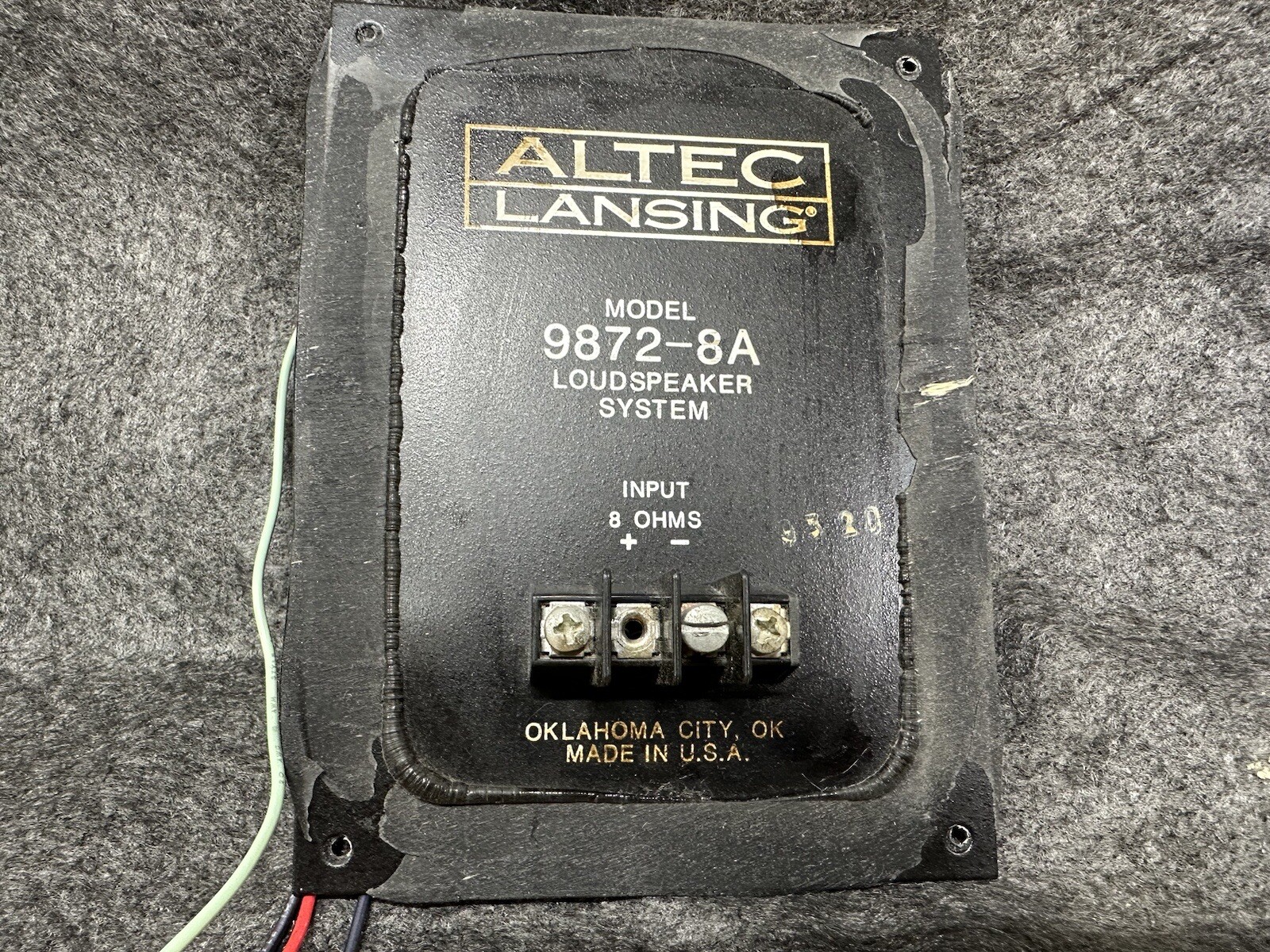
Altec Lansing 9872-8A
The Altec Lansing 9872-8A is a professional two-way loudspeaker system developed during the 1960s to early 1970s, representing the pinnacle of Altec’s studio monitor engineering. Designed for demanding environments such as recording studios, broadcast facilities, and cinema sound reinforcement, the 9872-8A embodies the classic Western Electric heritage of high-efficiency horn-loaded design. Known for its rugged construction and dynamic sound reproduction, this speaker remains a sought-after piece among vintage audio enthusiasts and professional monitor collectors.
Specifications
| Feature | Specification |
| Model | 9872-8A |
| Brand | Altec Lansing |
| Production Era | 1960s – early 1970s |
| Configuration | Two-way, bass-reflex with horn-loaded high end |
| Woofer | 15-inch direct-radiating cone |
| High-Frequency Driver | Compression driver with multicellular horn |
| Impedance | 8 ohms |
| Sensitivity | ~95–98 dB (1W/1m) (estimated) |
| Power Handling | Estimated 20–50W RMS (typical for era) |
| Frequency Response | Approx. 45 Hz – 15 kHz (typical for design) |
| Enclosure Type | Ported cabinet with front-firing bass reflex |
| Dimensions | ~30" H × 15" W × 12" D (varies by cabinet) |
| Weight | ~75 lbs per cabinet |
Historical Context
The Altec Lansing 9872-8A is part of Altec’s renowned A7-series lineage, which traces its roots back to the legendary "Voice of the Theatre" (VOTT) designs developed from Western Electric technology. The 9872-8A evolved from the earlier 604 and 605 models, incorporating refinements in horn geometry, crossover design, and cabinet construction to better suit professional monitoring applications.
Unlike consumer-grade speakers of the era, the 9872-8A was engineered for high sound pressure levels (SPL) and long-term durability, making it ideal for use in movie theaters, dubbing stages, and broadcast studios. Its multicellular horn provides controlled dispersion and low distortion, while the large 15-inch woofer delivers authoritative bass response without the need for external subwoofers.
This model reflects a transitional period in professional audio, bridging the gap between the pure horn-loaded systems of the 1950s and the more neutral studio monitors that emerged in the 1980s. Its sound signature—forward mids, punchy dynamics, and horn-defined clarity—offers a distinctive sonic character that many engineers and audiophiles still prize today.
Sound Signature
The 9872-8A delivers a bold, expressive sound shaped by its high-efficiency design:
- Midrange: Exceptionally clear and present, ideal for vocal and instrumental clarity
- Highs: Crisp and detailed with the characteristic "honeyed" warmth of vintage compression drivers
- Bass: Deep and impactful for its era, enhanced by the bass-reflex cabinet
- Overall Character: Dynamic, immediate, and engaging—perfect for critical listening in large rooms or immersive environments
Due to its high sensitivity, the 9872-8A pairs exceptionally well with low-powered tube amplifiers, allowing even 10–20 watt amps to drive them to impressive volume levels with minimal distortion.
Maintenance and Restoration Tips
As with all vintage professional speakers, proper maintenance is crucial to preserving performance and value. The 9872-8A, while robustly built, may require restoration after decades of use or storage.
Common Issues and Solutions
- Woofer Surrounds: Original foam or cloth surrounds often degrade over time. Re-foaming or reconing by a specialist is recommended to restore bass response and prevent damage.
- Crossover Components: Paper and early electrolytic capacitors in the passive crossover may dry out or fail. Replacing with modern film capacitors improves reliability and sonic clarity.
- Compression Driver Diaphragms: Check for tears or distortion in the aluminum diaphragm. Replacement or re-doping may be necessary for optimal high-frequency performance.
- Horn Throat Gaskets: Ensure airtight seal between driver and horn. Deteriorated gaskets can cause acoustic leaks and loss of efficiency.
- Cabinet Integrity: Inspect for wood rot, especially in older cabinets. Reinforce joints and refinish as needed to maintain structural rigidity.
Restoration Advice
- Use period-correct or upgraded components that preserve the original character
- Retain original labels and hardware for collectibility
- Consider professional alignment and crossover tuning post-restoration
- Store in a climate-controlled environment to prevent future degradation
Market Value and Collectibility
The Altec Lansing 9872-8A holds steady appeal in the vintage audio market:
- Market Value: $800–$1,500 per pair, depending on condition, originality, and restoration quality
- Collectibility Rating: 7/10 — highly valued by studio monitor collectors and horn speaker enthusiasts
- Demand Drivers: Studio heritage, professional build quality, and distinctive sonic character
Fully original, well-maintained pairs command premium prices, especially those with documented provenance from broadcast or cinema use.
Conclusion
The Altec Lansing 9872-8A stands as a testament to the golden age of professional loudspeaker design. Combining rugged engineering, high efficiency, and a vivid, engaging sound, it remains a compelling choice for vintage audio aficionados and studio monitor collectors. With proper care and restoration, the 9872-8A continues to deliver a powerful and authentic listening experience that modern speakers often struggle to replicate.
eBay Listings



As an eBay Partner, we earn from qualifying purchases. This helps support our independent vintage technology research.
Related Models
- Altec 1221A
- Altec 3000B
- Altec 600B
- Altec 603
- Altec A4X
- Akai AM-2850 (1975)
- Akai AP-206 (1975)
- Nakamichi BX-1 (1985)
- Acoustic Research research-ar-17 (1978)
- Acoustic Research AR-19 (1994)