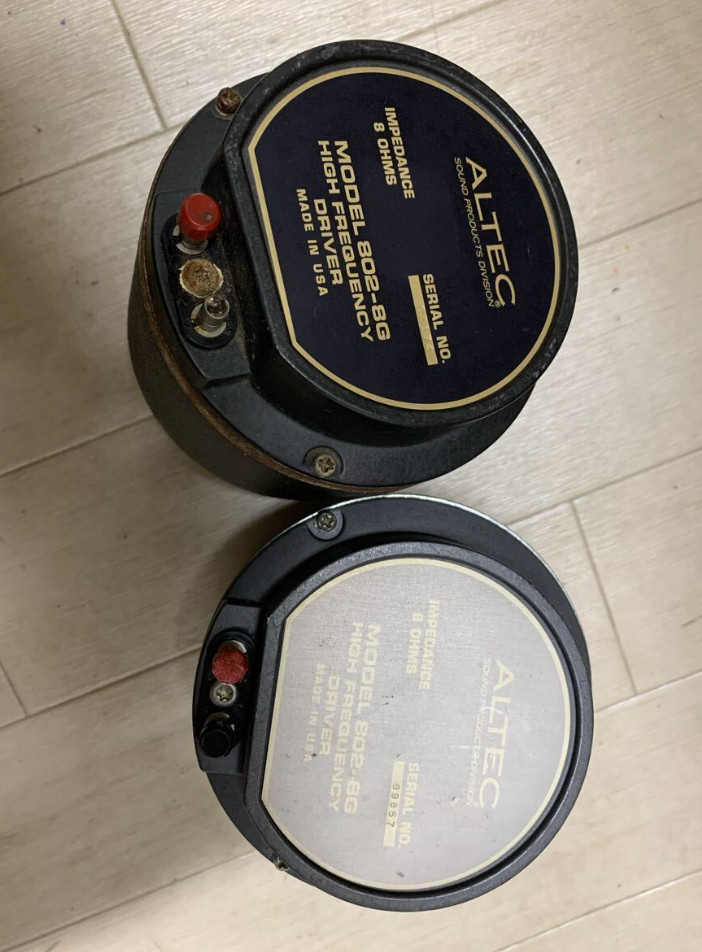
Altec Lansing 802-8C High-Frequency Compression Driver
The Altec Lansing 802-8C is a legendary high-frequency compression driver that played a pivotal role in shaping the sound of mid-20th-century professional audio. Produced from the 1950s through the 1970s, this driver became a cornerstone in many of Altec’s most celebrated speaker systems, including the iconic A7 Voice of the Theatre and the 604 Duplex. Known for its exceptional clarity, high sensitivity, and robust construction, the 802-8C remains a sought-after component among vintage audio enthusiasts, studio restorers, and high-fidelity collectors.
Specifications
| Parameter | Specification |
| Model | Altec Lansing 802-8C |
| Year of Production | 1950s–1970s |
| Power Handling | 30W RMS (driver only) |
| Nominal Impedance | 16 ohms |
| Sensitivity | 110 dB (1W/1m) |
| Diaphragm | 2-inch aluminum (early), phenolic (later models) |
| Throat Exit | 1-inch |
| Phase Plug | Radial design |
| Application | Horn-loaded high-frequency driver |
| Weight | 3.5 lbs (1.6 kg) |
| Mounting Pattern | Standard 4-bolt horn interface |
Historical Significance
The 802-8C was engineered as a high-efficiency driver for professional sound reinforcement and studio monitoring applications. It was specifically designed to be paired with exponential or constant-directivity horns, delivering extended high-frequency response with minimal distortion. Its integration into the Altec A7 cabinet—affectionately known as the "Voice of the Theatre"—cemented its status in audio history. These systems were widely adopted in cinemas, broadcast studios, and live venues during the 1950s and 60s.
The 802-8C’s radial phase plug design improved high-frequency dispersion and reduced resonance, setting a new benchmark for clarity in compression drivers. Its use in the Altec 604 series, a mainstay in American recording studios, further solidified its reputation. The driver’s ability to reproduce vocals and brass instruments with lifelike presence made it a favorite among audio engineers.
Sound Signature
The 802-8C delivers a clear, detailed, and dynamic high-frequency response with a slightly forward presentation. Its strength lies in midrange articulation and smooth upper mids, making it exceptionally well-suited for vocal reproduction and acoustic instruments like trumpets and saxophones. When properly mated with a compatible horn—such as the Tangerine or bullet-style designs—the driver exhibits excellent dispersion and coherence.
Due to its high sensitivity, the 802-8C pairs well with low-powered tube amplifiers, making it a favorite in vintage hi-fi restorations. However, optimal performance depends heavily on correct horn loading and crossover integration.
Common Issues and Maintenance Tips
Despite its robust build, the 802-8C is subject to age-related wear. Common issues include:
- Diaphragm fatigue or failure: Early aluminum diaphragms are prone to cracking after decades of use. Later phenolic versions are more durable and less susceptible to fatigue.
- Magnet corrosion: Units stored in humid environments may develop corrosion on the magnet structure, affecting magnetic field strength and efficiency.
- Gasket deterioration: The sealing gasket between the driver and horn can dry out or crumble, leading to acoustic leaks and reduced performance.
- Oxidized connections: Terminal tabs may tarnish over time, increasing resistance. Cleaning with electrical contact cleaner is recommended.
Maintenance Recommendations:
- Inspect the diaphragm under magnification for tears or warping.
- Replace deteriorated gaskets with modern neoprene equivalents for improved seal and longevity.
- Use a demagnetizer tool if magnetic field weakness is suspected.
- Store in a dry, temperature-controlled environment to prevent future degradation.
- When replacing diaphragms, consider upgrading to phenolic for improved reliability.
Collectibility and Market Value
The Altec 802-8C scores an 8/10 on the collectibility scale due to its historical importance, widespread use in classic systems, and enduring sonic reputation. Drivers in working condition with original phenolic diaphragms typically command higher prices. NOS (New Old Stock) units can fetch premiums, especially when accompanied by original packaging or documentation.
As of 2024, market values range from $200 to $400 per driver, depending on condition, diaphragm type, and provenance.
Conclusion
The Altec Lansing 802-8C stands as a milestone in compression driver design. Its combination of engineering excellence, sonic clarity, and historical impact ensures its continued relevance in vintage audio circles. Whether used in a restored Voice of the Theatre system or integrated into a modern horn project, the 802-8C delivers a listening experience that few drivers of its era can match. For collectors and audiophiles alike, it remains a worthy investment in the legacy of American audio innovation.
eBay Listings



As an eBay Partner, we earn from qualifying purchases. This helps support our independent vintage technology research.
Related Models
- Altec 804A
- Altec 288-16K (1975)
- Altec 802-8E (1975)
- Altec 806-8B (1975)
- Altec H-1003 (1975)
- Heathkit AA-2010 (1975)
- Sony MDR-4 (1978)
- Sony MDR-80 (1975)
- Sony MDR-A60 (1975)
- Accuphase DG-28