Altec Model 633A (1949–late 1960s)
At 10 ounces and barely 3½ inches long, it fits in the palm like a forgotten relic—until you hear the kick drum come alive.
Overview
The Altec Model 633A isn’t built for subtlety. It’s a compact, no-frills moving coil dynamic microphone that spent decades in radio booths and broadcast studios, doing the kind of work that didn’t require掌声—just durability and presence. Originally developed by Western Electric as their final dynamic mic design before shifting focus, the 633A emerged in 1937 and was later taken over by Altec Lansing after the spin-off of ERPI. Production under the Altec name began in 1949 and continued into the late 1960s, with some sources citing a peak in the mid-60s. Its nickname, “Salt Shaker,” comes from the distinctive ridged casing and perforated top, a utilitarian design that prioritized function over form.
Despite its age, the 633A carved out a second life in modern recording, not for fidelity, but for character. Reviewers describe it as a “great ‘go-to’ lo-fi mic,” with a bright, raspy top end that cuts through dense mixes. It’s not a neutral microphone—far from it. The frequency response spans 35 Hz to 12,000 Hz, but real-world use reveals a pronounced upper-mid bite that demands de-essing on lead vocals. Still, that same edge makes it ideal for background vocals, where it can sit just behind the lead without blending in. For punk-rock guitar solos or snappy acoustic textures at a distance, it delivers an “odd-sounding” but effective tone. But its most surprising application? Inside the kick drum. There, it produces a tight, beater-forward sound with low-end clarity that some describe as surprisingly modern—so much so that it can stand alone or complement an external mic when the bass needs more room.
The 633C variant builds on this with selectable impedance (30/50 or 150/250 ohms), thanks to an internal transformer, while the original 633A runs at a fixed 30 ohms directly off the voice coil. Altec’s switch from aluminum (used in Western Electric versions) to Mylar for the diaphragm reportedly smoothed the response slightly, though the core sonic signature remains aggressive and unapologetic. Mounting is standard via a ⅝"-24 thread, and placement flexibility allows for vertical (omnidirectional) or horizontal (directional) use, though documentation on this behavior is sparse.
Specifications
| Manufacturer | Altec Lansing |
| Product type | Moving Coil Dynamic microphone |
| Production years | Manufactured from 1949 to around the late 1960s |
| Type | Moving Coil Dynamic |
| Frequency Response | 35 to 12,000 cycles |
| Polar pattern | Omnidirectional |
| Output Impedance | 30/50 ohms |
| Output Level | –55 dBm/10 dynes/cm² |
| Dimensions | 3½ inches long, 2 inches diameter |
| Weight | 10 ounces |
| Finish | Instrument gray |
| Mounting | ⅝"-24 thread |
| Impedance type | Single impedance mic |
| Internal construction | Has no transformer |
| Diaphragm material | Mylar |
Key Features
Salt Shaker Form Factor with Perforated Dome
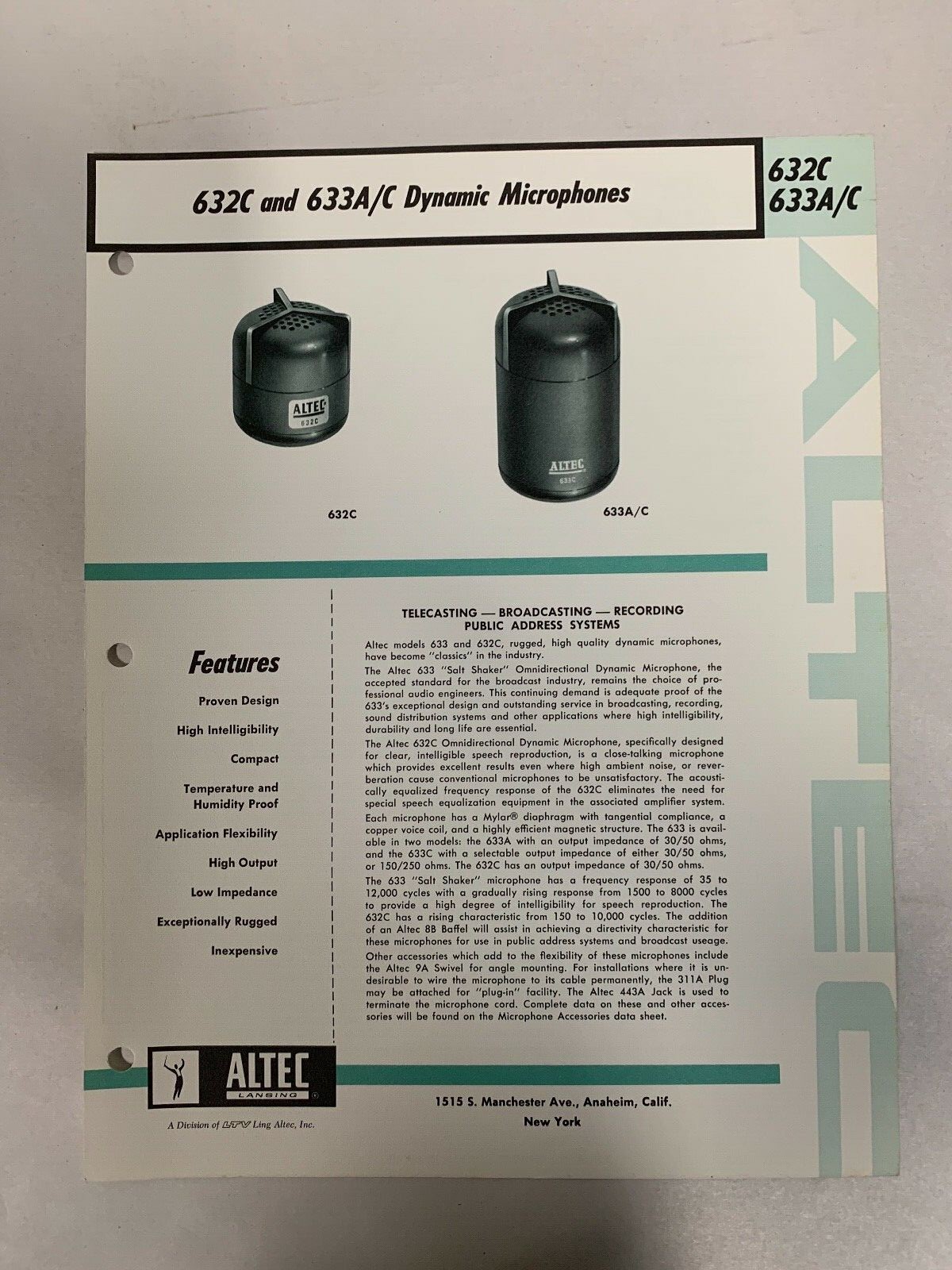
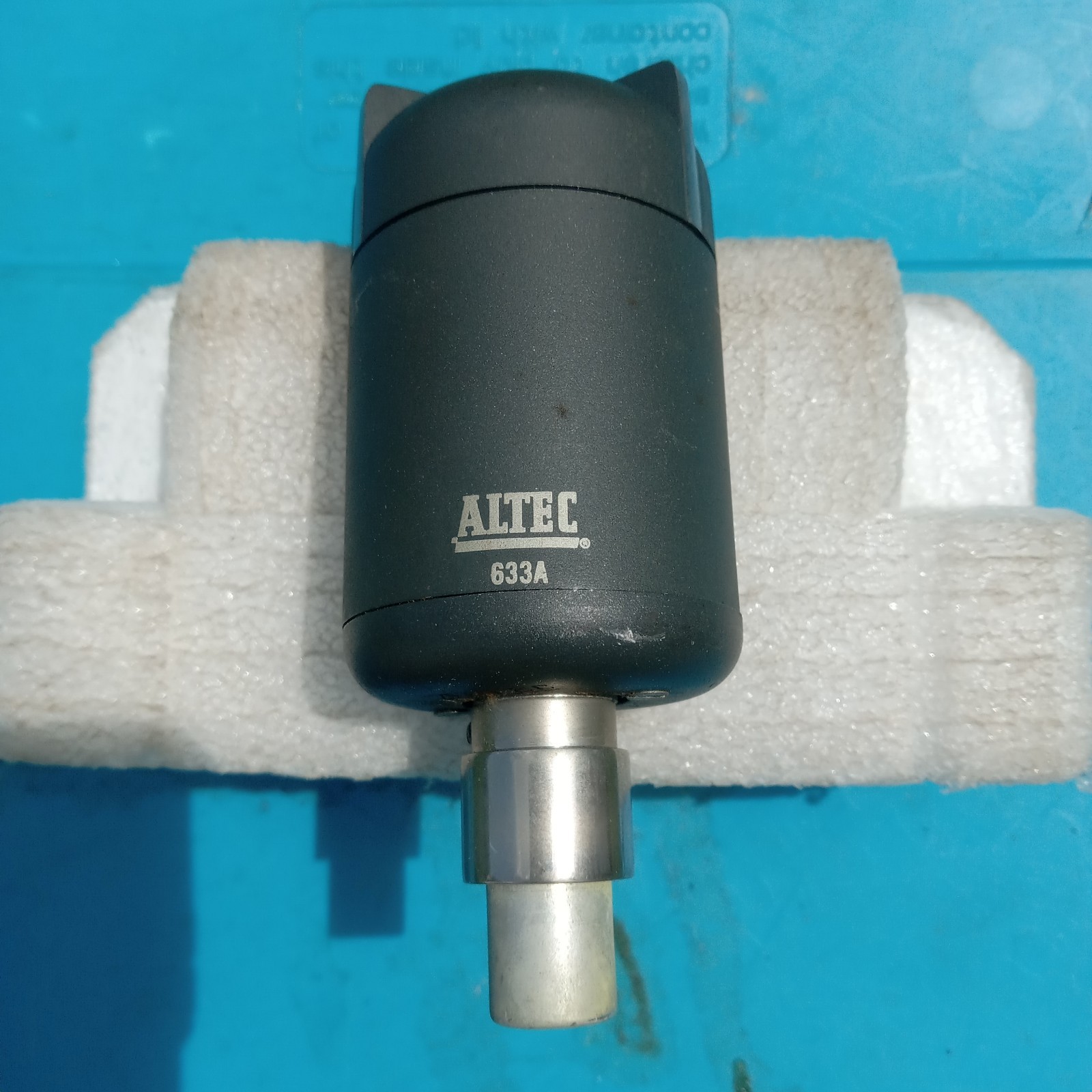
The nickname “Salt Shaker” isn’t just nostalgic branding—it’s a literal description. The microphone’s cylindrical body, measuring just 3½ inches long and 2 inches in diameter, is capped with a series of small holes arranged in concentric rings across the top. This perforated dome protects the internal diaphragm while allowing omnidirectional sound entry. The ridged edges provide grip and a visual signature that’s instantly recognizable on studio shelves or vintage radio consoles. Built entirely in instrument gray, it exudes industrial pragmatism, with no cosmetic flourishes.
Fixed 30 Ohm Output with Direct Voice Coil Connection
Unlike later variants, the 633A delivers a fixed output impedance of 30 ohms, tapped directly from the voice coil without the use of a transformer. This minimalist approach contributes to its ruggedness and low-noise operation in high-SPL environments. However, it also means the mic demands careful impedance matching with preamps, especially in modern setups where higher input impedances are standard. The lack of a transformer simplifies the signal path but limits versatility compared to transformer-coupled designs.
Mylar Diaphragm for Smoother Response vs. Aluminum Original
When Altec took over production from Western Electric, one of the key changes was the replacement of the original aluminum diaphragm with one made of Mylar. According to available documentation, this shift was intended to produce a smoother frequency response. While the spec sheet still lists the same 35 Hz–12 kHz range, user reports suggest the Mylar version tames some of the harshness inherent in earlier builds, making it slightly more usable in contemporary recording scenarios.
Threaded Brass Ring That Resists Disassembly
Owners report that the brass ring securing the casing is threaded with excessive force during assembly, making disassembly a notorious challenge. Forum accounts consistently describe attempts to open the mic as “a friggin’ NIGHTMARE,” with the ring often requiring specialized tools or risking damage to the housing. This over-torquing appears to be a manufacturing standard rather than an anomaly, suggesting Altec prioritized long-term durability over serviceability.
Historical Context
The Altec 633A traces its roots directly to Western Electric, where it was introduced in 1937 as the company’s last dynamic microphone design, following the iconic “Eight Ball” (618A). After ERPI—the audio division of Western Electric—was spun off in 1937, it eventually became Altec, which continued manufacturing the 633A under its own name starting in 1949. The microphone saw widespread use in broadcast environments, including radio stations and the United Nations, where reliability and clarity under pressure were paramount. Its longevity in production—nearly two decades under Altec—speaks to its effectiveness in professional settings where maintenance was minimal and uptime critical.
Collectibility & Value
In 2004, the Altec 633A was reportedly selling for $100–$150, but the market has shifted significantly since. More recent examples have sold for over $600 each, reflecting growing demand among engineers seeking its unique tonal character. However, collectibility comes with caveats. The diaphragm is prone to being “smashed in” or “locked up,” often resulting in a loss of low-end response—a common failure mode that renders the mic nearly unusable without repair. Restoration is possible, but the difficulty of disassembly means most owners rely on specialists who may charge a standard rate for servicing. As a result, working condition significantly affects value, and non-functional units are often passed over despite their pedigree.
eBay Listings

As an eBay Partner, we earn from qualifying purchases. This helps support our independent vintage technology research.