Altec 601 Duplex
1946 - 1954
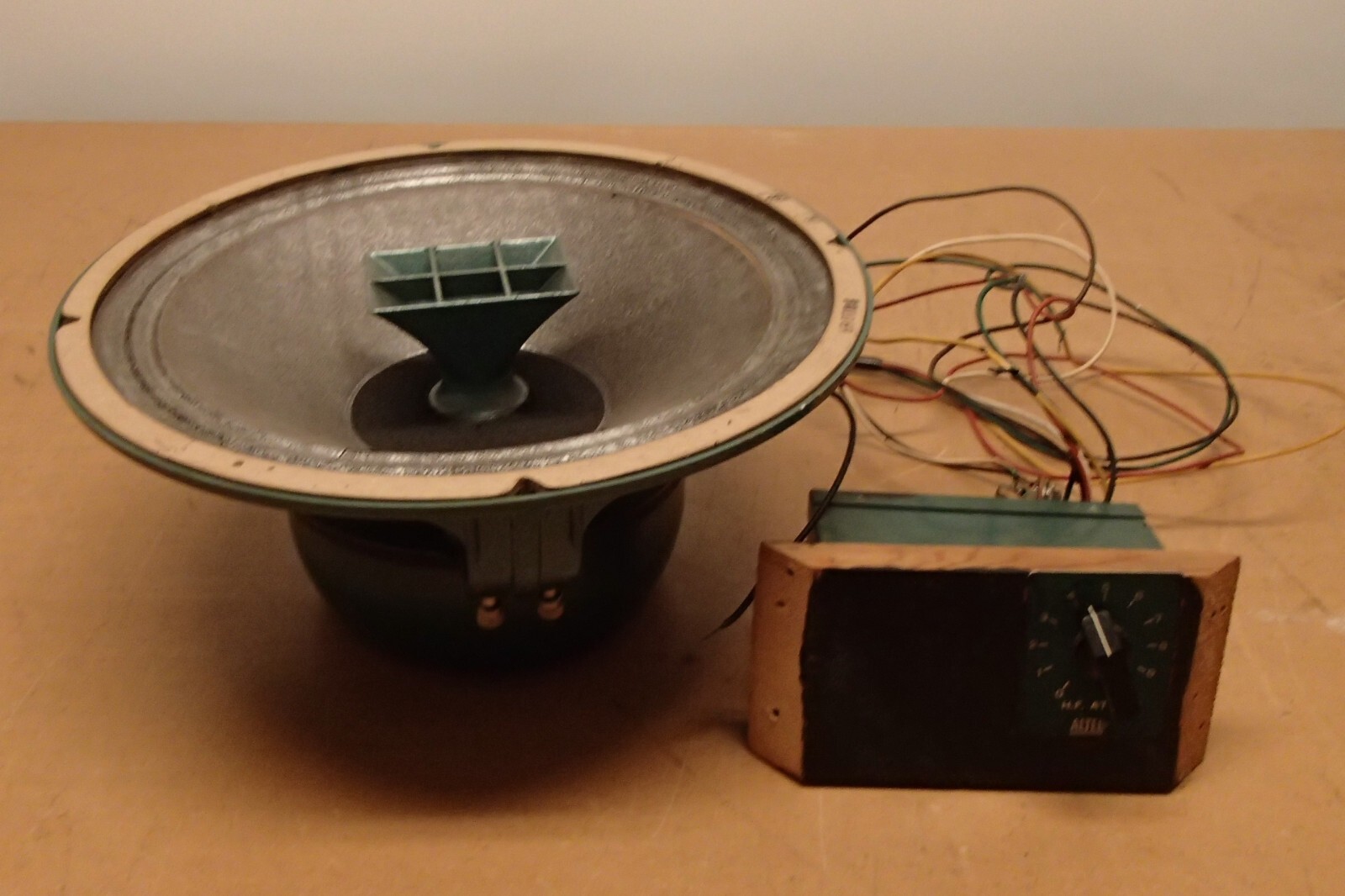
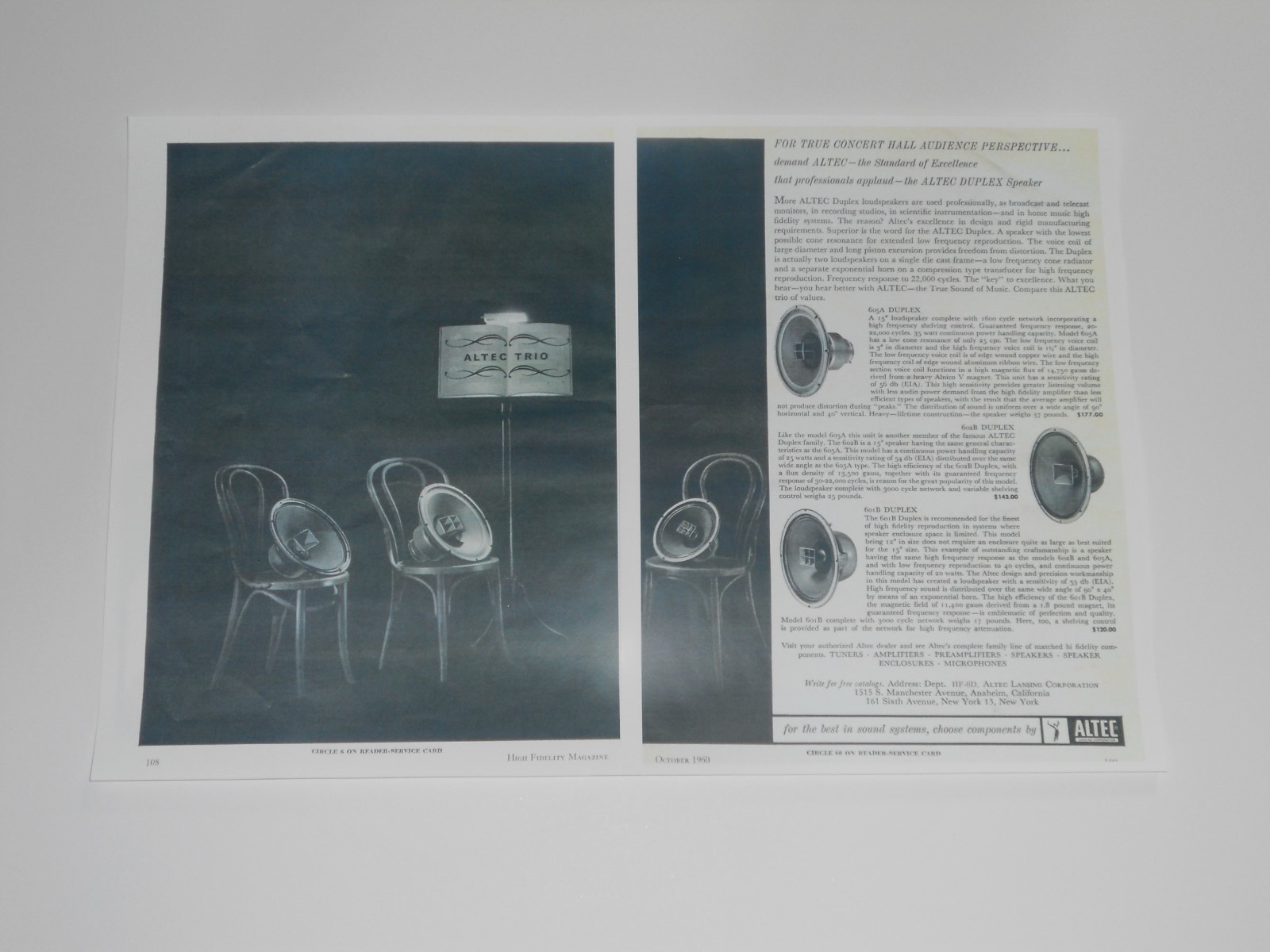
The Altec 601 Duplex was the predecessor to the legendary 604 series, establishing the coaxial loudspeaker concept that would define Altec Lansing for decades. Using a 12-inch woofer instead of the later 604's 15-inch driver, the 601 laid the groundwork for what would become the world's most famous studio monitor lineage.
Specifications
| Type | 2-way coaxial loudspeaker (Duplex) |
|---|---|
| Low Frequency Driver | 12" cone with 2.5" voice coil |
| High Frequency Driver | Compression driver with 1.5" diaphragm |
| Horn | Sectoral horn integrated into pole piece |
| Crossover Frequency | 1,500 Hz |
| Nominal Impedance | 8 Ω or 16 Ω |
| Power Handling | 25W continuous |
| Sensitivity | 95 dB/W/m |
| Frequency Response | 40 Hz - 16 kHz |
| Magnet Structure | Alnico V |
| Weight | Approximately 35 lbs |
Historical Context
The 601 Duplex was introduced in the immediate post-WWII era when Altec Lansing was establishing itself as a premier manufacturer of professional audio equipment. It represented an early attempt at creating a point-source loudspeaker where both low and high frequencies emanated from the same acoustic center—a concept that would prove revolutionary in studio monitoring.
The 601 found particular use in:
- Early broadcast studio monitors
- Film production monitoring
- Small theater installations
- Recording studio nearfield monitoring
The Evolution to the 604
The 601 established the basic Duplex formula that would be refined into the legendary 604 series. The key differences between the 601 and later 604 models were:
- 12" vs 15" Woofer: The 601 used a smaller 12-inch low-frequency driver
- Smaller Voice Coil: 2.5" coil compared to the 604's 3" voice coil
- Lower Power Handling: 25W vs 50W for later 604 models
- More Compact: Lighter and smaller than the professional 604 series
Studio Monitor Heritage
The 601 was used in Altec's early studio monitor systems, including variations of the 9840 series monitors. While not as famous as its 604 successor, the 601 established the coaxial monitor concept that would dominate recording studios for decades.
The Duplex design offered several advantages for studio use:
- Point Source: Single acoustic center for accurate imaging
- Time Alignment: Inherent time coherence between drivers
- Compact Footprint: Two-way performance from a single driver
- Consistent Off-Axis: Uniform dispersion pattern
Collectibility Today
Vintage 601 Duplex drivers are relatively rare today, as they were superseded by the 604 within a decade and many were upgraded or replaced over the years. When found, they represent an important piece of audio history as the genesis of the coaxial studio monitor concept.
Restoration of 601 drivers requires similar techniques to the 604 series:
- Reconing with appropriate surround materials
- Diaphragm replacement for the compression driver section
- Crossover capacitor replacement
- Magnetic structure inspection
eBay Listings


As an eBay Partner, we earn from qualifying purchases. This helps support our independent vintage technology research.
Documentation
- Altec Datasheets - Historical specifications
- Altec Lansing Unofficial - Historical documentation
Related Models
- Altec 1221A
- Altec 3000B
- Altec 600B
- Altec 603
- Altec A4X
- Akai AM-2850 (1975)
- Akai AP-206 (1975)
- Nakamichi BX-1 (1985)
- Acoustic Research research-ar-17 (1978)
- Acoustic Research AR-19 (1994)