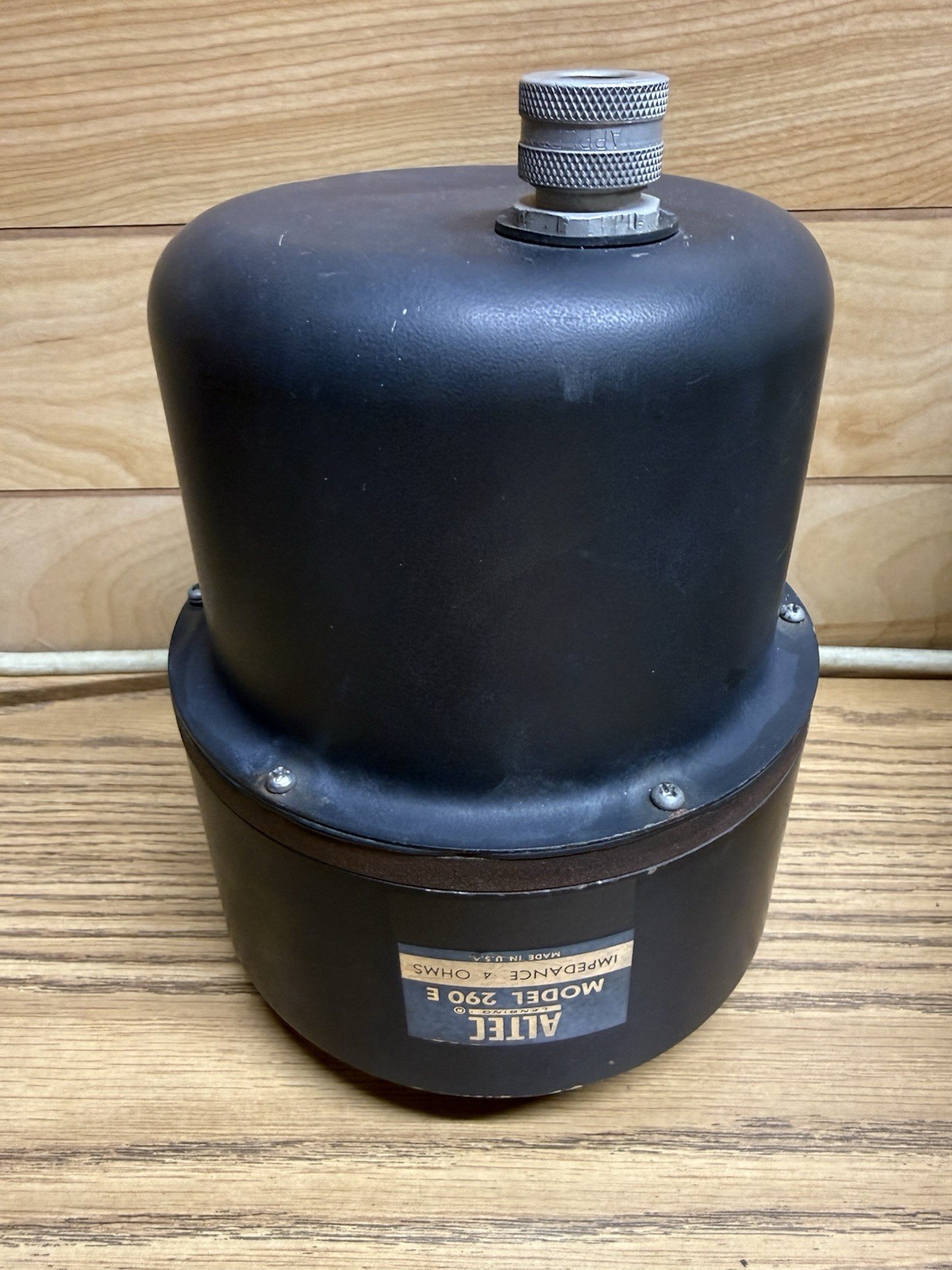
Altec Lansing 290E Compression Driver
The Altec Lansing 290E is a high-efficiency 2-inch throat compression driver produced during the 1960s and 1970s. Renowned for its robust build and exceptional output capabilities, the 290E was a staple in professional audio environments, particularly in cinema sound systems, public address installations, and high-fidelity monitoring setups. As part of Altec’s prestigious lineup of professional drivers, the 290E exemplifies the company’s commitment to reliability, clarity, and high sound pressure levels.
Specifications
| Parameter | Specification |
| Manufacturer | Altec Lansing |
| Model | 290E |
| Type | Compression Driver (HF) |
| Throat Size | 2 inches |
| Diaphragm Material | Aluminum; phenolic in some variants |
| Impedance | 16 ohms |
| Sensitivity | 110–112 dB (1W/1m) |
| Frequency Response | Designed for use with multicellular horns |
| Horn Compatibility | Multicellular and constant-directivity horns |
| Power Handling | Not officially rated (driver only) |
| Intended Use | Professional PA, cinema, studio monitoring |
| Production Era | 1960s–1970s |
Historical Context
The Altec Lansing 290E emerged during a golden era of professional audio development, when theaters and large venues demanded reliable, high-output sound reinforcement. As a successor to earlier models like the 285 and 286, the 290E offered improved efficiency and durability, making it a preferred choice for integration with Altec’s iconic multicellular horns such as the 802 and 811.
Altec Lansing had already established a dominant presence in cinema sound by the mid-20th century, and the 290E reinforced that reputation. It was commonly paired with low-frequency drivers in multi-way systems, delivering crisp, articulate high-frequency reproduction even at high volume levels. Its use extended beyond movie theaters into broadcast studios, houses of worship, and outdoor public address systems.
The 290E is often associated with the "Altec sound"—a balance of clarity, dynamic range, and slight upper-midrange presence that, when properly implemented, delivers a lively and engaging listening experience.
Sound Signature
The 290E is known for its clear, detailed, and dynamic high-frequency response. With a sensitivity rating between 110 and 112 dB, it is extremely efficient, requiring minimal amplifier power to achieve high output levels. When mated with an appropriate multicellular horn, it delivers wide dispersion and smooth high-frequency extension.
However, the driver can sound bright or even harsh if used with poorly matched horns or crossovers. Its performance is highly dependent on the horn loading and system design. In well-engineered systems, the 290E offers a transparent and energetic presentation, making it a favorite among vintage audio enthusiasts and restorers.
Maintenance and Restoration Tips
Due to its age, the Altec 290E may require maintenance to restore optimal performance:
- Diaphragm Inspection: Check for tears, warping, or corrosion on the aluminum or phenolic diaphragm. Replacement diaphragms are available from specialty vendors, though phenolic versions are rarer.
- Voice Coil and Gap Cleanliness: Ensure the magnetic gap is free of debris. Use a small brush or adhesive tape to remove particles—never insert metal tools.
- Re-magnetization: Over decades, the Alnico magnet may weaken. Re-magnetizing the driver can restore sensitivity and performance.
- Terminal and Wiring Check: Inspect for oxidation or broken connections. Clean terminals with contact cleaner and replace frayed leads.
- Horn Matching: Use with original-spec multicellular horns (e.g., 802C, 811) for best results. Mismatched horns can lead to uneven frequency response and distortion.
Restored 290E drivers are often used in vintage speaker re-creations or high-efficiency home audio systems, where their dynamic punch and clarity shine.
Collectibility and Market Value
The Altec 290E holds a collectibility rating of 7/10. While not as rare as some of Altec’s earlier drivers, it is highly sought after by professional audio historians, cinema restorers, and high-efficiency speaker enthusiasts.
- Market Value: $100–$300 per unit, depending on condition, diaphragm type, and originality.
- Higher Value: Units with intact phenolic diaphragms or original packaging command premium prices.
- Availability: Still relatively available on secondary markets such as eBay, audio forums, and vintage speaker restoration shops.
Conclusion
The Altec Lansing 290E remains a benchmark in vintage compression driver design. Its combination of high efficiency, rugged construction, and sonic clarity made it a workhorse in professional audio for decades. Today, it continues to be valued not only as a restoration component but also as a performance driver in modern high-efficiency audio systems. Properly maintained, the 290E delivers a listening experience that few modern drivers can replicate—authentic, dynamic, and full of presence.
eBay Listings


As an eBay Partner, we earn from qualifying purchases. This helps support our independent vintage technology research.
Related Models
- Altec 1224A
- Altec 1592A
- Altec 26420 (1975)
- Altec 288D (1975)
- Altec 288L (1975)
- Luxman L-530 (1975)
- Luxman R-404 (1975)
- Luxman RV-371 (1975)
- Luxman SQ-38U (1975)
- Luxman T-14 (1972)