Altec Lansing 290C Compression Driver
The Altec Lansing 290C is a high-efficiency 2-inch compression driver produced during the 1960s and 1970s as part of Altec's professional audio lineup. Revered for its role in cinema, broadcast, and high-fidelity sound reinforcement systems, the 290C exemplifies the golden era of horn-loaded loudspeaker design. It was commonly integrated into iconic speaker systems such as the Altec A7 Voice of the Theatre, where its clarity and output capability helped define the sound of live and recorded audio in its time.
Specifications
| Parameter | Specification |
| Manufacturer | Altec Lansing |
| Model | 290C |
| Type | Compression Driver |
| Diaphragm Size | 2 inches |
| Diaphragm Material | Aluminum (standard), phenolic (some variants) |
| Impedance | 16 ohms |
| Sensitivity | Approximately 110 dB (1W/1m) |
| Frequency Response | Designed for high-frequency reproduction (system-dependent) |
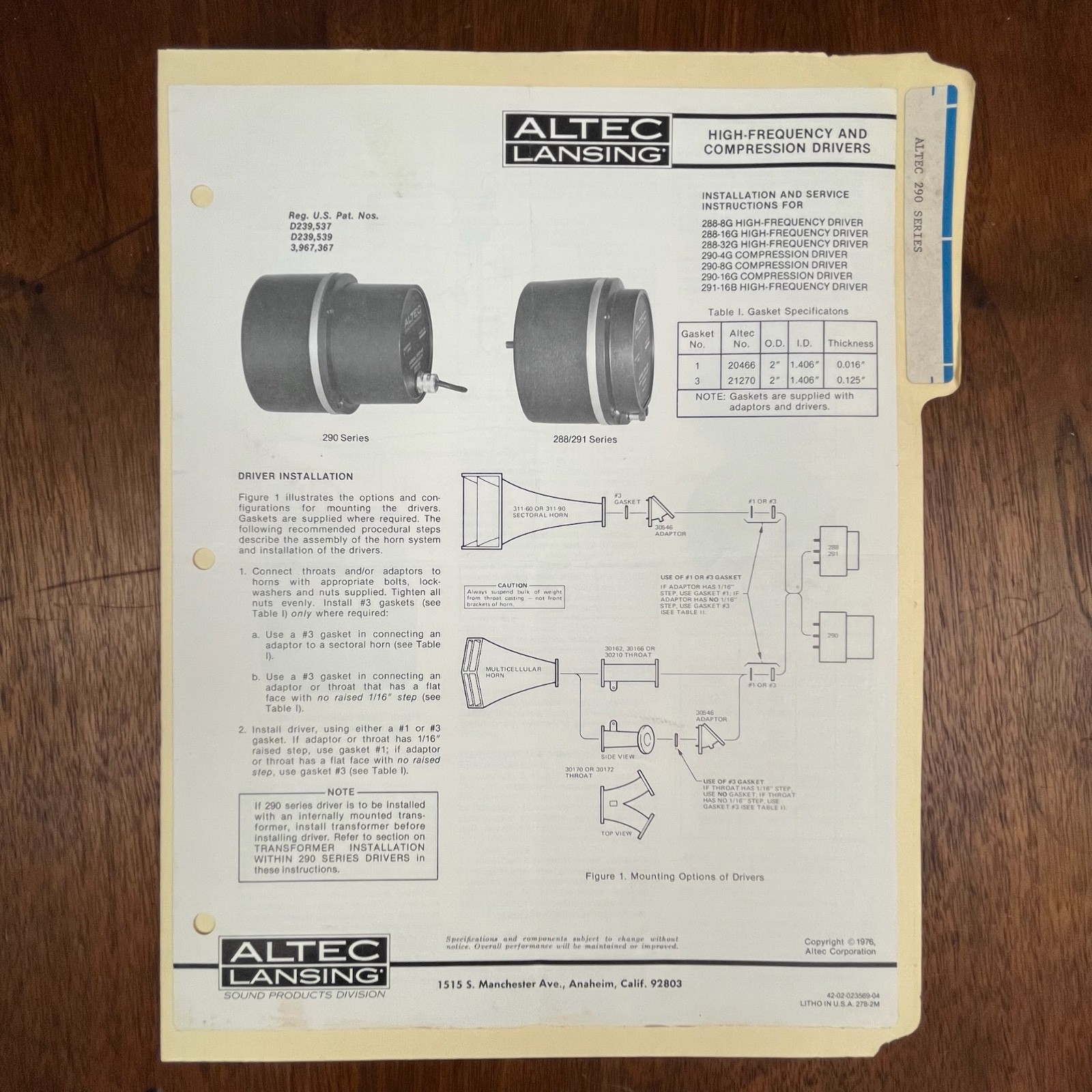
| Horn Compatibility | Multicellular horns (e.g., 802C, 811B) |
| Power Handling | Not independently rated; system-dependent |
| Production Period | 1960s–1970s |
| Intended Use | Professional audio, theater, high-fidelity |
Historical Context
The Altec Lansing 290C emerged during a transformative period in audio engineering when high-efficiency horn systems dominated professional sound environments. As a successor to earlier drivers like the 285C and 286C, the 290C offered improved power handling and extended high-frequency response, making it ideal for demanding applications in movie theaters, public address systems, and studio monitoring.
Its most famous application was in the Altec A7 Voice of the Theatre speaker system, a biamped configuration that paired the 290C with a 15-inch low-frequency driver and a passive crossover. The A7 became a benchmark for sound clarity and dynamic range, widely adopted in cinemas and later embraced by audiophiles for home use.
The 290C's design emphasized reliability and sonic precision, featuring a robust voice coil and phase plug optimized for use with multicellular horns. These horns reduced high-frequency diffraction and improved dispersion, contributing to the driver’s legendary clarity and punch.
Sound Signature
The 290C delivers a bright, articulate, and dynamic high-frequency response with exceptional midrange presence. Its high sensitivity allows it to achieve high sound pressure levels with relatively low amplifier power, making it ideal for use with tube amplifiers.
However, the driver’s forward character can become harsh if mismatched with improper horns or crossovers. When properly integrated—especially with Altec’s 802C or 811B multicellular horns—the 290C reveals its true potential: detailed, lively, and immersive sound with excellent transient response.
Maintenance and Restoration Tips
Due to its age, vintage 290C units often require servicing to restore optimal performance. Common issues include:
- Diaphragm degradation: Aluminum diaphragms may fatigue or corrode over time, leading to distortion or failure. Replacement with original-spec or modern phenolic diaphragms is recommended.
- Magnet weakening: Older units may have weakened magnetic fields. Remagnetizing the driver restores sensitivity and efficiency.
- Adhesive and seal deterioration: Aging adhesives in the voice coil assembly or phase plug can cause mechanical noise. Re-coning or professional servicing may be necessary.
- Corrosion and oxidation: Check terminals and internal wiring for signs of corrosion. Clean contacts and replace damaged leads as needed.
For best results, pair the 290C with period-correct horns and crossovers. Modern restoration services specialize in Altec drivers and can provide authentic rebuilds using original materials and techniques.
Collectibility and Market Value
The Altec 290C holds strong appeal among vintage audio enthusiasts, particularly those restoring Voice of the Theatre systems or building high-efficiency horn speakers. Its collectibility is rated 7/10, driven by its historical significance and sonic performance.
As of recent market trends, individual 290C drivers sell for $100–$300, depending on condition, originality, and whether they have been restored. Units with original labels, unmodified coils, and intact magnets command premium prices. Drivers paired with matching horns or sold as part of complete A7 systems can exceed $1,000.
Conclusion
The Altec Lansing 290C remains a cornerstone of vintage professional audio. Its combination of high efficiency, clarity, and durability made it a favorite in both commercial and high-fidelity applications. While it demands careful integration and occasional restoration, the 290C continues to deliver a thrilling listening experience that modern drivers often struggle to match. For collectors and audiophiles alike, it represents a vital piece of audio history.
eBay Listings


As an eBay Partner, we earn from qualifying purchases. This helps support our independent vintage technology research.
Related Models
- Altec 1224A
- Altec 1592A
- Altec 26420 (1975)
- Altec 288D (1975)
- Altec 288L (1975)
- Luxman L-530 (1975)
- Luxman R-404 (1975)
- Luxman RV-371 (1975)
- Luxman SQ-38U (1975)
- Luxman T-14 (1972)