Altec 1592A (1970s)
At 25 lbs and 19 inches wide, it fills the rack like a no-nonsense command center—this is pro gear built to last, not impress.
Overview
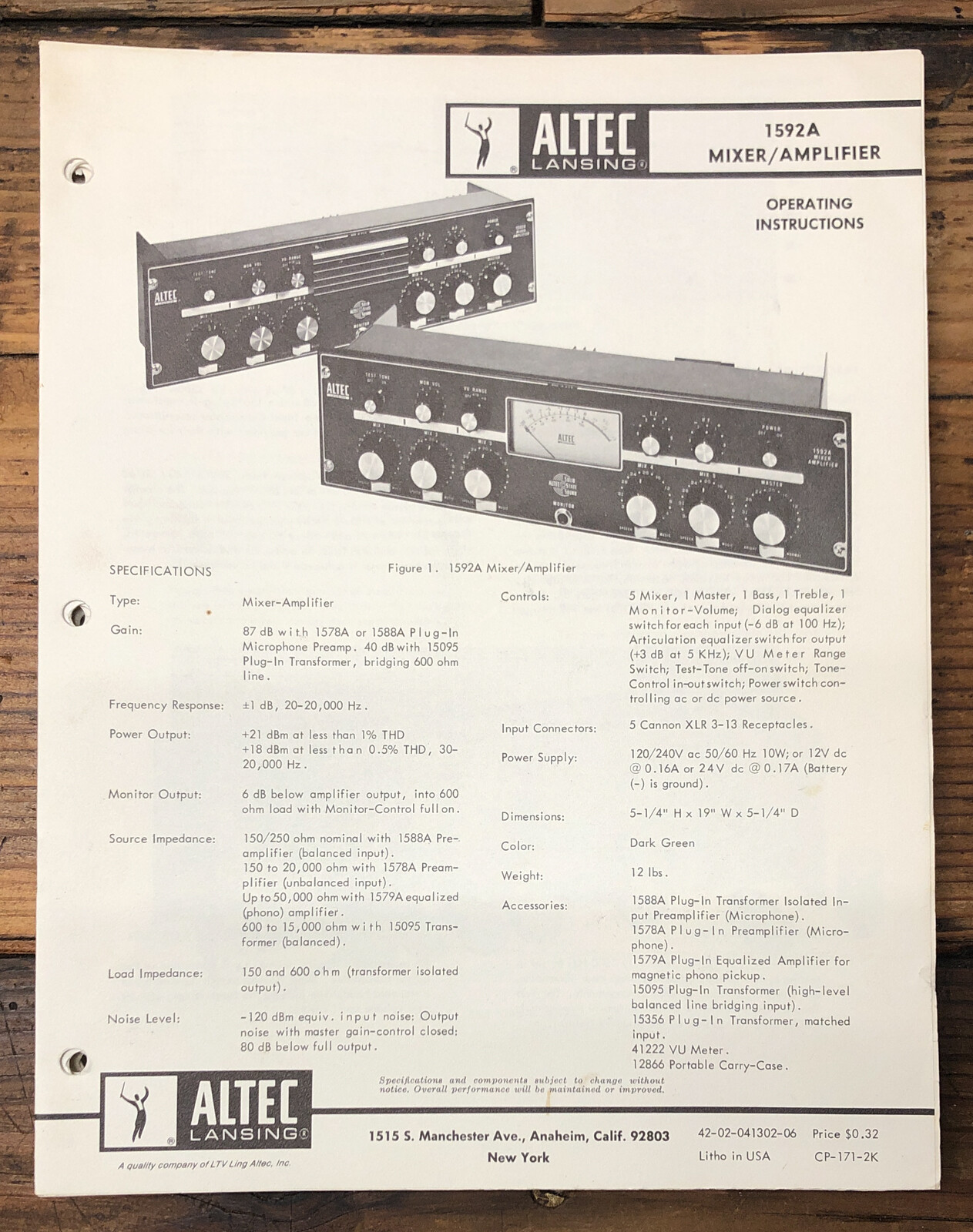
The Altec 1592A isn’t trying to be a hi-fi darling or a boutique mic pre with velvet gloves. It’s a solid-state, mono, five-channel microphone mixer and amplifier designed for real-world use in public address and commercial audio settings. Built during the 1970s, it reflects Altec’s engineering-first approach—rugged, functional, and sonically distinct. Owners report it was commonly used in studios, installations, and by audiophiles who valued its robust construction and ability to drive difficult speaker loads. It doesn’t offer phantom power, and it’s not a “clean” mic pre; instead, it delivers a thick, full-bodied sound that some describe as having a “1960s” character, especially when paired with dynamic or ribbon mics through the right input modules.
This unit combines amplification, mixing, and tone shaping in a single rack-mountable chassis. It features five XLR mic inputs, each routed through an octal slot for plug-in input accessories—modules like the 1588A, 1588B, or 1588C preamps or the 15095 line transformers. These plug-ins allow customization of gain structure and impedance matching, a modular flexibility rare in fixed-design amps. The front panel includes level controls for each channel, a power switch, and a master EQ section with a high-frequency pot and an EQ on/off switch. A “Bright” switch applies a broad +3dB treble boost from 3 to 20 kHz, adding presence when needed. Peerless transformers are used in the signal path, contributing to its balanced, weighty tonality.
Despite its professional roots, the 1592A has found a second life among project-minded users and analog enthusiasts. It’s been described as a “super cool vintage production tool,” particularly useful as a summing mixer or character-adding mic pre. When driven hard with low-impedance dynamics or ribbons, it introduces a noticeable noise floor and harmonic distortion—flaws in one context, but desirable coloration in another. Its built-in limiting and transformer-balanced inputs add to its utility in live and studio environments where reliability trumps transparency.
Specifications
| Manufacturer | Altec |
| Product type | Power amplifier |
| Power output | 50W per channel into 8 ohms |
| Power output | 100W per channel into 4 ohms |
| Frequency response | 20Hz to 20kHz ±0.5dB |
| Total harmonic distortion (THD) | 0.25% at rated output |
| Signal-to-noise ratio | 100dB |
| Input sensitivity | 1.5V for rated output |
| Damping factor | 40 |
| Dimensions (W x H x D) | 19" x 5-1/2" x 10-1/2" |
| Weight | 25 lbs |
| Inputs | Two pairs of RCA inputs |
| Inputs | 5 XLR inputs |
| Input accessory slots | 5 octal slots for a 'plug-in input accessory' |
| Outputs | Two pairs of speaker binding posts |
| Output | Summed to mono output |
| Power consumption | 250 watts |
| No provision for | phantom power |
Key Features
Solid-State Design with Plug-In Input Modules
The 1592A employs a fully solid-state circuit topology, avoiding tubes while retaining a warm, analog character through its transformer-coupled signal path. Its most distinctive feature is the set of five octal sockets on the rear panel, each corresponding to a mic channel and accepting plug-in input accessories. These modules—such as the 1588A, 1588B, or 1588C preamp types or the 15095 line transformers—allow users to tailor input impedance, gain, and tonal response. This modularity made the unit adaptable across different microphones and sources, a practical advantage in multi-purpose installations. The use of Peerless transformers in these stages contributes significantly to the unit’s sonic weight and balance.
Transformer-Balanced Mic Inputs and Built-In Limiting
Each of the five XLR inputs is transformer-balanced, providing common-mode noise rejection and galvanic isolation—critical in long cable runs and electrically noisy environments. This design choice enhances signal integrity and reduces ground loop issues, a hallmark of professional-grade gear from the era. Additionally, the unit includes built-in limiting, a safeguard against overloads in live or fixed-installation scenarios. While the exact threshold and ratio aren’t documented, the limiter ensures the amplifier can handle unpredictable input levels without damage, reinforcing its role as a reliable workhorse.
Master EQ Section with Bright Switch
The master channel includes an EQ section with a high-frequency potentiometer and an EQ on/off switch. According to repair observations, failures in this section are not uncommon—one unit examined had a disconnected leg on the EQ switch and an open center tap on the high-frequency pot. Despite these potential reliability issues, the EQ offers useful tonal shaping. The “Bright” switch delivers a broad +3dB boost across 3 to 20 kHz, adding clarity and air without harshness. The tone control circuit includes capacitors C21, C22, and C23, components likely influencing the EQ’s frequency curve and response. When functional, this section allows subtle but effective voicing adjustments.
Collectibility & Value
Vintage Altec amplifiers like the 1592A are sought after for their build quality and so-called “West Coast” sound character—present, punchy, and harmonically rich. However, aging electrolytic capacitors are the most common failure point, and recapping is often recommended for units still in service. Noise issues, particularly 120Hz hum, have been reported, often traced to grounding or power supply problems. Units sometimes appear missing knobs or with modified outputs, such as added 1/4" jacks, indicating field modifications. A service manual with schematics and parts list exists, making repairs feasible for the technically inclined. One listing offered a 1592A with original carrying case for $420.00, while individual 1588B or 1588C preamp modules have been priced at $40 each.
eBay Listings


As an eBay Partner, we earn from qualifying purchases. This helps support our independent vintage technology research.
Related Models
- Altec 1224A
- Altec 26420 (1975)
- Altec 288D (1975)
- Altec 288L (1975)
- Altec 290C (1975)
- Luxman L-530 (1975)
- Luxman R-404 (1975)
- Luxman RV-371 (1975)
- Luxman SQ-38U (1975)
- Luxman T-14 (1972)