Altec 1005B
Ten cells, 100 degrees of horizontal spread, and enough cast-iron attitude to cover a thousand seats. This is the midrange horn that made Voice of the Theatre systems sound like a room, not a box.
Overview
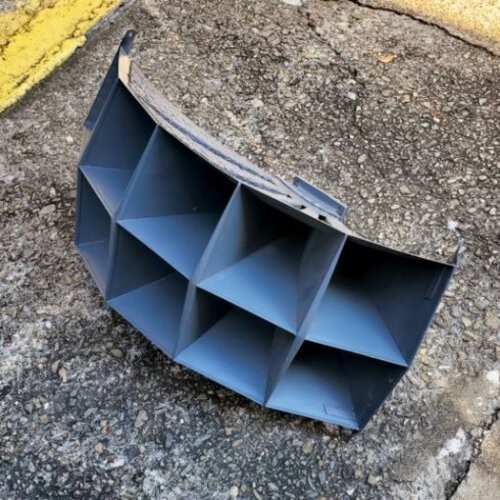
Pick up a 1005B and the first thing you notice is the size. It measures 440 mm wide, 760 mm tall and 330 mm deep. This is not a tweeter you tuck beside a bookshelf. It was built to sit on top of a cabinet in a theater and aim at an audience. Altec Lansing built it in the United States as a multi-cell horn for the company's Voice of the Theatre (VOTT) line, and it was one of a six-model Multi-Cell Horn Series that let system designers choose a horn by coverage pattern instead of guessing. Its job was mid and high frequencies in large-venue sound reinforcement - theaters and halls where a single system had to reach 1,000 to 1,500 people, and where multiple systems were stacked for anything bigger.
The 1005B is a horn speaker in the plainest sense. It has no cabinet and no crossover network of its own, just a shaped throat and mouth that couples a compression driver to the air. The interesting part is the throat. Altec designed it to be swapped, so the same horn can run either a single driver or a pair. Fit the 30210 throat and it runs one driver. Fit the 30170 and it runs two. Altec's own literature lists those two as the applicable throats, and that one decision is why the 1005B shows up in so many different VOTT configurations. An installer could scale output without buying a different horn.
Coverage is rated at 100 degrees horizontal by 40 degrees vertical. That is a wide left-to-right spread with a tight vertical window, the classic cinema pattern. It covers a seated audience across the width of a room without dumping energy into the ceiling and the floor. The crossover frequency is listed at 500 Hz, which puts the 1005B in the midrange and up, right where a multicell horn earns its keep. Altec's 1976 literature confirms the 500 Hz low-frequency limit and the 40°V x 100°H pattern. It lists the horn at 17¼ inches wide by 30 inches tall by 13 inches deep, weighing 20 lbs (9.1 kg), which checks out against the metric dimensions.
Ten small cells, described both as "2x5 cells" and as a 10-cell horn, each with its own throat, work together to shape the wavefront. That is the multicell approach, and it gives these horns their controlled dispersion. Sound spreads evenly across a wide room instead of beaming. The two descriptions count the same array differently, so treat them as equivalent.
Key Features
Interchangeable Throats: One Driver or Two
The 1005B's defining trait is that you reconfigure it by changing the throat. Fit the 30210 and the horn runs a single driver. Fit the 30170 and it runs two. Altec's adjustable diffusion characteristics come from exactly this, since the throat change alters how the horn behaves, not just how loud it plays. For anyone restoring or rebuilding a system, the throat is the first thing to check and the part most likely to be missing. A 1005B without its correct throat is an incomplete horn, and the market prices it that way.
100° × 40° Coverage from Ten Cells
The rated pattern is 100 degrees horizontal by 40 degrees vertical. The ten cells divide the horn's mouth into individual waveguides, each contributing to the overall directivity, and the result is a wide, shallow coverage window suited to a seated audience. The challenge of covering a wide room evenly with a horn-based system is well documented in the period press. Sound and Communication (November 1988, p.45) described a sanctuary installation built around a 90-degree horizontal by 40-degree vertical horn paired with stacked 12-inch low-frequency drivers. That is the same design logic the 1005B was built around decades earlier.
Three-Point Mounting for the 825B
Altec designed the 1005B to rest on top of specific cabinets, the 825B chief among them, using a three-point mounting system. The horn sits on the cabinet, and the mounting scheme integrates directly with the 825B to keep it aligned. In a room seating a thousand people, a few degrees of drift is audible. A horn that shifts or vibrates out of position throws its coverage pattern off, so the mounting detail is not cosmetic. It is one of the things that separates a properly assembled VOTT stack from a pile of loose components.
Built as the Bottom Horn in Multi-Component Systems
In a full VOTT stack, the 1005B is the bottom horn in a multi-component setup. Altec's documentation shows it combined with cabinets like the 211 or 815A, woofers such as the 515B, and top horns like the 203B or 1003B. The 1005B handles mid and high frequencies while the woofer covers the low end, and the 500 Hz crossover marks the handoff. The horn is specifically used with drivers like the 288C in A5 VOTT system restorations, and the 288C compression driver is the natural partner for a 1005B in that configuration. A theater's sound system in this era was assembled from discrete, purpose-built parts rather than bought as a single box.
Historical Context
The 1005B is a component of Altec's Voice of the Theatre speaker systems, introduced in the late 1930s and established as the industry standard for cinema and live sound. That late-1930s date belongs to the VOTT line as a whole, not to this horn individually. No production years specific to the 1005B are documented in the available material, and the page title carries no year for that reason. Altec's design intent was coverage. The 1005B was specified to deliver even sound distribution across audiences of 1,000 to 1,500 people per system, with multiple systems deployed for larger venues.
Collectibility & Value
The 1005B carries a collectibility rating of 8/10 and is highly sought after by vintage audio enthusiasts, professional restorers, and DIY speaker builders. A pair was listed for $1,365.00 in 2023, and more recent eBay listings show single 2x5-cell units at $2,178. The throats trade separately, with individual 30210 throats at $180 and a pair of 30210 throats at $400. A horn missing its throat is worth considerably less than a complete one. A Yahoo Auctions listing for a 1005B drew a bid of ¥149,999. Reverb has seen mint-condition 1005B horns sold together with custom-made wood cabinets, and at least one Craigslist seller offered a 1005B as a parts source, where surviving examples are worth more as donors than as working units.
Condition is the central issue. Due to their age, most surviving units require inspection or restoration. The available material does not document specific failure modes for the 1005B itself, so buyers should treat any unrestored example as a project until proven otherwise. Check whether the correct throat is present and whether the horn body has been damaged or modified. Third-party diaphragms and horn adapters do circulate, which helps restorers, but original parts are not something to assume.
eBay Listings


As an eBay Partner, we earn from qualifying purchases. This helps support our independent vintage technology research.