Altec Lansing System 3
A three-piece speaker system with compact satellites and a uniquely designed multipath subwoofer for seamless full-range audio.
Overview
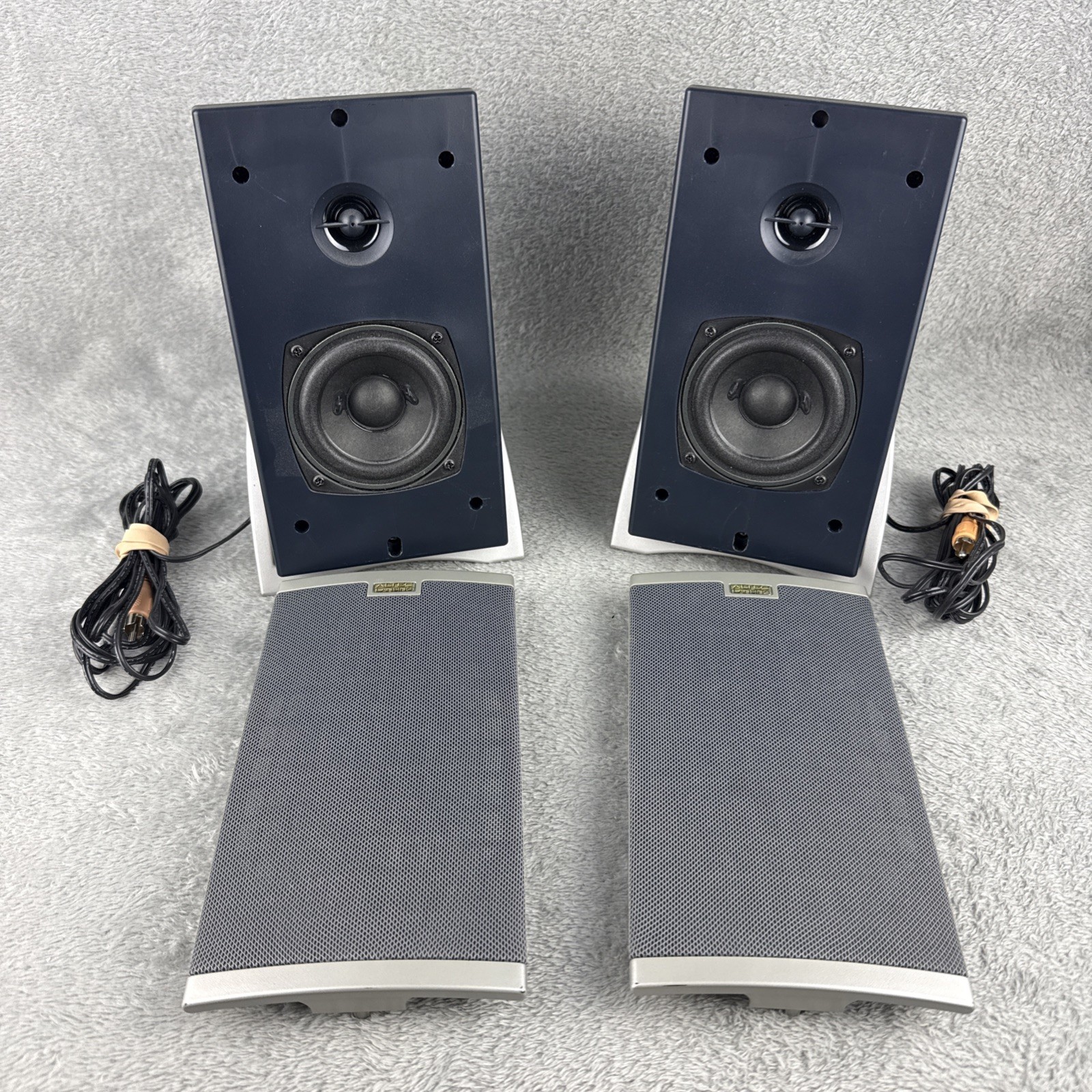
The Altec Lansing System 3 is a three-piece speaker system consisting of two satellite speakers and a separate subwoofer, designed for high-value, full-range sound reproduction. The satellites use dual 3-inch polypropylene-cone drivers and a half-inch dome tweeter with ferrofluid cooling, while the subwoofer features two 8-inch polypropylene-cone drivers in a sealed enclosure. Its standout design element is the System 3 Multipath Subwoofer, which outputs sound through a 1-1/2-inch slot around the periphery created by offset flat panels. This configuration allows the subwoofer to be placed on any of its six sides without affecting performance. Reviewers noted its smoothly integrated sound, with bass that extends seamlessly from the satellites and remains undetectable as a separate source. The system achieves a specified frequency response of 30 to 20,000 Hz with 90 dB sensitivity and a 4-ohm nominal impedance, making it compatible with amplifiers delivering 10 to 100 watts per channel.
Specifications
| Original Price | $600 |
| System composition | Two satellite speakers and one separate subwoofer |
| Satellite Speaker Drivers | Two 3-inch polypropylene-cone drivers and a half-inch dome tweeter per satellite |
| Subwoofer Drivers | Two 8-inch polypropylene-cone drivers |
| Subwoofer Name | System 3 Multipath Subwoofer |
| Subwoofer Enclosure Type | Sealed |
| Subwoofer Design | Drivers on opposite sides of the enclosure; a flat panel is held 1-1/2 inches out from the speaker board on each side, creating a 1-1/2-inch slot around the periphery for output |
| System Nominal Impedance | 4 ohms |
| Recommended Amplifier Power | Between 10 and 100 watts per channel |
| System Sensitivity | 90-dB sound-pressure level (SPL) at 1 meter with 1 watt input |
| Satellite Frequency Response | 180 to 20,000 Hz |
| Satellite Crossover | 12-dB-per-octave crossover at 4,500 Hz |
| Subwoofer Frequency Response | 32 to 190 Hz |
| Subwoofer Crossover Slope | 12-dB-per-octave |
| System Frequency Response (specified) | 30 to 20,000 Hz |
| Subwoofer Input/Output Connectors | Spring-loaded, recessed |
| Subwoofer Orientation | Can operate on any of its six sides |
| Subwoofer Dimensions | 9-3/4 x 12 x 20 inches (including outer panels) |
| Satellite Dimensions (each) | 8-1/2 inches high overall; the housing for the two 3-inch drivers is 4 x 3-1/2 x 3-3/4 inches |
| Weight | 18.0kg |
| Lab Test - Averaged Room Response | Very flat over most of the audio range, varying ±2.5 dB from below 100 Hz up to about 10,000 Hz, rising slightly from 10,000 to 20,000 Hz |
| Lab Test - Quasi-anechoic EFT Response | Revealed a sharp, narrow dip at about 3,000 Hz |
| Lab Test - Subwoofer FFT Response | Maximum at 100 Hz; output at 30 Hz was down 6 dB relative to the 100 Hz level |
| Lab Test - Overall System Response | ±6 dB from 30 to 20,000 Hz |
| Lab Test - Minimum System Impedance | 4.3 ohms at 40 Hz |
| Lab Test - Impedance Range | Varied between 7 and 15 ohms over most of the range above 130 Hz; maximum was 19 ohms at 3,500 Hz |
| Lab Test - Sensitivity Confirmation | 90 dB, as rated |
| Lab Test - Subwoofer Distortion (at 2.83-volt input) | 8 to 10 percent at 40 Hz, decreasing to less than 0.5 percent at 100 Hz and above |
| Lab Test - Satellite Horizontal Dispersion | Good; above the 4,500 Hz crossover, on-axis and 45 degrees off-axis response curves were nearly identical almost to 20,000 Hz except for an approximately 6-dB level difference |
| Lab Test - Group-Delay Variation | Typically less than 0.4 millisecond from 1,000 to more than 20,000 Hz, apart from a sharp 0.7-millisecond dip at 3,000 Hz |
| Lab Test - Power Handling | Excellent; amplifier clipped before the speaker produced significant distortion at test frequencies (100, 1,000, and 10,000 Hz). Clipping levels were in the range of 810 to 950 watts. |
Design
The satellites are housed in strong, black molded plastic with perforated metal grilles and feature keyhole slots on the rear for wall or pole mounting. The half-inch dome tweeter uses ferrofluid cooling for improved thermal performance. The subwoofer’s unique multipath design places drivers on opposite sides of a sealed enclosure, with flat outer panels offset by 1-1/2 inches to create a continuous peripheral output slot. This allows flexible placement, as the subwoofer can operate on any of its six sides. All components are finished in black.
Context
Reviewers praised the Altec Lansing System 3 for its seamless integration, noting that the bass appeared to extend naturally from the satellites without drawing attention to the subwoofer’s location. It was considered a smooth, well-balanced system free of unnatural coloration across the spectrum. One reviewer observed a clean, subtle tone at 32 Hz that was both heard and felt, confirming deep bass capability. While the system was lauded as a worthy high-value three-piece design, it was acknowledged that its bass output could not match that of larger, more expensive standalone subwoofers.
eBay Listings



As an eBay Partner, we earn from qualifying purchases. This helps support our independent vintage technology research.