Altec Lansing Model 6 (1981)
A three-way bookshelf speaker system with bass reflex design, released in 1981 and featuring Altec’s constant-directivity horn technology.
Overview
The Altec Lansing Model 6 is a three-way, three-speaker bookshelf system released in 1981, designed by Paul Supran Gar, Altec's top engineer. It was part of a line of more compact speaker systems that brought high-end horn technology—like the Tangerine radial phase plug and Mantaray constant-directivity horn—from larger professional models into a domestic format. The system features a 10-inch woofer, 5-inch midrange cone, and a piezoelectric compression driver using lead-zirconate titanate (LZT). It includes front-panel controls for adjustable midrange and high-frequency output, and incorporates a passive "Automatic Power Control" circuit that attenuates the signal during overload, indicated by a glowing red light.
Specifications
| Type | Three-way system |
| Frequency response | 60 to 20,000 Hz ±2.5 dB |
| Nominal impedance | 8 Ω |
| Laboratory measured impedance | 5 ohms in the 20- to 30-Hz region, peaking at 30 ohms at 60-Hz resonance, 7 ohms at 100 Hz, varied between 7 and 16 ohms over the rest of the audio range |
| Maximum impedance | 17 ohms in the upper treble region |
| Rated sensitivity | 90 dB SPL at 1 meter with 1 watt of wideband pink noise |
| Laboratory sensitivity measurement | 87 dB with 1 watt input using an octave band of noise at 1,000 Hz |
| Recommended amplifier power | 20 to 200 watts per channel |
| Continuous power handling | 100 watts (28.3 volts into 8 ohms) |
| Peak power handling | 400 watts (56.6 volts into 8 ohms) for peaks up to 117 dB SPL |
| Crossover frequencies | 700 Hz, 5 kHz |
| Crossover type | Pass-band stable network |
| Drivers | 10-inch woofer, 5-inch midrange cone, piezoelectric compression driver (LZT) |
| Woofer resonance | about 62 Hz |
| External dimensions | 15-1/2 inches wide, 25-1/2 inches high, 13-1/2 inches deep |
| Weight | 37 pounds |
| Cabinet finish | Glossy polish, Endriana wood veneer |
| Grille | Semitransparent black grille cloth |
| Input connectors | Spring-loaded, recessed into the rear of the cabinet |
| Controls | Continuously variable midrange and tweeter-level adjustment knobs on front panel |
| Midrange control range | Maximum cut of 15 dB at 2.5 kHz; up to 2 1/2 dB of boost at 2.5 kHz |
| High-frequency control range | About 7 dB of additional output above 8 kHz at maximum; gradual rolloff starting at 2.5 kHz, down approximately 7 dB or more above 8 kHz at minimum |
| Protection | "Automatic Power Control," a passive circuit that attenuates the signal during overload; a red light glows when activated |
| Warranty | Limited, five years parts and labor |
Design
The Model 6 uses a bass reflex (ported) enclosure with a front baffle covered in black acoustic-damping material and flush-mounted drivers for reduced diffraction. The tweeter is a piezoelectric compression driver using lead-zirconate titanate (LZT), paired with Altec’s Tangerine radial phase plug and the computer-designed Mantaray constant-directivity horn, which can be rotated 90 degrees for horizontal placement. The "Automatic Power Control" is a passive, signal-powered circuit that activates under overload, protecting the drivers without external power.
Context
Released in 1981, the Model 6 was the three-way centerpiece in a series of more compact speaker systems from Altec Lansing, bringing horn-loaded high-frequency technology from professional models like the Model 19 into a domestic bookshelf format. It was designed to deliver flat frequency response, deep bass, and wide dispersion with low distortion, offering high performance at a fair market price of $350 at launch.
eBay Listings


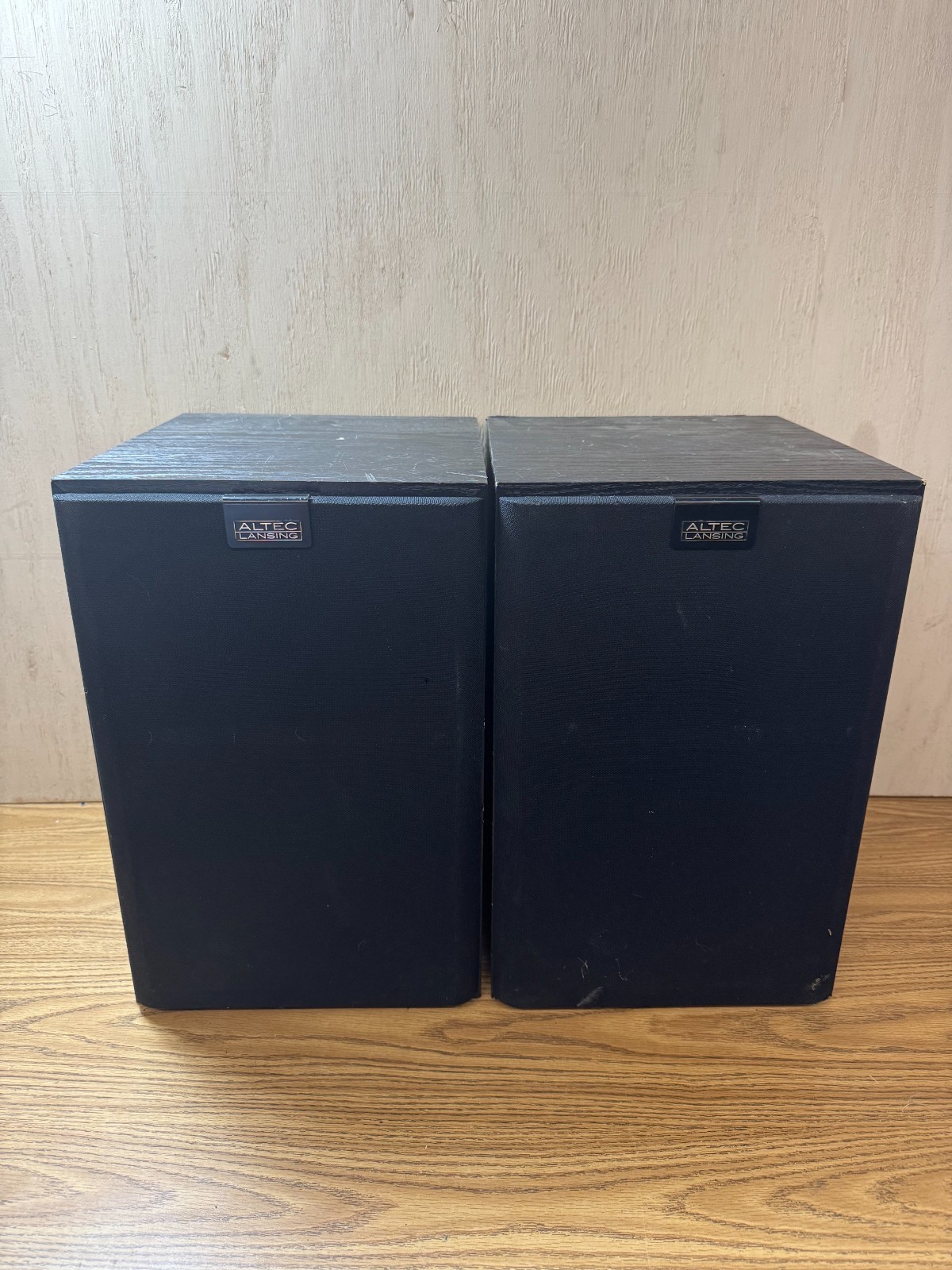
As an eBay Partner, we earn from qualifying purchases. This helps support our independent vintage technology research.