Altec Lansing 755E/Medina (around 1970)
At 14kg and just under 60cm tall, it commands space like a statement — one full-range driver doing the work of three.
Overview
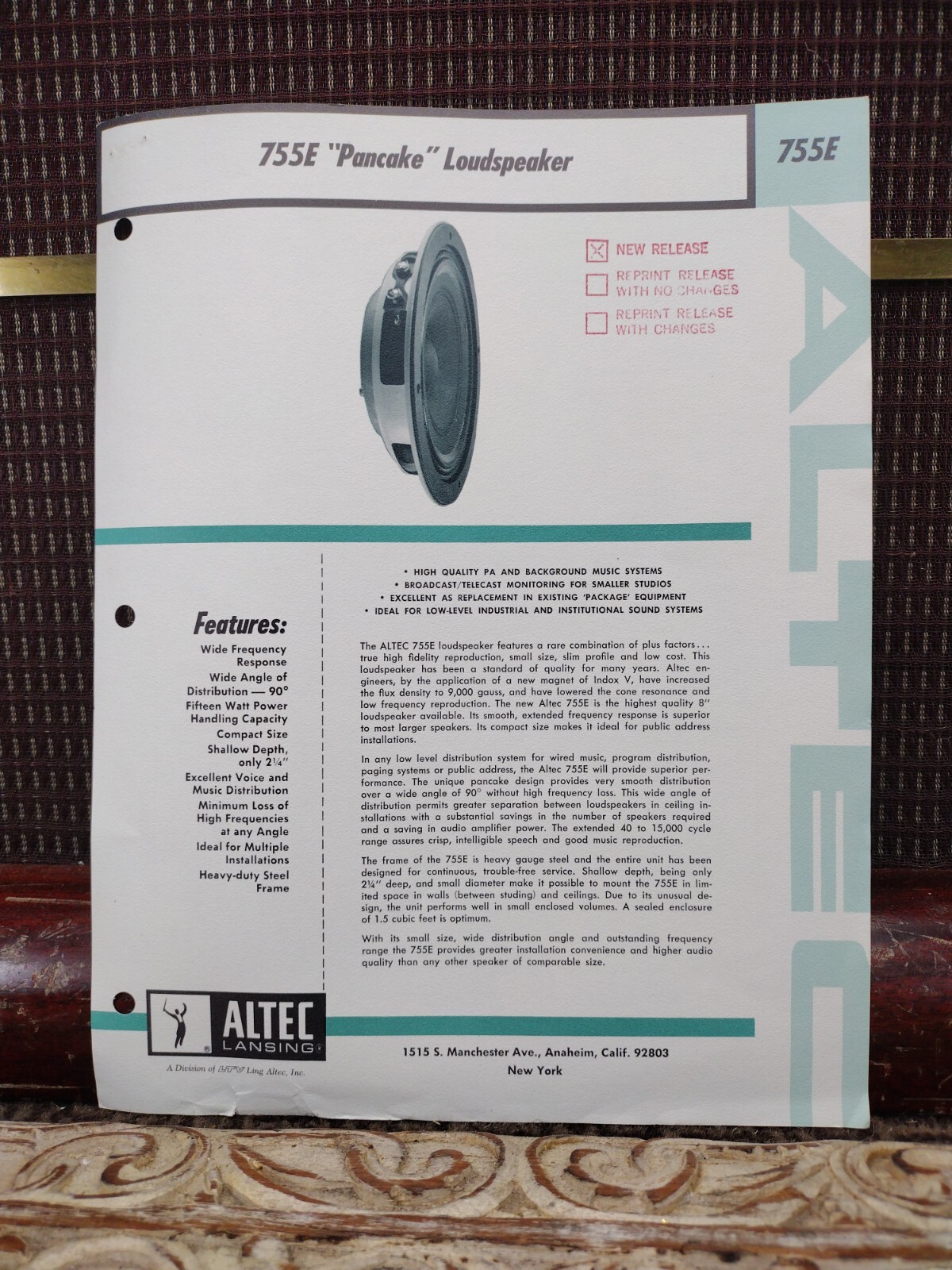
The Altec Lansing 755E/Medina isn’t a conventional speaker. It’s a single-driver bookshelf system built around the 755E "Pancake" unit, a 20 cm full-range cone designed to cover everything from 40 Hz to 15 kHz without crossover networks. Marketed for the Japanese market around 1970, it was produced by Elektri, an Altec agent at the time, under technical guidance from ALTEC Sound Laboratory L. T. V Research.
Despite its modest 15W power handling, the Medina delivers 100dB/W (JIS), making it highly efficient — a trait that suggests it was engineered to shine with lower-powered tube amplifiers common in that era. The physical presence is notable: nearly 60cm in height and weighing 14kg, it’s , hinting at a densely constructed cabinet meant to control resonance. Its single-driver approach eliminates phase distortion between drivers but places extreme demands on the unit itself — a challenge Altec met with a specialized design.
Specifications
| Manufacturer | Altec Lansing |
| Product type | Speaker system, 1-Way, 1-Speaker, Bassref System, Bookshelf Type |
| Units Used | All Band : 20 cm Cone Type (755E) |
| Impedance | 8 Ω |
| Playback frequency band | 40 Hz to 15 kHz |
| Lowest resonance frequency | 52Hz |
| Output sound pressure level (JIS) | 100dB/W |
| Allowable input | 15W |
| Voice Coil Diameter | 50mm |
| Magnetic flux density | 9,000gauss |
| Enclosure Material | Rigid Homogen + Special Plywood |
| Painting/Exterior finish | Walnut oil finish |
| External dimensions | Width 358x Height 596x Depth 280 mm |
| Weight | 14kg |
| Original price | ¥ 36,800 (1 unit, around 1970) |
Key Features
755E "Pancake" Full-Range Driver
The heart of the Medina is the 755E driver, part of Altec’s 755 series nicknamed "Pancake" . It uses a 20 cm cone with an effective diameter of 17 cm, integrating a central dome pressed directly into the cone to eliminate anti-resonance strain caused by poor bonding in conventional designs. This mechanical unity between cone and dome was — a clever solution for a full-range unit expected to reach 15 kHz.
Cloth Edge with Bis Colloid Damping
The peripheral suspension uses a cloth edge selected for high linearity, lightly treated with bis colloid to control damping. Given the 52Hz lowest resonance frequency, the edge plays a critical role in maintaining control at the bottom end of its range, especially when reproducing bass-heavy material within its 15W input limit.
50mm Aluminum Ribbon Voice Coil
At the core of the motor system is a 50mm diameter voice coil wound from aluminum ribbon wire, edgewise — a technique that increases surface area and improves heat dissipation compared to round wire. This large coil contributes to power handling and thermal stability, though the 15W rating suggests conservative engineering. The use of aluminum ribbon also reduces moving mass, aiding high-frequency response in a driver that must cover three octaves above middle C.
DACS V-Type Magnet with 9,000 Gauss
The 755E employs a DACS V-type magnet structure produced exclusively for this model, delivering a magnetic flux density of 9,000 gauss. According to available documentation, the magnet is excited only up to its specified density, ensuring consistency across units — a manufacturing detail that likely reduced performance variance in production. , supporting strong motor control and efficiency.
Aluminum Die-Cast Frame (Holem)
The driver’s structural foundation is an aluminum die-cast frame, referred to as "Holem" in the documentation. This material choice improves rigidity and heat dissipation while minimizing unwanted resonance from the basket itself — a common issue in stamped steel frames. The precision of die-casting also ensures consistent alignment of critical components, which is essential in a driver expected to maintain linearity across a wide bandwidth.
Modified Distributed Port Enclosure
The cabinet, constructed from Rigid Homogen and special plywood, uses a modified distributed port design focused on internal pressure management. While not a conventional bass reflex, the system — dubbed "Bassref" — appears to distribute porting effects across the internal structure rather than relying on a single tuned port. , though the 40 Hz lower limit suggests it relies primarily on the driver’s own excursion rather than cabinet reinforcement.
Historical Context
It fit into a broader ecosystem: contemporary catalogs included upgrade paths, allowing owners to add a low-frequency unit (416A or 414A) with crossover frequencies between 300–800 Hz, or extend the highs with the 3000H tweeter, crossing over at 3–5 kHz. These plans suggest Altec positioned the Medina not as a final product, but as a modular foundation — a full-range core that could evolve into a multi-way system for more demanding listeners.
eBay Listings



As an eBay Partner, we earn from qualifying purchases. This helps support our independent vintage technology research.