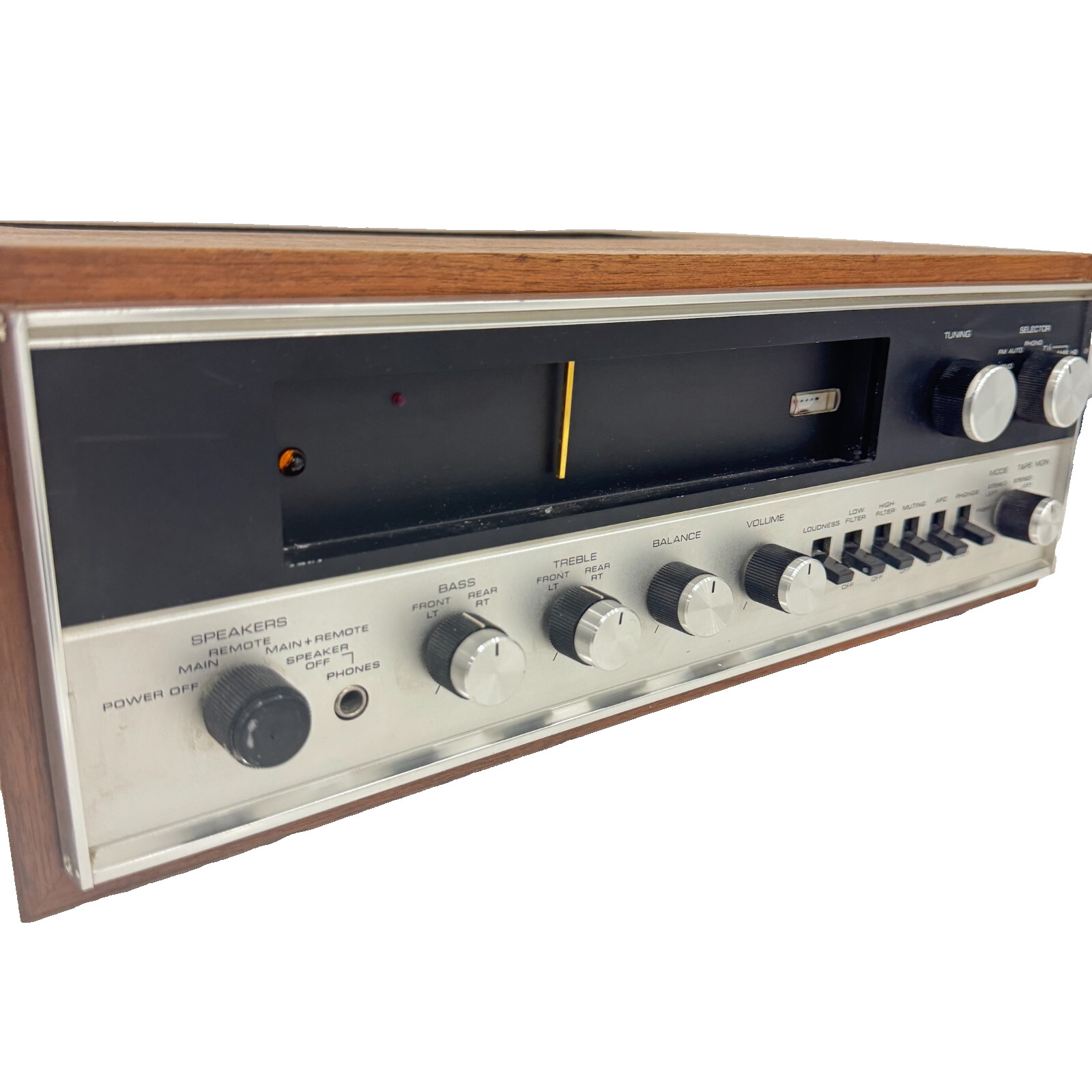
Allied Solid State AM-FM Stereophonic Receiver Model 395 (?)
At 55 watts per channel, it doesn’t shout — but in the right setup, it sings with a clarity that belies its modest specs.
Overview
The Allied Solid State AM-FM Stereophonic Receiver Model 395 is a bookshelf-sized AM/FM stereo receiver built for Allied Radio Corp. of Chicago, IL, and widely reported to have been manufactured in Japan by Pioneer. Though it carries the Allied name, its engineering lineage points firmly toward Pioneer’s high-quality 1970s receiver designs, with the Pioneer SX-1000TW frequently cited as its functional twin. This isn’t a cosmetic curiosity or a budget console from a mail-order catalog — it’s a serious piece of solid-state audio gear aimed at listeners who valued performance over flash. The metal case houses a full complement of analog circuitry centered around a superheterodyne tuner system, supporting both AM (Broadcast) and FM bands with a tuning indicator for precise station alignment.
Owners report a receiver that, when properly maintained, delivers a surprisingly refined sound — some even drawing favorable comparisons to the Marantz 2270 and certain tube amplifiers in terms of tonal richness. It’s not about brute power; one user put it plainly: “It’s a stereo where quality watts surpasses quantity.” While initial impressions from some forums label it merely “ok,” those who’ve restored units often revise that view sharply upward — “now it is a downright hot performer!” according to one Antique Radio Forums contributor. The 395 was clearly built to last, with durable construction and a component layout that suggests attention to serviceability, even if the original design cuts a few corners with transistor choices prone to failure over time.
Specifications
| Manufacturer | Allied Radio Corp. (Chicago, IL) |
| Product type | AM/FM Stereo Receiver |
| Country of manufacture | Japan |
| Power output | 55 Watts per channel RMS |
| Damping factor | 25 |
| Frequency response | 20-70k hz +/- 1 db |
| Harmonic distortion | .5 percent |
| Bandwidth | 15-70k hz |
| Power type and voltage | 120V AC, 50-60 Hz |
| Wave bands | AM (Broadcast) and FM |
| Loudspeaker | Requires external speaker(s) |
| Speaker connectors | 2 sets |
| Inputs | Phono1 (Mag), Phono2 (Mag), Phono (Cer) |
| Features | Bass & Treble Control, Loudness, Low & High Filter |
| AC Outlets | 1x Switched, 1x Unswitched |
| Tuning Indicator | Present |
| Cabinet material | Metal case |
| Shape | Book-shelf unit |
| Circuit type | Capacitor-coupled (cap-coupled) |
Key Features
55 Watts per Channel RMS Output
Rated at 55 watts per channel RMS, the Allied 395 delivers modest but clean power suitable for efficient bookshelf speakers or modest living room setups. This figure, sourced from Worthpoint and echoed in collector discussions, suggests a design focused on headroom and stability rather than peak output. The receiver is also listed with a total system output of 270 watts (4–16 ohms), likely representing combined stereo power under specific load conditions, though the per-channel RMS figure is more meaningful for real-world use. When functioning correctly — especially after servicing — owners note a dynamic, controlled presentation that outperforms expectations based on wattage alone.
Capacitor-Coupled (Cap-Coupled) Circuit Design
The amplifier section uses a capacitor-coupled (cap-coupled) design, a common but effective topology in solid-state receivers of the era. This approach isolates stages using coupling capacitors, which can influence bass response and transient behavior. Stock speaker coupling capacitors are 1000uF @ 50 volts, and upgrading to 2000uF is a documented modification said to tighten bass response — though going higher risks overloading the power supply. The power supply itself uses two 1000uF capacitors and runs a high voltage rail of 80 VDC, with a recommended upgrade limit of ~2200uF per cap to avoid blowing fuses.
2SC458 Transistor-Based Amplifier Stage
The amplifier relies on 2SC458 transistors, with some units reportedly using 2SC871s as substitutes. These components are now recognized failure points after decades of service, and collectors strongly recommend replacing them preemptively with modern equivalents like the KSC1845 or 2SC2240 during restoration. The front end also includes a JFET — specifically a 3SK22 — which users report can fail; the 2N3823 is a known substitute. These vulnerabilities aren’t signs of poor design but rather the inevitable aging of semiconductor materials from the 1970s.
Phono Input Flexibility with Magnetic and Ceramic Support
The Allied 395 stands out for offering three dedicated phono inputs: Phono1 (Mag), Phono2 (Mag), and Phono (Cer). This configuration accommodates both magnetic and ceramic cartridges without requiring external preamps, a rare level of flexibility for a receiver of this class. It suggests the unit was intended for users with multiple turntables or legacy equipment, reinforcing its role as a practical hub for analog audio sources.
20–70 kHz Frequency Response with Low Distortion
According to available documentation, the receiver achieves a frequency response of 20–70 kHz (+/- 1 dB), with a bandwidth extending down to 15 kHz. Harmonic distortion is rated at 0.5 percent, indicating a clean signal path when the unit is in good condition. These figures, while not class-leading for the era, reflect a design prioritizing linearity and transparency over sheer power. The damping factor of 25 further supports tight bass control, especially when paired with compatible speakers.
Historical Context
The Allied Model 395 was made for Allied Radio Corporation and manufactured in Japan, with strong consensus among owners and forums that Pioneer was the original equipment manufacturer. The Pioneer SX-1000TW is repeatedly cited as the equivalent or sister model, and the service manual for that receiver is considered applicable for repairing the Allied unit. While no official documentation confirms the OEM relationship, the consistency of this claim across Worthpoint, Audiokarma, and Steve Hoffman Forums lends it significant weight. The receiver likely dates from around 1978, though this date remains unconfirmed by primary sources.
Collectibility & Value
The Allied 395 occupies a niche but respected place among vintage audio enthusiasts. Tested units have sold for $179 (PicClick), with mint-condition examples listed at $299. One owner suggests $40 could be a fair price depending on condition — a testament to how value hinges entirely on functionality and restoration status. Because of the known failure modes of the 2SC458 transistors and aging capacitors, untested or “as-is” units carry little value until serviced. Recapping the power supply and amplifier boards is considered essential maintenance, not an upgrade. When properly restored, the 395 transforms from a forgotten Allied-branded unit into a high-performing amplifier that rivals more famous contemporaries.
eBay Listings


As an eBay Partner, we earn from qualifying purchases. This helps support our independent vintage technology research.