Akai AM-U-41 (1975)
Step into any well-appointed living room in 1975, and you might have spotted the understated elegance of the Akai AM-U-41 anchoring a carefully curated stereo setup. While Akai had already built a reputation for precision in reel-to-reel tape recorders, the AM-U-41 marked their quiet but confident entry into the world of hi-fi amplification. It wasn’t flashy, nor was it chasing audiophile headlines—this was a no-nonsense power amplifier built for clarity, reliability, and seamless integration with the analog sources defining the era: turntables, cassette decks, and AM/FM tuners. For today’s vintage audio enthusiasts, the AM-U-41 isn’t a legend, but it’s something more honest—a well-engineered workhorse from Japan’s golden age of stereo.
Design and Build Quality
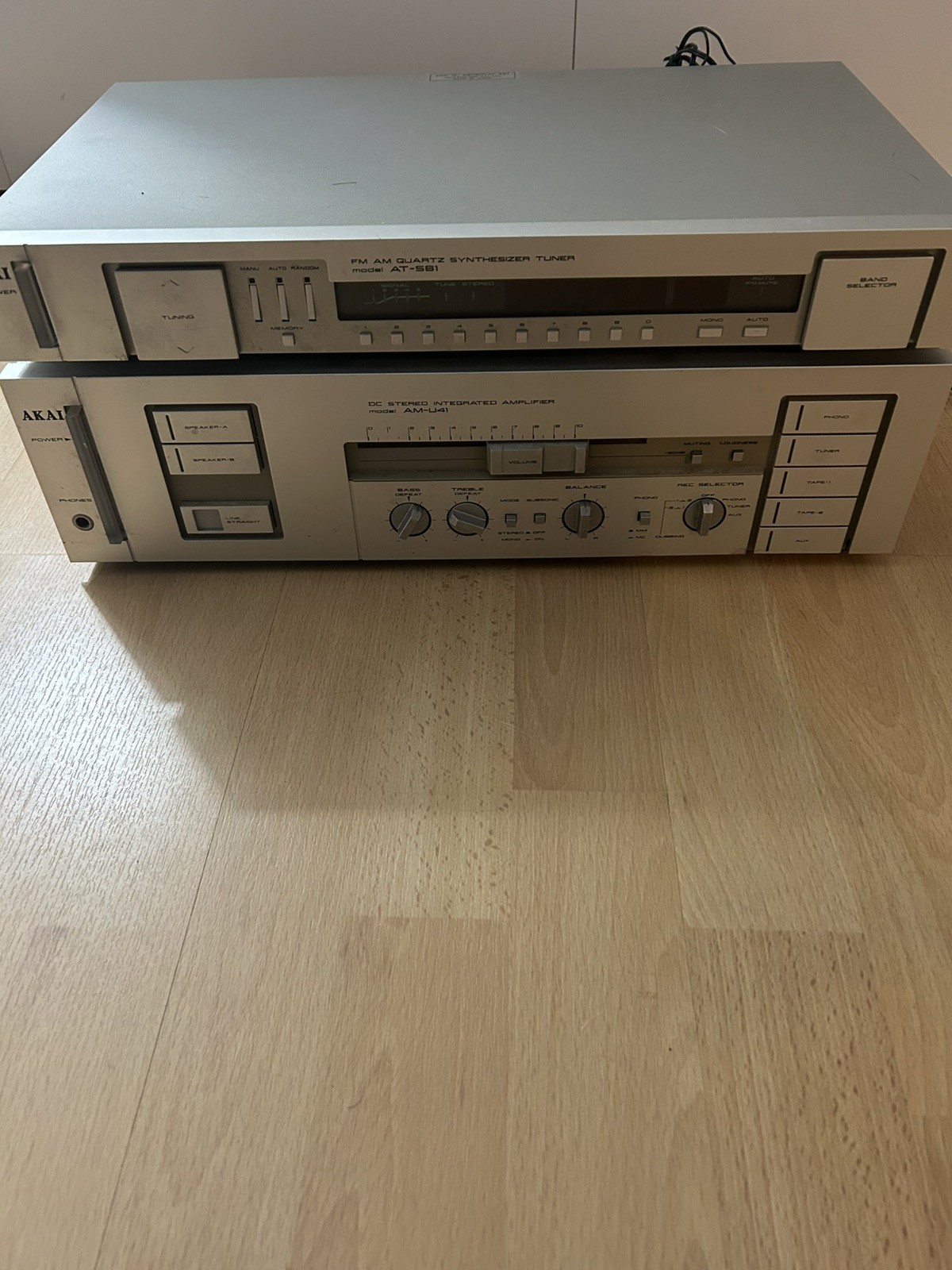
True to its mid-tier roots, the AM-U-41 wears its 1970s Japanese design with quiet confidence. The brushed aluminum faceplate is clean and functional, dominated by a large central volume knob flanked by smaller dials for balance, bass, and treble. Input selection is handled by a front-panel rotary switch, giving you access to four RCA line-level inputs—plenty for a tuner, tape deck, external phono preamp, and maybe a second source for flexibility.
Out back, gold-plated speaker terminals support both A and B speaker outputs, a thoughtful touch that let users switch between rooms or speaker pairs without rewiring. Rated at 40 watts per channel into 8 ohms, the AM-U-41 wasn’t built to shake walls, but it delivered more than enough power for intimate listening spaces. Paired with efficient vintage speakers, it held its own against contemporaries from Pioneer, Sansui, and Sony.
Inside, the amplifier reveals its true character: a solid-state, dual-mono design built entirely with discrete transistors—no ICs in the signal path. A hefty toroidal transformer anchors the power supply, minimizing noise and ensuring stable delivery to the output stages. Heat is managed by vertical aluminum fins along both sides, doubling as a visual signature that whispers performance without shouting for attention.
Technical Specifications
Based on surviving service manuals and user documentation, the technical specifications of the Akai AM-U-41 are as follows:
- Output Power: 40 watts per channel into 8 ohms (both channels driven, 20Hz–20kHz, 0.08% THD)
- Frequency Response: 20Hz – 20kHz (+/-0.5dB)
- Total Harmonic Distortion: Less than 0.08% at full power
- Signal-to-Noise Ratio: 86dB (IHF-A weighted)
- Input Sensitivity: 150mV for rated output
- Input Impedance: 47kΩ
- Damping Factor: 80 (at 1kHz)
- Speaker Impedance: 8Ω minimum
- Tone Controls: Bass ±12dB at 100Hz, Treble ±12dB at 10kHz
- Inputs: 4x RCA line-level
- Outputs: Preamp out, Tape out, Speaker A/B
- Power Consumption: 280 watts
- Dimensions: 430mm (W) × 150mm (H) × 330mm (D)
- Weight: 12.5 kg (approx. 27.5 lbs)
The class AB output stage strikes a smart balance between efficiency and fidelity. And while it lacks a built-in phono preamp—common for power amps of the time—this actually plays to its strength. By leaving phono gain to external stages, Akai let audiophiles pair the AM-U-41 with their preferred preamp, preserving signal purity and system customization.
Sound Characteristics
Fire it up, and the AM-U-41 reveals a sound that’s clean, transparent, and just warm enough through the midrange to keep things engaging. Its low distortion and ruler-flat frequency response make it a faithful messenger of the source—ideal for listeners who value accuracy over coloration. It won’t rattle your floorboards like a high-powered beast, but with the right speakers, it delivers a surprisingly dynamic and well-controlled performance.
Pair it with high-efficiency classics like the Yamaha NS-1000M, AR-3a, or the original KEF LS50, and the AM-U-41 opens up—offering a wide, stable soundstage with precise imaging. Bass is tight and articulate, if not earth-shaking, while the treble remains smooth and detailed, never veering into harshness. It’s the kind of amplifier you can listen to for hours without fatigue.
One standout feature? The tone controls. Too often, bass and treble circuits muddy the signal, but here, Akai implemented them with precision circuitry that preserves clarity. Whether you’re compensating for room acoustics or just dialing in a personal preference, the adjustments feel musical, not compromised.
Market Position and Legacy
In the 1970s, Akai was best known for tape machines that set broadcast standards. The AM-U-41 was part of their push to offer a complete hi-fi ecosystem—tuners, preamps, amplifiers, and decks that worked seamlessly together. While it never reached the cult status of Marantz or Harman Kardon, the AM-U-41 was a solid performer in the mid-tier market: reliable, well-built, and fairly priced.
Often paired with the Akai AM-P41 preamplifier, it formed the backbone of a full Akai-based system, ideal for those building a period-correct setup. The dual speaker outputs and clean signal path made it a practical centerpiece for real-world listening environments.
Today, the AM-U-41 flies under the radar. It doesn’t command sky-high prices, but it’s cherished by collectors who appreciate its unpretentious design and honest sound. Finding one in working order—especially outside Japan—can take patience. But when you do, you’re holding a piece of Akai’s broader vision: a company stepping confidently beyond tape into the heart of the stereo chain.
Restoration and Maintenance
After nearly 50 years, most AM-U-41 units will need some attention. Electrolytic capacitors in the power supply tend to dry out, potentiometers can wear or crackle, and input jacks may oxidize. A recapped power supply and a thorough cleaning of the volume and tone controls with quality contact cleaner usually bring the amp back to life.
The discrete transistor design makes repairs more accessible than modern integrated amps. Replacement parts and original service manuals are still available through vintage audio specialists, though care is essential—those vintage circuit boards and transformers don’t forgive careless probing. Done right, a restored AM-U-41 can deliver decades more service, sounding every bit as clean as it did in 1975.
eBay Listings


As an eBay Partner, we earn from qualifying purchases. This helps support our independent vintage technology research.
Related Models
- Akai AM-A301
- Akai AM-U04
- Akai AM-U7
- Akai AM-U-2 (1975)
- Akai AM-A-70 (1978)
- Luxman L-530 (1975)
- Luxman R-404 (1975)
- Luxman RV-371 (1975)
- Luxman SQ-38U (1975)
- Luxman T-14 (1972)