Akai SW-170A: The Vintage Passive Subwoofer That Defined Deep Bass
In the mid-1970s, as stereo systems began to evolve from basic two-speaker setups into more immersive audio experiences, manufacturers like Akai sought to push the boundaries of sound reproduction. While many brands focused on amplifiers, receivers, or turntables, Akai took a different path with the release of the SW-170A—a passive subwoofer designed to complement their line of bookshelf and floor-standing speakers. Though not as widely recognized as some of Akai’s reel-to-reel tape decks or receivers, the SW-170A holds a quiet but important place in vintage audio history as one of the early dedicated subwoofers aimed at home listeners.
Introduction and Historical Context
The Akai SW-170A was introduced around 1975, during a period when high-fidelity audio was becoming increasingly accessible to the average consumer. While most stereo systems of the era struggled to reproduce deep bass frequencies—especially from vinyl records—Akai recognized the need for a solution that could extend low-end response without requiring complex electronics or active components.
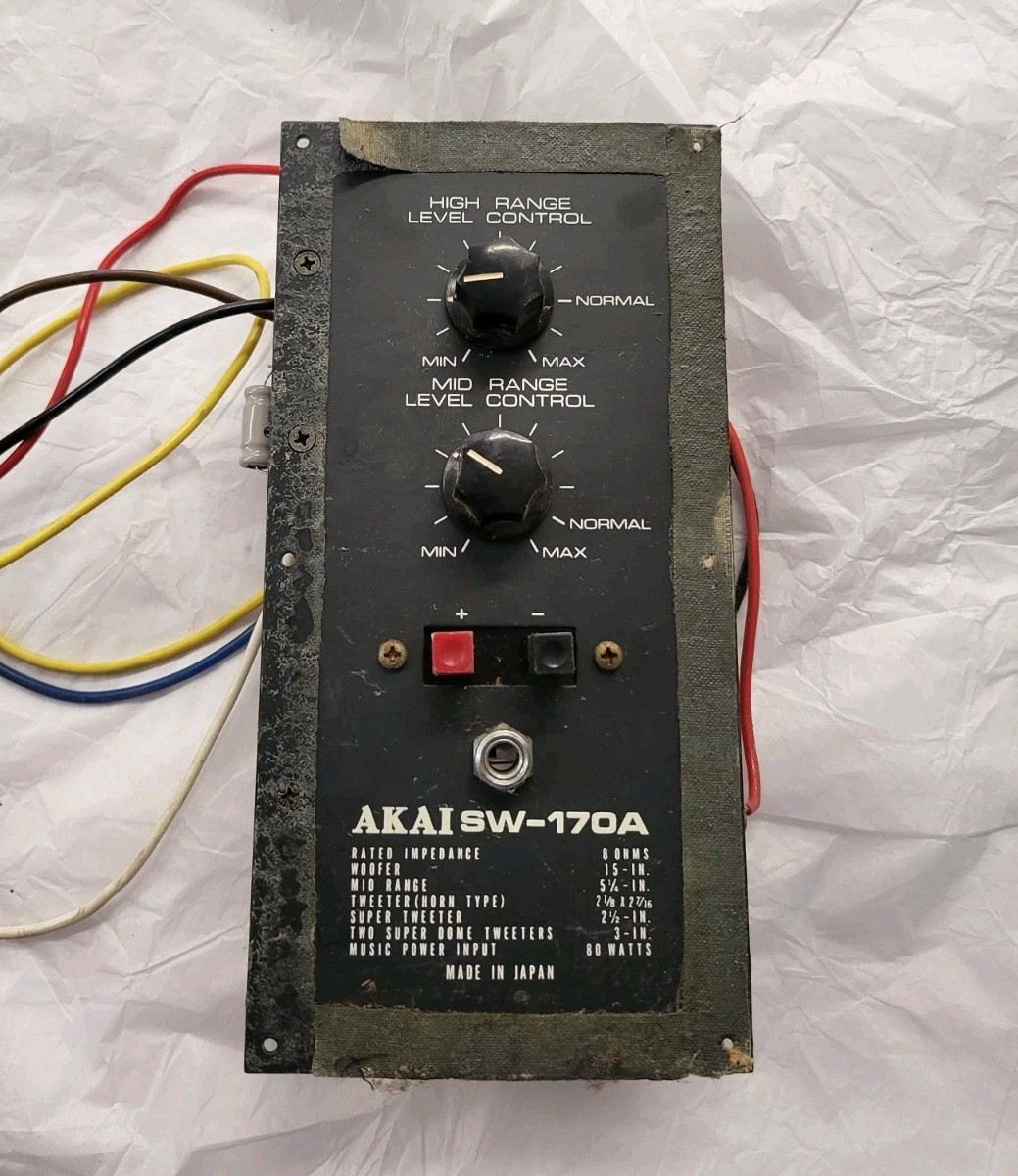
Unlike modern powered subwoofers, the SW-170A is a passive design, meaning it lacks an internal amplifier and must be driven by an external receiver or amplifier. This places it in a unique category among vintage audio gear: a specialized component that bridges the gap between full-range speakers and the deep, room-filling bass that audiophiles craved.
Designed to pair seamlessly with Akai’s speaker systems of the era—such as the CS-5750D or CS-6700D—the SW-170A was often marketed as part of a complete audio ecosystem. It reflected Akai’s broader philosophy of offering integrated, high-performance audio solutions that emphasized both technical precision and aesthetic cohesion.
Technical Specifications
| Specification | Detail |
| Model | Akai SW-170A |
| Type | Passive subwoofer |
| Year Introduced | 1975 |
| Driver Size | 12 inches (30 cm) |
| Enclosure Type | Bass reflex (ported) |
| Frequency Response | Approx. 35 Hz – 150 Hz (estimated) |
| Sensitivity | Not officially documented |
| Impedance | 8 ohms (nominal) |
| Crossover | Passive internal crossover (low-pass) |
| Inputs/Outputs | Spring clip speaker terminals |
| Dimensions (H×W×D) | 45 × 35 × 40 cm (approx.) |
| Weight | ~15 kg (33 lbs) |
| Finish | Black textured vinyl with woodgrain trim |
The SW-170A features a single 12-inch long-throw woofer, housed in a ported (bass reflex) enclosure designed to enhance low-frequency output and efficiency. The cabinet is constructed from medium-density fiberboard (MDF) with a black vinyl wrap and subtle woodgrain side panels, giving it a classic 1970s aesthetic that blends well with other vintage components.
Internally, the subwoofer includes a passive crossover network that filters out mid and high frequencies, ensuring only bass signals are sent to the driver. This allows the SW-170A to be connected in parallel with main speakers using standard speaker wire—no additional amplifier or electronic crossover is required.
Sound Characteristics and Performance
The Akai SW-170A delivers a warm, natural bass response that complements the tonal balance of vintage stereo systems. Its frequency range—estimated to extend down to 35 Hz—enables it to reproduce the fundamental tones of kick drums, bass guitars, and pipe organs with authority, adding depth and realism to recordings.
Because it’s passive, the SW-170A’s performance is heavily dependent on the power and quality of the connected amplifier. When paired with a robust receiver (such as the Pioneer SX-1980 or Sansui AU-9500), it can produce surprisingly deep and articulate bass. However, underpowered systems may struggle to drive the subwoofer effectively, resulting in sluggish or indistinct low end.
One of the SW-170A’s strengths is its integration capability. Thanks to its passive crossover and 8-ohm impedance, it can be easily added to most stereo setups without altering the overall system impedance significantly. When properly positioned in the room—typically in a corner or along a wall—it enhances the spatial fullness of the soundstage without overwhelming the mids and highs.
Notable Features and Innovations
While the SW-170A may seem modest by today’s standards, it introduced several forward-thinking features for its time:
- Integrated Passive Crossover: Eliminated the need for external filtering, simplifying setup for average users.
- Bass Reflex Design: The ported cabinet increases efficiency and extends low-frequency response—uncommon in consumer-grade subwoofers of the 1970s.
- Aesthetic Matching: Designed to visually coordinate with other Akai components, reinforcing the brand’s system-based approach.
- Durability: Built with thick cabinet walls and a robust driver, the SW-170A was engineered for long-term use.
Akai also paid attention to internal damping, using acoustic foam to minimize cabinet resonance and standing waves—a detail that contributed to cleaner bass output.
Common Issues and Maintenance
As with any vintage audio equipment, the Akai SW-170A requires some care to maintain optimal performance:
- Aging Foam Surrounds: The most common issue is deterioration of the foam surround on the 12-inch woofer. Over time, exposure to humidity, heat, and ozone can cause the foam to crumble. Replacement foam kits or full reconing services are available from specialty restoration shops.
- Crossover Components: The internal crossover may suffer from capacitor aging. Electrolytic capacitors in passive networks can dry out, leading to reduced performance or distortion. Replacing these with modern equivalents can restore clarity.
- Speaker Terminals: The spring clip terminals are functional but not as reliable as modern binding posts. Upgrading to 5-way binding posts improves connectivity and allows for thicker gauge wire.
- Cabinet Integrity: Check for loose joints or warped panels, especially if the unit has been moved frequently. Reinforcing the cabinet ensures optimal acoustic performance.
Regular cleaning with a soft cloth and keeping the unit in a dry, temperature-stable environment will help preserve its condition.
Current Market Value and Collectibility
The Akai SW-170A is a relatively rare find today, especially in working condition. It is not as sought-after as Akai’s reel-to-reel decks or amplifiers, but it holds niche appeal among vintage audio enthusiasts restoring period-correct systems.
As of 2024, a fully functional SW-170A typically sells for $100–$200, depending on condition and geographic location. Units with original grilles, intact foam surrounds, and upgraded terminals command higher prices. Complete sets—such as an SW-170A paired with matching Akai speakers—can fetch upwards of $300–$400 among collectors.
Its collectibility is bolstered by its historical significance as one of the earliest consumer subwoofers, and its passive design offers a purist-friendly alternative to modern powered models.
Conclusion and Legacy
The Akai SW-170A may not be a household name, but it represents an important step in the evolution of home audio. At a time when most listeners accepted limited bass response as a fact of life, Akai offered a practical, elegant solution that expanded the sonic possibilities of stereo systems.
Today, the SW-170A appeals to audiophiles who value authenticity, simplicity, and the warm, analog character of vintage gear. While it requires some maintenance and careful system matching, it remains a rewarding addition to any classic setup.
For those restoring a 1970s-era Hi-Fi system or seeking to add authentic deep bass without modern electronics, the Akai SW-170A stands as a testament to thoughtful engineering and timeless design—an underappreciated gem in the world of vintage audio.
eBay Listings

As an eBay Partner, we earn from qualifying purchases. This helps support our independent vintage technology research.
Related Models
- Akai AM-2850 (1975)
- Akai AP-206 (1975)
- Akai AM-2450 (1978)
- Akai CS-M40R (1983)
- Akai GX-F66RC (1981)
- Nakamichi BX-1 (1985)
- Acoustic Research research-ar-17 (1978)
- Acoustic Research AR-19 (1994)
- Acoustic Research AR-1W (1954)
- Acoustic Research AR-28S (1992)