Akai GXC-39: The Compact Dual-Cassette Workhorse of the Early '80s
In the early 1980s, cassette technology was at the peak of its cultural and technological influence. As home audio enthusiasts sought convenient ways to record from records, radio, or other tapes, manufacturers responded with increasingly sophisticated cassette decks. Among them, Akai carved out a niche with functional, no-frills designs that prioritized reliability and practicality. The Akai GXC-39, released around 1981, stands as a quintessential example of this philosophy—a compact, dual-cassette auto-reverse deck built for everyday use in the home environment.
Though not a high-fidelity audiophile machine, the GXC-39 served a vital role in the cassette ecosystem: making duplication, time-shifting, and music sharing effortless. Its dual-deck configuration allowed users to copy tapes quickly without needing a second machine, and its auto-reverse function on both decks maximized usability. While Akai’s higher-end models like the GX series garnered more attention from serious listeners, the GXC-39 was designed for the average consumer who valued convenience over critical listening.
Technical Specifications
The Akai GXC-39 was engineered with simplicity and reliability in mind. It lacks the advanced tape transport mechanisms and high-end electronics of premium decks, but its specifications reflect its intended role as a practical home recorder.
| Specification | Detail |
| Model | GXC-39 |
| Year Introduced | 1981 |
| Type | Dual cassette deck with auto-reverse |
| Tape Speed | 4.76 cm/s (1⅞ ips) |
| Recording System | AC bias, single-hole azimuth |
| Playback System | Fixed playback head |
| Frequency Response | 80 Hz – 12 kHz (Type I tape) |
| Signal-to-Noise Ratio | ~56 dB (Dolby off) |
| Wow and Flutter | < 0.25% (WRMS) |
| Inputs | Line In (RCA), Mic In (3.5mm) |
| Outputs | Line Out (RCA) |
| Headphone Output | 3.5mm stereo jack |
| Power Requirements | 120V AC, 60Hz (North American models) |
| Dimensions | Approx. 430 mm × 140 mm × 320 mm |
| Weight | 5.8 kg (12.8 lbs) |
| Special Features | Auto-reverse (both decks), dubbing, pause, timer recording |
The GXC-39 uses a single capstan and rubber pinch roller per deck, a cost-effective design common in mid-tier cassette decks. It supports standard Type I (ferric) tapes and does not include noise reduction systems like Dolby B or C, which keeps the electronics simple but limits high-frequency clarity and background noise performance.
Sound Characteristics and Performance
As expected from a dual-deck machine of this class, the Akai GXC-39 is not a high-fidelity powerhouse. Its sound is functional and acceptable for casual listening, but audiophiles will notice limitations in detail, stereo imaging, and dynamic range. The frequency response is rolled off at both ends—bass lacks punch, and treble is somewhat dull—typical of budget cassette mechanisms with fixed heads and minimal equalization options.
However, for its intended purpose—tape dubbing and home recording—the GXC-39 performs reliably. When copying tapes, the signal path is direct and consistent, minimizing generational loss as much as possible within the constraints of the format. The lack of noise reduction means tapes sound noisier than those recorded on Dolby-equipped decks, but this also avoids the compression artifacts sometimes associated with Dolby B.
The auto-reverse function works smoothly, using a mechanical flip mechanism that rotates the head 180 degrees to play the opposite side. While not as refined as the rotating head drum found in higher-end models, it’s dependable and rarely causes tape jams when maintained properly.
Notable Features and Innovations
What made the GXC-39 stand out in its class was its combination of dual-deck functionality and compact design. In an era when many dual cassette decks were large and heavy, the GXC-39 offered a space-saving form factor that fit neatly into crowded entertainment centers.
Key features include:
- Full auto-reverse on both decks: Users could record or play both sides of a tape without manual intervention.
- Direct dubbing capability: One-touch copying from Deck A to Deck B, ideal for making mixtapes or preserving records.
- Timer recording: Allowed users to schedule recordings from a radio or external source.
- Microphone input: Enabled voice recording or live commentary, useful for home messages or educational use.
- Headphone monitoring: Let users listen privately during recording or playback.
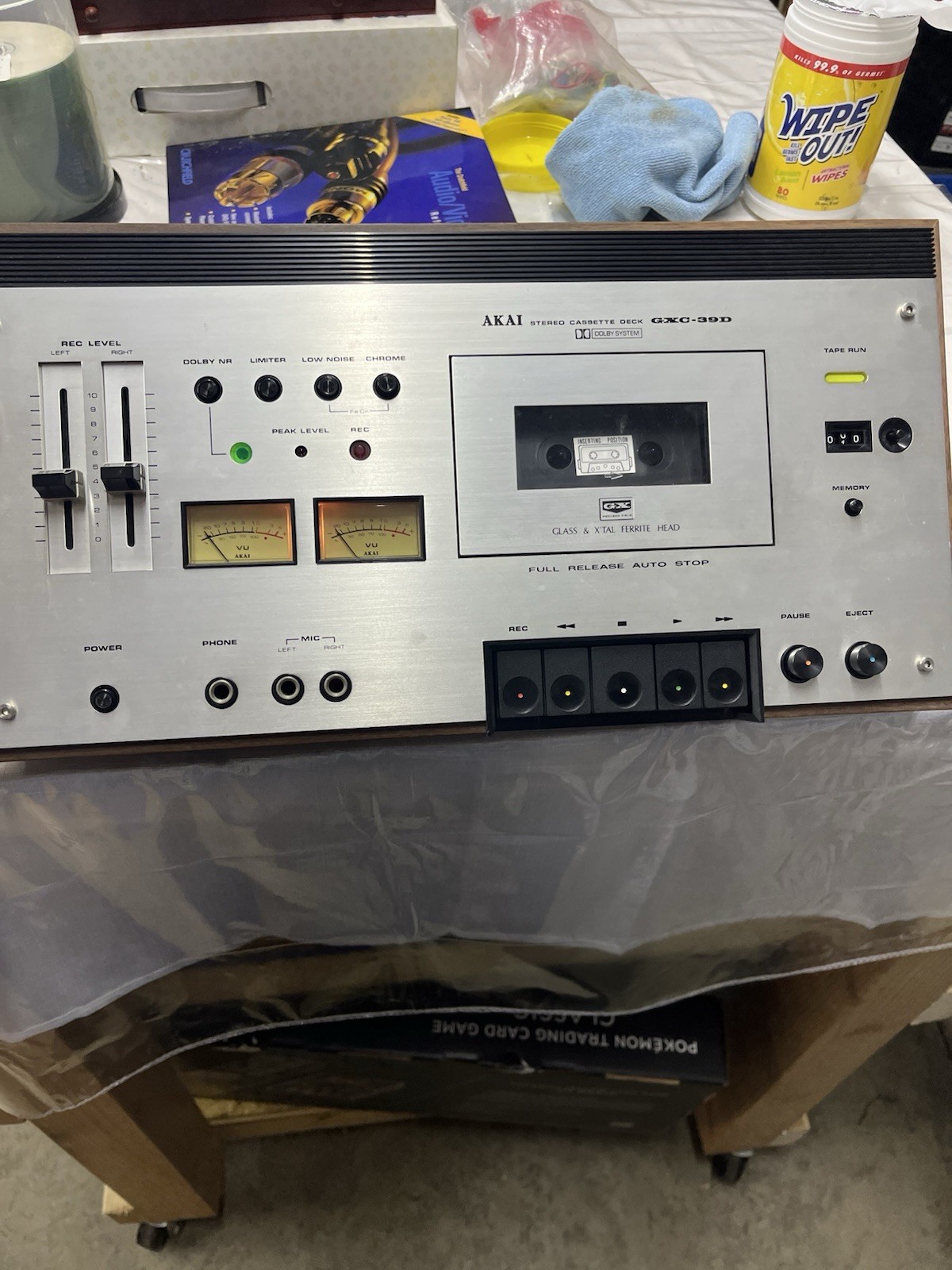
The front panel is straightforward, with large, clearly labeled buttons and sliding level controls for recording volume. The tape counter, while not calibrated in time, helps users locate specific sections of a tape.
Common Issues and Maintenance
Like all vintage cassette decks, the Akai GXC-39 requires attention to remain functional. The most common issues stem from age-related wear and degraded rubber components.
- Pinch roller hardening: The rubber pinch rollers can become glazed or sticky over time, causing speed instability or tape slippage. Replacement or cleaning with isopropyl alcohol is often necessary.
- Deteriorated belts (if used): While the GXC-39 primarily uses direct drive, some internal mechanisms may rely on small rubber belts that can perish.
- Dirty or oxidized tape heads: Regular cleaning with 99% isopropyl alcohol and a lint-free swab is essential for maintaining sound quality.
- Sticky mode buttons or switches: Dust and oxidation can affect the mechanical switches, requiring contact cleaner or gentle disassembly.
- Capstan shaft dryness: The capstan shaft should be cleaned and lightly lubricated to ensure smooth tape transport.
Owners should also demagnetize the tape heads periodically using a tape demagnetizer (under $20) to prevent dull, muffled playback.
Current Market Value and Collectibility
The Akai GXC-39 is not a highly sought-after collector’s item, but it holds nostalgic value for those who grew up with cassette culture. It occasionally appears on eBay, Etsy, or Japanese vintage audio markets, typically priced between $40 and $100, depending on condition and included accessories.
Fully functional units with clean heads, responsive buttons, and working auto-reverse command higher prices. Because it’s a dual-deck machine, it appeals to DIY musicians, cassette enthusiasts, and retro tech collectors who appreciate its utility for analog duplication.
While not as iconic as a Nakamichi or a Revox, the GXC-39 represents an important chapter in home audio history—the democratization of tape recording. It made copying music and preserving audio accessible to millions.
Conclusion and Legacy
The Akai GXC-39 may not be a star in the vintage audio firmament, but it deserves recognition as a reliable, practical tool of its era. It embodies the shift from high-fidelity pursuit to mass-market convenience, offering families an easy way to record, share, and enjoy music at home.
Today, it serves as a charming reminder of a time when making a mixtape was a deliberate, hands-on process. For collectors of 1980s audio gear or those building a retro bedroom setup, the GXC-39 is a functional and nostalgic addition. It may not deliver audiophile sound, but it delivers authentic vintage experience—and sometimes, that’s exactly what matters most.
eBay Listings



As an eBay Partner, we earn from qualifying purchases. This helps support our independent vintage technology research.
Related Models
- Akai CS-F33R (1985)
- Akai DX-59 (1983)
- Akai GX-280D-SS (1979)
- Akai DX-57 (1978)
- Akai AA-5200 (1978)
- Sony TC-2050SD (1978)
- Aiwa AD-F990 (1993)
- Kenwood KX-3060 (1982)
- Sony TC-2130A (1974)
- Sony TC-2220 (1972)