Akai GX-F90: The Pinnacle of Japanese Reel-to-Reel Engineering
In the late 1970s, Japanese electronics manufacturers were at the forefront of high-fidelity audio innovation, and Akai stood proudly among them. Known for their meticulous engineering and commitment to sonic excellence, Akai produced a line of open-reel tape recorders that bridged the gap between professional studio gear and high-end consumer audio. The Akai GX-F90, introduced in 1978, stands as one of the crowning achievements in that lineage—a sophisticated, precision-built reel-to-reel tape recorder designed for serious audiophiles and semi-professional users who demanded the utmost in recording fidelity, mechanical reliability, and user control.
While not as widely recognized today as some of its contemporaries from brands like Sony or TEAC, the GX-F90 represents the culmination of Akai’s decades-long expertise in tape transport design and analog signal processing. It was positioned at the top of Akai’s consumer reel-to-reel range, offering features and build quality that rivaled studio machines costing far more.
Technical Specifications
| Specification | Detail |
| Model | GX-F90 |
| Manufacturer | Akai Corporation, Japan |
| Year Introduced | 1978 |
| Format | 1/4" open-reel analog tape |
| Tape Speeds | 7.5, 15 ips (ips = inches per second) |
| Tracks | 4-track, 2-channel stereo (full-track mono at 15 ips) |
| Head Configuration | Separate record, playback, and erase heads |
| Head Type | Permalloy (high-saturation alloy) |
| Equalization | 120 µs (15 ips), 180 µs (7.5 ips) |
| Frequency Response | 30Hz – 20kHz (±3dB) at 15 ips |
| Signal-to-Noise Ratio | >68 dB (Dolby B/C compatible) |
| Wow and Flutter | <0.15% (WRMS) |
| Input Level | -10 dBV (line), adjustable |
| Output Level | 0.3 V (for 50 kΩ load) |
| Inputs | Line (RCA), Mic (RCA) |
| Outputs | Line (RCA), Monitor (RCA) |
| Head Amp | Built-in high-impedance mic preamp |
| Noise Reduction | Compatible with Dolby B and C |
| Motor System | Dual capstan servo-controlled DC motors |
| Power Supply | 110–120V AC, 60 Hz (varies by region) |
| Dimensions (W×H×D) | 440 × 145 × 355 mm (17.3" × 5.7" × 14") |
| Weight | 14.5 kg (32 lbs) |
Sound Characteristics and Performance
The Akai GX-F90 was engineered for transparency, dynamic range, and low distortion—hallmarks of a true audiophile-grade recorder. Its separate record and playback heads allow for precise alignment and optimal performance in both recording and playback modes. The use of high-quality permalloy heads ensures excellent high-frequency response and low saturation, even at high signal levels.
At 15 inches per second (ips), the GX-F90 delivers a frequency response that extends to the upper limits of human hearing, with a rich, detailed midrange and tight, controlled bass. The 7.5 ips mode remains impressively musical, making it ideal for long-duration recordings without a significant sacrifice in fidelity.
One of the GX-F90’s standout qualities is its remarkably low wow and flutter—below 0.15% WRMS—thanks to its dual capstan servo system. This results in a stable, pitch-accurate playback that preserves the natural timbre of instruments and vocals. Combined with a wide dynamic range and excellent channel separation, the GX-F90 produces a spacious, three-dimensional soundstage that rivals modern digital formats in emotional impact.
When paired with Dolby B or C noise reduction (which the GX-F90 fully supports), tape hiss is dramatically reduced, further enhancing the perceived clarity and realism of recordings.
Notable Features and Innovations
The GX-F90 was packed with advanced features for its time, many borrowed from professional studio recorders:
- Three-Motor, Dual Capstan Transport: Ensures precise tape tension and speed control, minimizing slippage and wear. This system contributes significantly to the machine’s low wow and flutter.
- Separate Record and Playback Heads: Allows for independent optimization and alignment, a feature typically found only on high-end studio decks.
- Front-Panel Level and Bias Calibration: Includes built-in test tone generators and VU meters for accurate setup, essential for achieving optimal recording levels.
- Selectable Record Equalization: Automatically switches between 120 µs (15 ips) and 180 µs (7.5 ips) based on tape speed.
- Direct Drive Reel Tables: Reduces mechanical noise and improves tape winding consistency.
- High-Visibility VU Meters: Large, centrally mounted meters with peak-hold capability for precise level monitoring.
- Remote Control Capability: Optional remote unit available for transport control, useful in studio or multi-component setups.
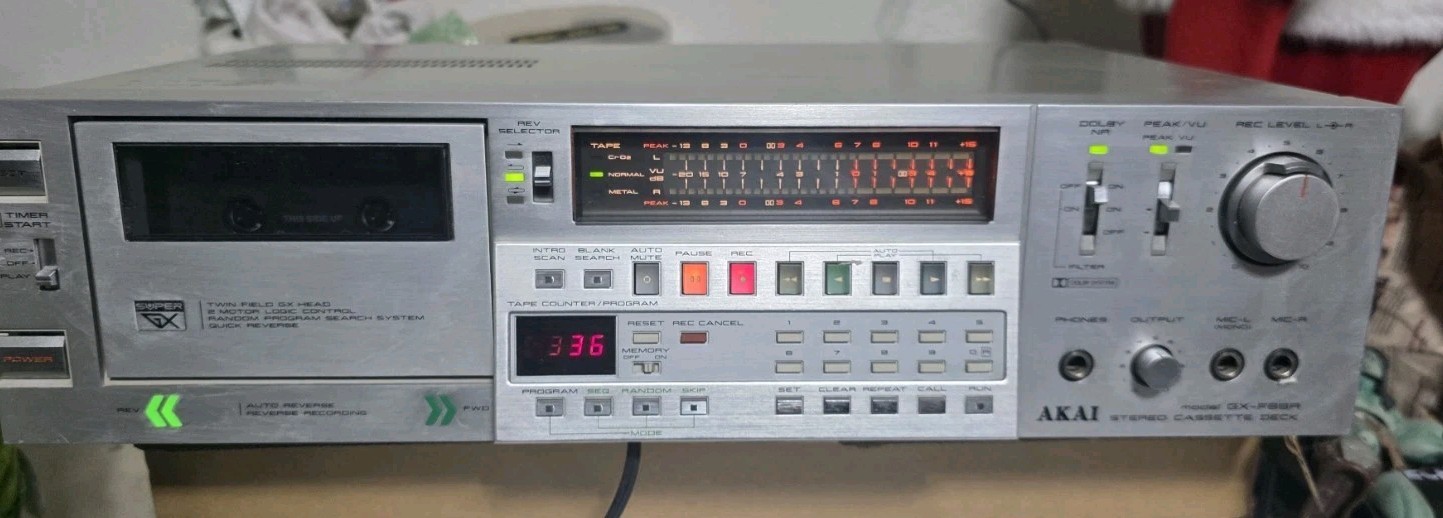
The build quality is exceptional: a heavy steel chassis dampens vibration, while the front panel combines brushed aluminum and durable plastic with a clean, functional layout. Every knob, switch, and reel table feels solid and precise—no rattles, no play.
Common Issues and Maintenance
Like all vintage reel-to-reel machines, the GX-F90 requires periodic maintenance to perform at its best. Common issues include:
- Deteriorated Rubber Components: Idler tires, pinch rollers, and drive belts can harden or crack over time. These should be replaced with modern equivalents.
- Dirty or Worn Heads: Tape heads accumulate oxide buildup and may become misaligned. Regular cleaning with isopropyl alcohol and demagnetizing are essential.
- Capstan Bearing Dryness: The capstan shafts may require lubrication to maintain smooth rotation and speed stability.
- Capacitor Aging: Electrolytic capacitors in the power supply and signal path may degrade, potentially causing hum or channel imbalance. A full recap is recommended for units that haven’t been serviced in decades.
- Head Wear: With heavy use, heads can develop grooves. Resurfacing or replacement by a specialist may be necessary.
Fortunately, the GX-F90’s modular design makes servicing relatively straightforward. Parts and service manuals are available through vintage audio enthusiast communities and online archives, and the machine’s popularity in Japan means spare parts are more accessible than for some rarer models.
Current Market Value and Collectibility
The Akai GX-F90 is not as commonly seen on the vintage audio market as models from TEAC, Tandberg, or Revox, but it is highly regarded among reel-to-reel enthusiasts. Well-maintained, fully serviced units typically sell for $800 to $1,400, depending on condition, included accessories (such as remote controls or calibration tapes), and regional demand.
Its collectibility is growing, particularly among analog purists who appreciate its combination of studio-grade features and consumer-friendly operation. While not yet a “blue chip” vintage item like a Revox B77, the GX-F90 is increasingly recognized as a hidden gem from Akai’s golden era.
Conclusion and Legacy
The Akai GX-F90 is a testament to the art of analog tape recording at its peak. It combines precision engineering, luxurious build quality, and sublime sound in a package that, while complex by today’s standards, offers a deeply rewarding experience for those who appreciate the tactile and sonic pleasures of reel-to-reel audio.
More than just a playback device, the GX-F90 invites engagement—threading tape, adjusting bias, watching the VU meters dance. It’s a machine that connects the listener not just to the music, but to the process of creating and preserving it.
For collectors, restorers, or audiophiles seeking the ultimate in analog warmth and realism, the Akai GX-F90 remains a compelling and underappreciated masterpiece of late-1970s Japanese audio craftsmanship. In an age of digital convenience, it stands as a powerful reminder of the beauty of analog dedication.
eBay Listings


As an eBay Partner, we earn from qualifying purchases. This helps support our independent vintage technology research.
Service Manuals & Schematics
- Service Manual — archive.org
Related Models
- Akai AM-2850 (1975)
- Akai AP-206 (1975)
- Akai AM-2450 (1978)
- Akai CS-M40R (1983)
- Akai GX-F66RC (1981)
- Nakamichi BX-1 (1985)
- Acoustic Research research-ar-17 (1978)
- Acoustic Research AR-19 (1994)
- Acoustic Research AR-1W (1954)
- Acoustic Research AR-28S (1992)