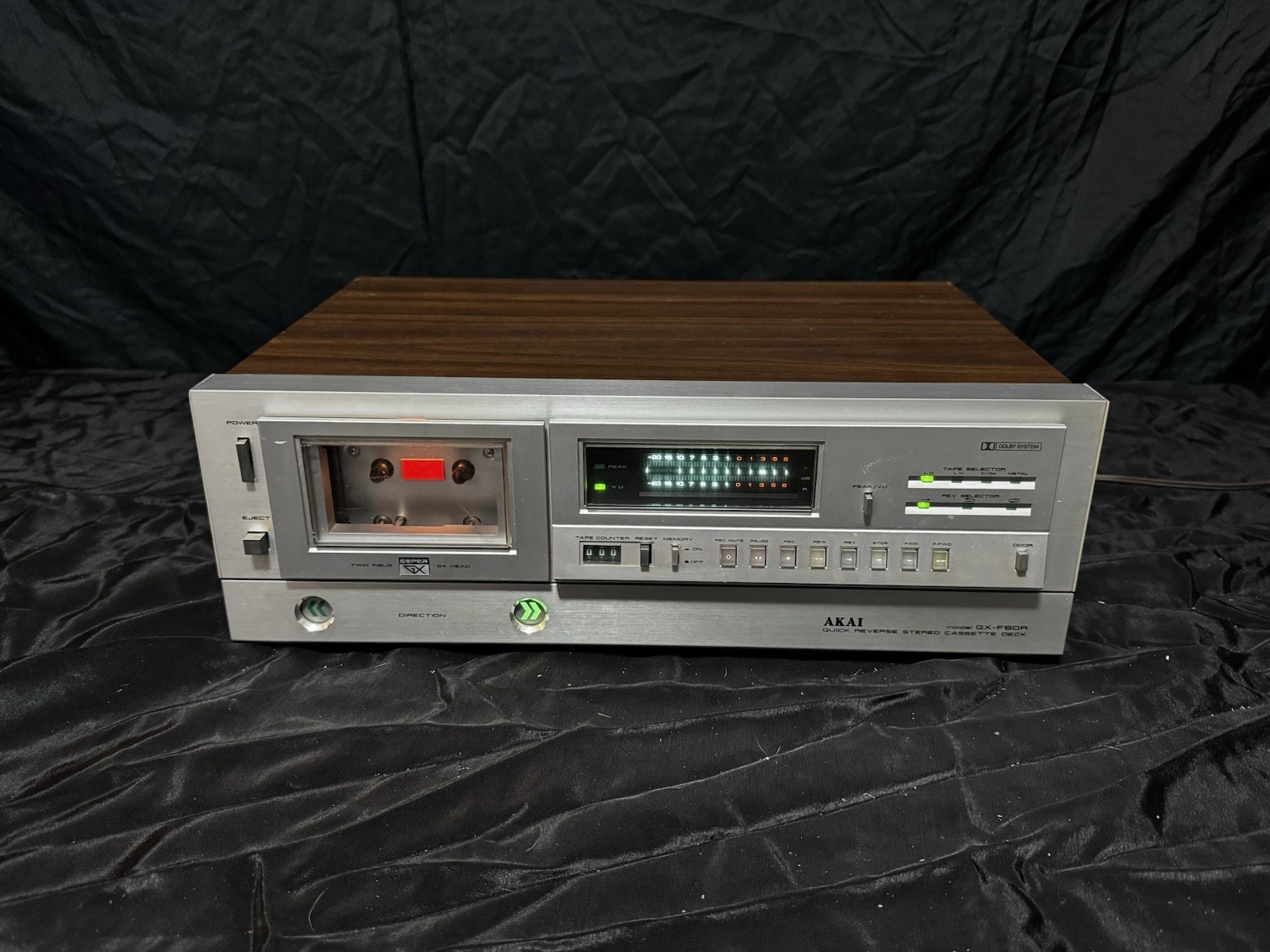
Akai GX-F60R: A Hidden Gem from Akai’s Reel-to-Reel Legacy
In the late 1970s, Japanese audio manufacturers were at the peak of their analog engineering prowess, and Akai was no exception. While often overshadowed by more mainstream names like Sony, TEAC, and Denon in the reel-to-reel world, Akai carved out a respected niche with a series of professional-grade and high-fidelity consumer tape recorders. Among these, the Akai GX-F60R stands as a compelling example of the company’s commitment to performance, durability, and thoughtful design.
Released around 1978, the GX-F60R was part of Akai’s mid-to-high-end open-reel lineup, aimed at serious audiophiles, semi-professional users, and recording enthusiasts who demanded more than what cassette decks could offer. Though not as widely documented as some of its contemporaries, the GX-F60R has earned a quiet reputation among vintage audio collectors for its robust mechanics, clean signal path, and the unmistakable warmth of analog tape reproduction.
Technical Specifications
The GX-F60R is a ¼-inch, 2- or 4-track stereo reel-to-reel tape recorder capable of operating at multiple tape speeds, making it versatile for both music playback and recording applications. While full service manuals are rare today, available user reports and surviving units confirm the following specifications:
| Specification | Detail |
| Format | ¼-inch tape, 2 or 4-track stereo |
| Tape Speeds | 7.5, 15, and 30 inches per second (ips) |
| Tracks | 2-track stereo (full-track mono compatible) |
| Head Configuration | 3-head system (record, playback, erase) |
| Recording Modes | Stereo, mono, and laterally compatible |
| Motors | Dual capstan servo-controlled motors |
| Wow and Flutter | < 0.20% (15 ips, RMS) |
| Frequency Response | 30Hz – 20kHz (±3dB, 15 ips, normal bias) |
| Signal-to-Noise Ratio | > 60dB (Dolby B optional) |
| Input/Output | Line in/out (RCA), mic in (¼" and RCA) |
| Equalization Settings | 120µs / 180µs switchable |
| Bias Control | Manual bias adjustment |
| Power Supply | 110-120V AC (60Hz) or 220-240V (50Hz) |
| Dimensions | 440mm (W) × 145mm (H) × 330mm (D) |
| Weight | Approx. 12.5 kg (27.5 lbs) |
The three-head configuration is a hallmark of higher-end machines from this era, allowing for precise monitoring of the recorded signal immediately after laying it down on tape. This was particularly valuable for home recording enthusiasts aiming for studio-quality results.
Sound Characteristics and Performance
The GX-F60R delivers the rich, full-bodied sound that reel-to-reel enthusiasts cherish. With its wide ¼-inch tape format and high-speed options (up to 30 ips), it captures music with exceptional dynamic range and low distortion. At 15 ips, the frequency response extends cleanly to 20kHz, offering a level of clarity and spatial depth that even the best cassette decks of the time couldn’t match.
Users often praise the GX-F60R for its neutral yet warm tonal balance, with a smooth high end and tight, controlled bass. The manual bias and equalization controls allow for fine-tuning with different tape formulations—ideal for those using premium tapes like Ampex 456 or BASF SM468. When paired with a good preamp and a high-output tape, the GX-F60R can produce recordings that rival those from professional studios of the 1970s.
Dolby B noise reduction was an optional feature on some variants, helping to reduce tape hiss during playback—though purists often prefer to run the deck in "flat" mode to preserve the natural analog character.
Notable Features and Innovations
While not as flashy as some of its competitors, the GX-F60R was packed with thoughtful engineering:
- Dual Capstan Transport: Ensures stable tape tension and consistent speed, minimizing wow and flutter.
- Front-Panel Speed Selection: Easy switching between 7.5, 15, and 30 ips with illuminated indicators.
- Manual Bias and EQ Calibration: Allows optimization for different tape brands and types—crucial for maximizing fidelity.
- Full Logic Transport Controls: Motorized reel tables with auto-stop at tape ends.
- Direct Drive Reel Motors: Provide strong, responsive winding and back-transport for quick cueing.
- Head Flip Mechanism: Some units featured a flip-back head assembly for easy cleaning and demagnetizing.
The front panel is cleanly laid out with large VU meters, rotary level controls, and tactile switches—everything within easy reach. The chassis is built like a tank, with a heavy steel frame and shock-mounted deck mechanism to reduce vibration.
Common Issues and Maintenance
Like all vintage reel-to-reel machines, the GX-F60R requires regular maintenance to perform at its best. Common issues include:
- Dried-up lubricants: The capstan shafts, pinch rollers, and reel motors often need relubrication with synthetic grease.
- Pinch roller hardening: Over time, rubber rollers can glaze or crack, leading to speed instability. Replacement or rejuvenation with specialized cleaners is recommended.
- Dirty or oxidized heads: Tape heads should be cleaned with isopropyl alcohol and demagnetized regularly using a quality tape head demagnetizer.
- Capacitor aging: Electrolytic capacitors in the power supply and audio circuits may need replacement to prevent noise or failure.
- Worn belts (if applicable): While the GX-F60R uses direct drive, some internal mechanisms may rely on rubber belts that degrade over decades.
A well-serviced GX-F60R can run reliably for years. It’s advisable to have the machine evaluated by a technician familiar with vintage tape gear before regular use.
Current Market Value and Collectibility
The Akai GX-F60R is not as common on the vintage market as models from TEAC or Sony, which gives it a certain appeal among collectors seeking under-the-radar classics. Units in good working condition typically sell for $400–$700, depending on geographic location, included accessories, and cosmetic state.
Fully calibrated machines with low usage and original packaging can command higher prices, especially if sold with tapes, calibration tools, or documentation. While not yet a "blue-chip" collectible like the TEAC A-3340S, the GX-F60R is gaining recognition in niche circles as a serious performer with excellent build quality.
Its value lies not just in nostalgia, but in its ability to produce authentic analog recordings—a feature increasingly prized in the age of digital saturation.
Conclusion and Legacy
The Akai GX-F60R may not have the name recognition of some of its peers, but it represents the quiet excellence of Akai’s engineering during the analog golden age. Built for durability, precision, and musicality, it stands as a testament to a time when high-fidelity audio was a craft, not just a commodity.
For the modern audiophile, the GX-F60R offers more than just a playback device—it’s a hands-on experience with the tactile, organic nature of analog recording. Whether used for archiving vinyl, recording live music, or simply enjoying high-resolution tape copies, the GX-F60R delivers a sonic experience that few digital formats can replicate.
If you’re lucky enough to find one in good condition, consider restoring it. The Akai GX-F60R deserves to be heard—and remembered.
eBay Listings


As an eBay Partner, we earn from qualifying purchases. This helps support our independent vintage technology research.
Related Models
- Akai AM-2850 (1975)
- Akai AP-206 (1975)
- Akai AM-2450 (1978)
- Akai CS-M40R (1983)
- Akai GX-F66RC (1981)
- Nakamichi BX-1 (1985)
- Acoustic Research research-ar-17 (1978)
- Acoustic Research AR-19 (1994)
- Acoustic Research AR-1W (1954)
- Acoustic Research AR-28S (1992)