Akai GX-F44R: The Enthusiast's Reel-to-Reel Workhorse
In the golden era of analog audio, when magnetic tape reigned supreme and home recording began to reach new levels of fidelity, Akai carved out a respected niche with its line of reel-to-reel tape recorders. Among these, the Akai GX-F44R stands as a compelling example of late-1970s Japanese engineering—designed not for the professional broadcast studio, but for the serious audiophile, musician, or semi-pro engineer who demanded studio-grade performance without the six-figure price tag. Though not as widely documented as some of its contemporaries, the GX-F44R embodies the precision, durability, and sonic integrity that made Akai a trusted name in analog recording.
Released in 1979, the GX-F44R arrived at a time when cassette decks were gaining popularity for convenience, yet open-reel machines still offered unmatched sound quality. Akai targeted a growing market of home studio enthusiasts and audio purists who wanted to master their own recordings or archive vinyl collections with minimal generational loss. The GX-F44R was built to deliver just that: a reliable, high-fidelity 4-track stereo recorder with professional features wrapped in a compact, user-friendly design.
Technical Specifications
The GX-F44R is a 4-track, 2-channel stereo recorder, meaning it can record two tracks in each direction on standard ¼-inch tape, effectively doubling recording time when used in full-track mono mode. It supports multiple tape speeds—typically 7.5, 3.75, and 1.875 inches per second (ips)—allowing users to balance sound quality and tape economy. The inclusion of a quartz-locked capstan servo system ensures exceptional speed stability, minimizing wow and flutter for near-studio-grade performance.
| Specification | Detail |
| Format | 4-track, 2-channel stereo (½-track per direction) |
| Tape Width | ¼ inch (6.35 mm) |
| Tape Speeds | 7.5, 3.75, 1.875 ips |
| Wow and Flutter | < 0.15% (weighted, at 7.5 ips) |
| Frequency Response | 30 Hz – 20 kHz (±3 dB, at 7.5 ips, with 15 µs EQ) |
| Signal-to-Noise Ratio | > 60 dB (Dolby B NR enabled) |
| Total Harmonic Distortion | < 1.5% |
| Inputs | Line (RCA), Mic (¼" jack) |
| Outputs | Line Out (RCA), Headphones (¼" stereo) |
| Equalization | 120 µs (3.75 ips), 70 µs (7.5 ips), 15 µs (optional) |
| Noise Reduction | Dolby B |
| Motor System | Dual capstan, direct-drive with quartz lock |
| Transport Controls | Front-panel mechanical buttons (Play, Record, Stop, Rewind, FF) |
| Display | VU meters (dual needle), speed indicator |
The machine features dual VU meters for precise level monitoring, a hallmark of Akai’s attention to detail. Its transport system uses a dual capstan design with rubber pinch rollers and a robust tape threading mechanism, minimizing tape slippage and ensuring consistent head-to-tape contact. The heads themselves—typically manufactured from high-permeability ferrite or permalloy—are fixed and non-swiveling, ensuring alignment stability over time.
Sound Characteristics and Performance
The GX-F44R delivers a warm, natural analog sound signature that many modern digital recordings struggle to replicate. At 7.5 ips, the frequency response is impressively flat, with tight bass, clear mids, and smooth highs—ideal for capturing acoustic instruments or mastering tape dubs. The inclusion of Dolby B noise reduction helps suppress tape hiss, especially at the slower speeds, making 3.75 ips a viable option for longer recordings without a drastic loss in fidelity.
One of the standout qualities of the GX-F44R is its low wow and flutter, thanks to the quartz-locked capstan. This makes it particularly well-suited for piano recordings or any material with sustained tones, where speed inconsistencies would be immediately noticeable. The 4-track capability also opens creative doors: users can record two tracks, then overdub on the remaining two, enabling basic multitrack projects—a feature that appealed to home musicians in the pre-digital era.
Notable Features and Innovations
While not as flashy as some of Akai’s larger studio models, the GX-F44R incorporates several thoughtful design elements:
- Quartz-locked speed control: Ensures precise tape speed for accurate pitch and timing.
- 4-track flexibility: Enables overdubbing and creative tape manipulation.
- Dolby B integration: Improves signal-to-noise ratio without complex setup.
- Dual VU meters: Provide real-time visual feedback for balanced recording.
- Solid mechanical transport: Durable, smooth-feeding mechanism with minimal maintenance needs.
The front panel layout is intuitive, with clearly labeled controls and a clean aesthetic typical of late-’70s Japanese electronics. The use of high-quality potentiometers and switches further enhances the user experience, giving the machine a professional feel despite its semi-pro positioning.
Common Issues and Maintenance
Like all vintage reel-to-reel machines, the GX-F44R requires regular maintenance to perform at its best. After decades of dormancy, common issues include:
- Deteriorated rubber parts: Pinch rollers and idler tires can harden or crumble, leading to speed instability or transport failure. These should be replaced with modern equivalents.
- Dirty or oxidized heads and guides: Tape heads, capstans, and tape guides accumulate oxide buildup and should be cleaned with isopropyl alcohol and lint-free swabs.
- Sticky pots and switches: Controls may develop crackling or intermittent signals. Contact cleaner can help, but potentiometers may need replacement if worn.
- Belt degradation: While the capstan is direct-drive, some internal functions may rely on rubber belts that degrade over time.
Regular demagnetization is also recommended—ideally every 10–20 hours of use—to prevent high-frequency loss and distortion. When properly maintained, the GX-F44R can operate reliably for decades, a testament to Akai’s build quality.
Current Market Value and Collectibility
The Akai GX-F44R is not as commonly seen on the vintage market as models like the GX-635D or GX-4000, which makes it something of a hidden gem. Units in working condition typically sell for $300–$600, depending on completeness, cosmetic condition, and included accessories (such as reels, power cords, or calibration tapes).
Collectibility is moderate but growing, particularly among analog enthusiasts and DIY musicians interested in tape-based recording. Its 4-track functionality gives it an edge over simpler 2-track machines, and its compact size makes it suitable for small studios or desktop setups. While not a museum-piece like a Studer or Ampex, the GX-F44R represents excellent value for those seeking authentic analog warmth with practical features.
Conclusion and Legacy
The Akai GX-F44R may not have the name recognition of some high-end reel-to-reel recorders, but it occupies a special place in the history of accessible analog recording. It bridged the gap between consumer gear and professional equipment, offering serious performance at a reasonable price. For today’s audiophiles, tape lovers, and analog experimenters, the GX-F44R is more than just a relic—it’s a fully functional tool for creating rich, warm, authentic sound.
In an age of digital perfection, the GX-F44R reminds us of the tactile joy of threading tape, watching VU meters dance, and hearing music unfold through magnetic fidelity. For those willing to service and appreciate it, the Akai GX-F44R remains a rewarding machine—one that continues to spin analog magic, one reel at a time.
eBay Listings


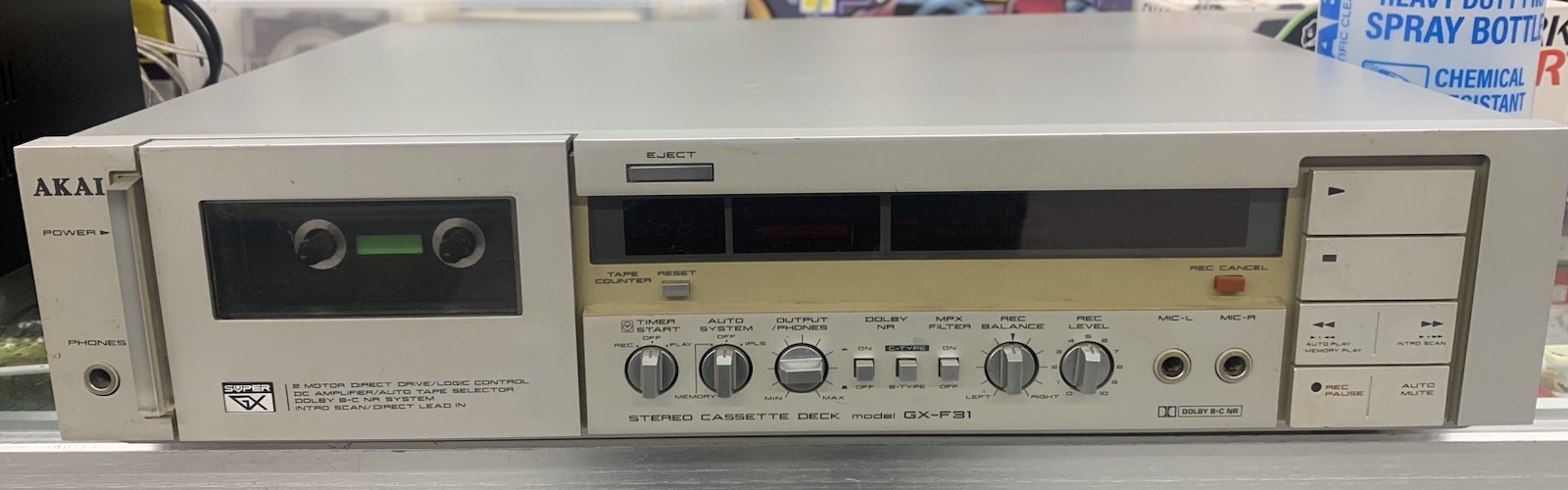
As an eBay Partner, we earn from qualifying purchases. This helps support our independent vintage technology research.
Related Models
- Akai AM-2850 (1975)
- Akai AP-206 (1975)
- Akai AM-2450 (1978)
- Akai CS-M40R (1983)
- Akai GX-F66RC (1981)
- Nakamichi BX-1 (1985)
- Acoustic Research research-ar-17 (1978)
- Acoustic Research AR-19 (1994)
- Acoustic Research AR-1W (1954)
- Acoustic Research AR-28S (1992)