Akai GX-F37: The Compact Reel-to-Reel Workhorse of the Late 1970s
In the golden era of analog audio, when magnetic tape ruled both the professional studio and the discerning audiophile’s living room, Akai carved out a reputation for building reliable, well-engineered reel-to-reel recorders that balanced performance with accessibility. Among their mid-tier offerings, the Akai GX-F37 stands as a quiet achiever — not as flashy as the flagship GX-635D or as widely celebrated as the GX-4000, but a solid, no-nonsense machine that brought high-fidelity tape recording within reach of home users and semi-professional enthusiasts.
Introduced in 1977, the GX-F37 arrived at a pivotal moment in audio history. While cassette tapes were rapidly gaining popularity for their convenience, audiophiles and recording hobbyists still prized the superior sound quality of open-reel tape. Akai, a Japanese manufacturer with a strong engineering pedigree, positioned the GX-F37 as a compact, user-friendly recorder that delivered genuine reel-to-reel performance without the bulk or price tag of professional gear.
Though not a flagship model, the GX-F37 reflects Akai’s commitment to quality transport mechanics and thoughtful design. It was marketed as a “compact” reel-to-reel deck, making it ideal for smaller setups or portable use — a rare feature in an era when most reel-to-reel machines demanded significant shelf space.
Technical Specifications
| Feature | Specification |
| Year Introduced | 1977 |
| Format | 1/4" open reel |
| Tape Speeds | 7.5 ips (standard), 3.75 ips (optional) |
| Tracks | 4-track, 2-channel stereo (full-track mono compatible) |
| Heads | 3-head design (separate record, playback, erase) |
| Motor | Dual capstan servo system (quartz-locked speed control) |
| Frequency Response | 30Hz – 18kHz (at 7.5 ips, +3dB/-3dB) |
| Wow and Flutter | < 0.20% (weighted, RMS) |
| Signal-to-Noise Ratio | 62 dB (Dolby B optional) |
| Inputs | Line-level RCA (stereo), Mic XLR/RCA combo |
| Outputs | Line-level RCA, headphone 1/4" jack |
| Dimensions | 430 mm (W) × 135 mm (H) × 320 mm (D) |
| Weight | 9.5 kg (approx. 21 lbs) |
| Power Requirements | 120V AC, 60Hz (region-specific variants exist) |
Sound Characteristics and Performance
The GX-F37 delivers the warm, natural sound signature typical of well-designed analog tape recorders from the 1970s. Its 3-head configuration — with separate record, playback, and erase heads — allows for precise monitoring during recording, a feature usually reserved for higher-end models. This setup ensures accurate real-time playback without relying on the record head, minimizing distortion and phase issues.
With a frequency response extending to 18kHz at 7.5 inches per second (ips), the GX-F37 captures a wide sonic spectrum, offering clarity in the highs and solid bass response. While not quite matching the extended bandwidth of studio-grade machines running at 15 ips, it performs admirably for home recording, music duplication, and archival transfers.
The dual capstan servo drive system, stabilized with quartz-locked speed control, contributes to its low wow and flutter — crucial for maintaining pitch stability and minimizing tape-induced artifacts. This level of speed accuracy was uncommon in compact decks at the time and speaks to Akai’s engineering priorities.
Though the GX-F37 lacks built-in Dolby C or dbx noise reduction, it supports Dolby B via an optional module or external processor, helping to reduce tape hiss — a common concern with Type I (ferric) tapes, which the F37 was primarily designed to handle.
Notable Features and Innovations
Despite its modest footprint, the GX-F37 packs several thoughtful features:
- Compact Chassis Design: Unlike most reel-to-reel decks of the era, the F37 was engineered to fit in tight spaces, making it ideal for mobile recording setups, educational use, or home studios with limited room.
- Quartz-Locked Speed Control: Ensures stable tape speed, critical for pitch accuracy and consistent playback — a feature that elevated it above many budget-oriented competitors.
- Front-Panel Tape Selector: Allows users to adjust bias and equalization settings for different tape types (normal and high-bias), improving recording fidelity across various tape formulations.
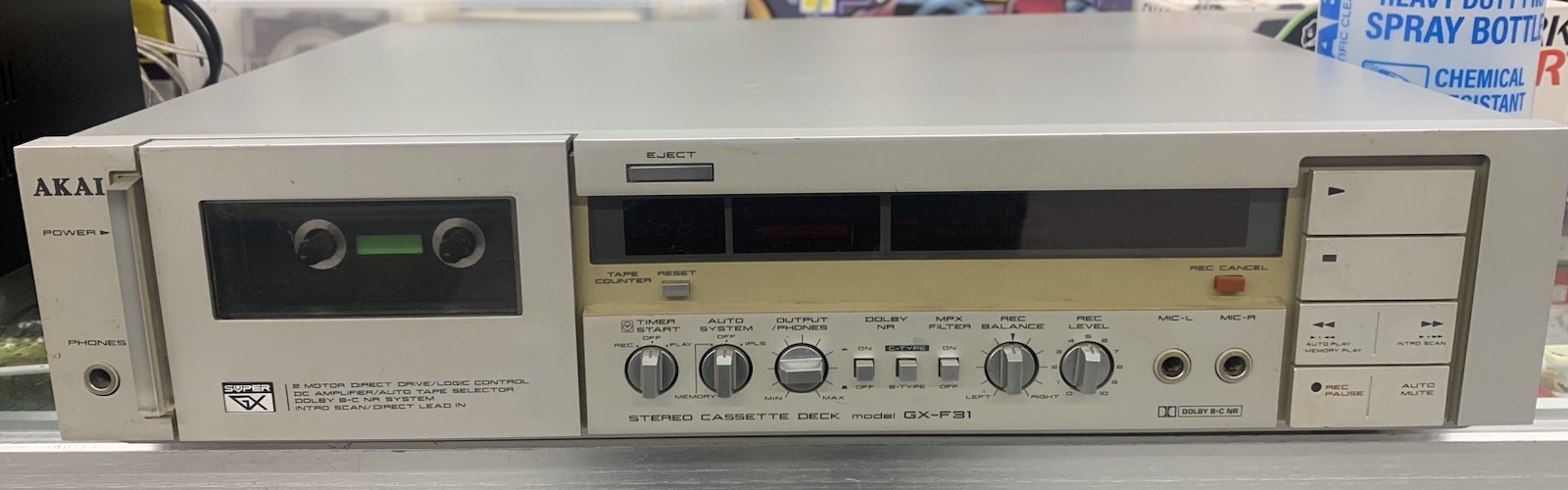
- Dual VU Meters: Large, centrally mounted VU meters provide clear visual feedback during recording, helping users avoid distortion and optimize levels.
- Headphone Monitoring with Mix Control: Offers real-time monitoring with adjustable mix between input and playback, useful for overdubbing and editing.
The inclusion of XLR microphone inputs (on some regional variants) hints at its semi-professional aspirations, suggesting use in field recording, interviews, or small-scale music production.
Common Issues and Maintenance
Like all vintage tape equipment, the Akai GX-F37 requires careful maintenance to perform at its best. Over four decades, common issues include:
- Deteriorated Rubber Components: Idler tires, pinch rollers, and drive belts can harden or crack over time. These should be replaced with modern equivalents during restoration.
- Dirty or Worn Tape Heads: Accumulated oxide buildup degrades sound quality. Regular cleaning with isopropyl alcohol and demagnetization are essential.
- Capstan and Pinch Roller Wear: The dual capstan system is robust, but the pinch roller can lose elasticity, leading to speed fluctuations.
- Lubrication of Mechanical Parts: Gear trains and transport mechanisms may require relubrication with appropriate synthetic grease to prevent binding or excessive wear.
- Capacitor Aging: Electrolytic capacitors in the power supply and audio circuits may dry out, leading to hum, noise, or failure. A full recapping is recommended for long-term reliability.
Finding replacement parts can be challenging, though the GX-F37 shares some components with other Akai models like the GX-F27 and GX-67. Online vintage audio communities and specialized suppliers occasionally stock compatible parts.
Current Market Value and Collectibility
The Akai GX-F37 is not a high-profile collector’s item like the Nakamichi 1000 or the Revox A77, but it holds quiet appeal among reel-to-reel enthusiasts who value reliability, compact design, and solid performance.
In today’s market (2024), a fully functional and well-maintained GX-F37 typically sells for $300–$500, depending on condition, included accessories, and regional demand. Units with original boxes, manuals, or rare accessories may command slightly higher prices.
Its collectibility is niche but growing, particularly among:
- Audiophiles restoring vintage systems
- Musicians experimenting with analog tape effects
- Archivists digitizing old tapes
- Compact gear collectors seeking space-efficient reel-to-reel solutions
While not a showstopper, the GX-F37 is appreciated for its "workhorse" reliability and understated engineering — a testament to Akai’s ability to deliver professional-grade features in a consumer-friendly package.
Conclusion and Legacy
The Akai GX-F37 may not have the fame of its bigger siblings, but it represents an important segment of analog audio history: the democratization of high-quality tape recording. In an era when reel-to-reel was transitioning from studio exclusivity to home accessibility, Akai bridged the gap with thoughtful, durable designs.
More than just a recorder, the GX-F37 symbolizes a time when audio fidelity was a tangible, mechanical pursuit — where every turn of the reel, every flicker of the VU meter, connected the user to the music in a deeply physical way.
Today, as vinyl and analog gear enjoy a renaissance, the GX-F37 stands as a quiet reminder that great sound doesn’t always come from the most famous names. For those willing to seek it out, clean its heads, and thread the tape just right, the Akai GX-F37 still has stories to tell — one warm, magnetic passage at a time.
eBay Listings



As an eBay Partner, we earn from qualifying purchases. This helps support our independent vintage technology research.
Related Models
- Akai AM-2850 (1975)
- Akai AP-206 (1975)
- Akai AM-2450 (1978)
- Akai CS-M40R (1983)
- Akai GX-F66RC (1981)
- Nakamichi BX-1 (1985)
- Acoustic Research research-ar-17 (1978)
- Acoustic Research AR-19 (1994)
- Acoustic Research AR-1W (1954)
- Acoustic Research AR-28S (1992)