Akai GX-F35: Compact Precision in Reel-to-Reel Form
The Akai GX-F35 stands as a quiet yet significant representative of Akai’s golden era in analog tape recording. Released in 1977, this open-reel tape recorder was designed to bridge the gap between consumer convenience and semi-professional audio fidelity. While not as widely celebrated as some of its larger GX-series siblings like the legendary GX-635D or the high-end GX-747, the GX-F35 carved out a niche for itself among audiophiles, educators, and home recording enthusiasts who valued compact design, solid engineering, and the unmistakable warmth of analog tape.
At a time when cassette decks were gaining popularity for their portability and ease of use, Akai continued to champion the open-reel format for those who demanded superior sound quality. The GX-F35 was part of this commitment—offering a no-frills, reliable machine that delivered excellent performance without the bulk or complexity of studio-grade recorders.
Technical Specifications
| Feature | Specification |
| Year Introduced | 1977 |
| Format | 1/4" Open-Reel Tape |
| Tape Speeds | 7.5 ips, 15 ips (with optional crystal sync) |
| Tracks | 4-track, 2-channel stereo (half-track) |
| Head Configuration | Separate Record, Playback, and Erase Heads |
| Motors | Dual capstan motors with servo control |
| Frequency Response | 30 Hz – 18 kHz (at 15 ips, +3/-3 dB) |
| Signal-to-Noise Ratio | 62 dB (Dolby B optional) |
| Wow and Flutter | < 0.25% (WRMS) |
| Inputs | Line In (RCA), Mic In (1/4" jack) |
| Outputs | Line Out (RCA), Headphone Out (1/4" jack) |
| Headphones | Up to 1000Ω impedance supported |
| Power Supply | AC 120V / 240V (region-specific) |
| Dimensions | 430 mm × 140 mm × 330 mm (W×H×D) |
| Weight | 8.5 kg (18.7 lbs) |
Sound Characteristics and Performance
The GX-F35 delivers the rich, warm, and dynamically engaging sound that defines the best of analog reel-to-reel reproduction. With its separate record and playback heads, the machine achieves a level of clarity and tracking accuracy that surpasses many integrated-head designs in its class. The use of ferrite heads ensures durability and consistent performance over time, while the dual-capstan transport system minimizes tape slippage and maintains steady speed.
At 15 inches per second (ips), the GX-F35 reveals its full potential: extended high frequencies, tight bass response, and a wide stereo image that brings recordings to life. Even at the slower 7.5 ips, the machine performs admirably—ideal for archiving or casual listening where tape economy is a priority.
The optional Dolby B noise reduction (available on some variants) further enhances the listening experience by reducing tape hiss without introducing the "breathing" artifacts sometimes associated with early noise reduction systems. When paired with quality tape stock—such as Ampex 406, Scotch 226, or BASF SM468—the GX-F35 produces results that rival much more expensive recorders.
Notable Features and Innovations
Though compact, the GX-F35 is packed with thoughtful engineering:
- Modular Head Assembly: The heads are mounted on a removable sub-chassis, simplifying alignment and maintenance—a rare feature in machines of this size.
- Crystal-Locked Speed Control (Optional): When equipped, this ensures precise tape speed for critical recording and playback, minimizing pitch variation.
- Front-Panel Level Meters: Large VU meters provide real-time monitoring of input levels, essential for avoiding distortion during recording.
- Mic/Line Toggle and Input Mixing: The ability to blend microphone and line-level sources makes the GX-F35 versatile for voice recording, interviews, or live music capture.
- Headphone Monitoring with Mix Control: Users can monitor either the source input or the recorded playback signal directly, with level control for comfortable listening.
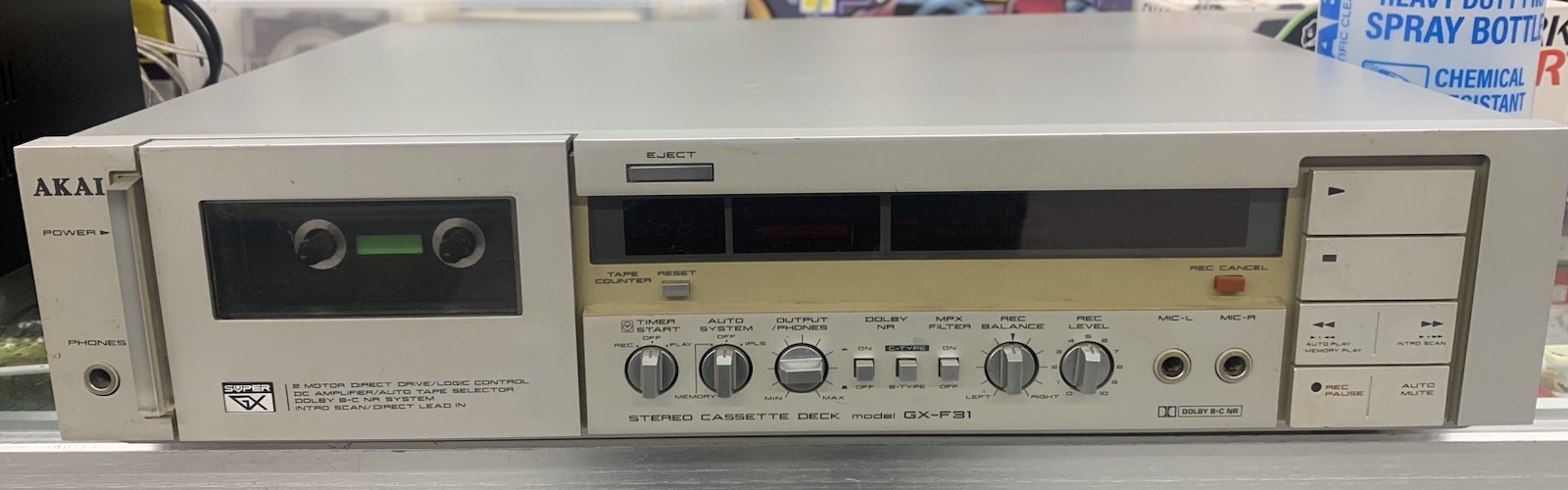
The front panel is clean and intuitive, with clearly labeled controls and a layout that prioritizes usability. The tape transport buttons are tactile and well-spaced, reducing the chance of misoperation—a hallmark of Akai’s user-centric design philosophy.
Common Issues and Maintenance
Like all vintage tape machines, the Akai GX-F35 requires periodic maintenance to perform at its best. Over four decades, several components may degrade:
- Capstan Belts and Idler Tires: Though the GX-F35 uses direct-drive capstans, rubber components in the tension arm and brake system may harden or crack. Replacement with modern equivalents is recommended.
- Head Alignment: Misaligned heads are a common cause of poor stereo imaging or muffled sound. A professional alignment using a calibration tape ensures optimal performance.
- Dirty or Worn Heads: Accumulated oxide residue can dull sound quality. Regular cleaning with isopropyl alcohol and cotton swabs is essential.
- Capacitor Aging: Electrolytic capacitors in the power supply and audio circuits may dry out, leading to hum, distortion, or failure. A recap by a qualified technician is advisable for long-term reliability.
- Pinch Roller Glazing: The rubber pinch roller can become glazed or sticky over time. Light sanding or replacement restores proper tape grip.
With proper care, the GX-F35 remains a dependable machine. Its robust metal chassis and high-quality components reflect Akai’s commitment to durability.
Current Market Value and Collectibility
The Akai GX-F35 is not a high-profile collector’s item like the Nakamichi 1000 or the Revox A77, but it holds steady appeal among reel-to-reel enthusiasts and those seeking an affordable entry into open-reel audio. In working condition, units typically sell for $200–$400, depending on completeness, cosmetic condition, and included accessories (such as reels, tapes, or dust covers).
Fully restored models with new belts, aligned heads, and recapped electronics may command higher prices, especially if equipped with crystal sync or original packaging. While not a rare machine, the GX-F35 is increasingly valued for its compact footprint and excellent sound-to-size ratio—making it ideal for modern setups where space is limited.
It’s also sought after by tape restoration hobbyists and analog archivists who appreciate its reliability for digitizing old tapes without investing in bulkier equipment.
Conclusion and Legacy
The Akai GX-F35 may not have the star power of flagship reel-to-reel decks, but it embodies the quiet excellence of Akai’s mid-tier engineering. It represents a moment when high-fidelity audio was becoming accessible without sacrificing core performance. For the home user who wanted more than a cassette deck but didn’t need a studio behemoth, the GX-F35 was an ideal choice.
Today, it stands as a testament to an era when tape was king, and every detail—from head alignment to VU meter glow—mattered. In the resurgence of analog appreciation, the GX-F35 offers a gateway to the tactile, immersive experience of open-reel recording. Whether used for archiving vintage tapes, creating new analog recordings, or simply enjoying music with authentic warmth, the Akai GX-F35 remains a reliable, musical, and deeply satisfying piece of audio history.
For those exploring the world of reel-to-reel, the GX-F35 is a hidden gem—compact in size, but large in character.
eBay Listings


As an eBay Partner, we earn from qualifying purchases. This helps support our independent vintage technology research.
Service Manuals & Schematics
- Service Manual (1983) — archive.org
Related Models
- Akai AM-2850 (1975)
- Akai AP-206 (1975)
- Akai AM-2450 (1978)
- Akai CS-M40R (1983)
- Akai GX-F66RC (1981)
- Nakamichi BX-1 (1985)
- Acoustic Research research-ar-17 (1978)
- Acoustic Research AR-19 (1994)
- Acoustic Research AR-1W (1954)
- Acoustic Research AR-28S (1992)